100 Home Feng Shui Cases
From interior layout to external terrain — Master Andrew Chan breaks down 100 common home feng shui patterns, their impact and practical remedies.
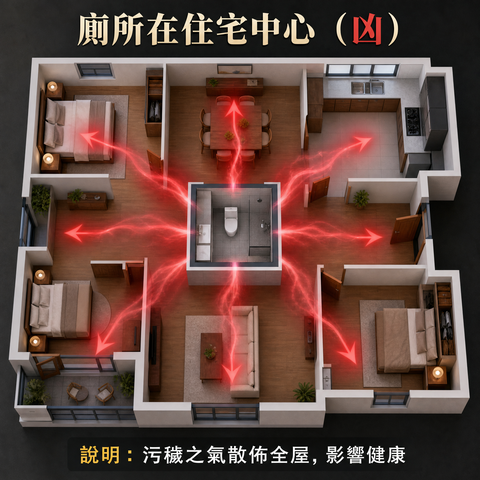
Case 1 · Toilet in the Center of the House
What feng shui hidden dangers does a toilet in the center of a residence bring? Renowned Hong Kong Feng Shui Master Andrew Chan deeply analyzes the severe damage that "Central Palace Sha" can inflict on family health and wealth, and provides professional feng shui guidance for fundamentally adjusting and neutralizing negative qi.
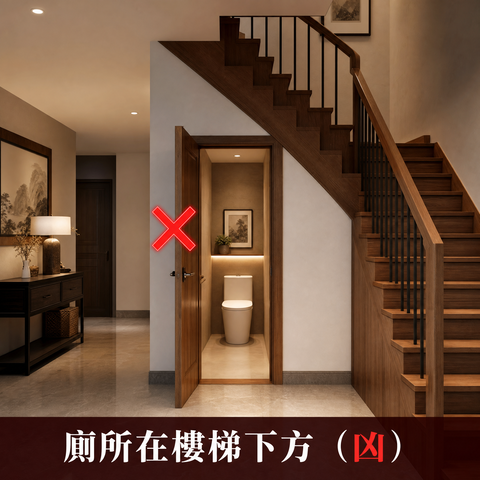
Case 2 · Toilet Under Stairs
In duplexes or villas, placing a toilet under the stairs is a common space-saving solution, but it's a major feng shui taboo. Hong Kong Feng Shui Master Andrew Chan thoroughly explains how this layout affects the entire family's fortune and provides practical, non-demolition remedies.
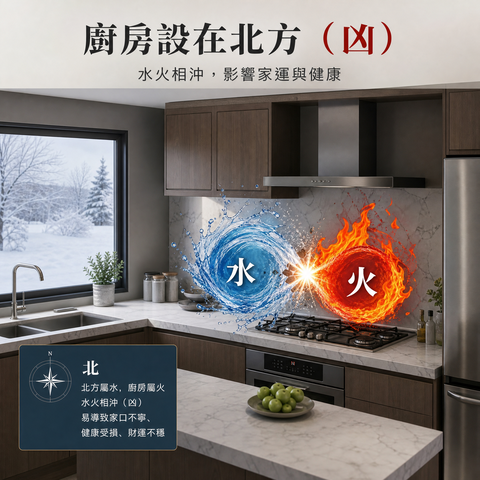
Case 3 · Kitchen in the North
A kitchen located in the north is a classic 'water-fire clash' layout. Renowned Hong Kong Feng Shui Master Andrew Chan explains the negative impact of the northern Kan trigram's water element clashing with the kitchen's fire, and teaches you how to use the five elements' generative cycle to resolve family conflicts and financial crises.
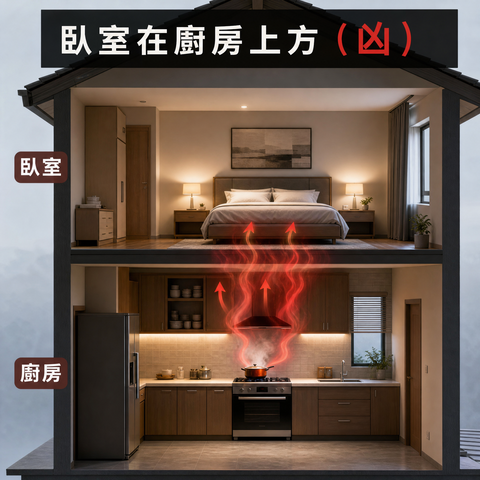
Case 4 · Bedroom Above Kitchen
What happens when a bedroom is directly above a kitchen? Hong Kong Feng Shui Master Andrew Chan deeply analyzes the chronic damage of "rising fire energy" on the magnetic field of an upstairs bedroom, and teaches you how to alleviate insomnia and restless sleep through scientific bed placement and color arrangements.
Case 5 · Main Door Facing Room Door
When the main door directly faces a room door or back door, it creates a typical "through-draft" (穿堂风) where qi flows straight through. Hong Kong Feng Shui Master Andrew Chan guides you to understand the dangers of this wealth-leaking pattern and teaches you how to use screens and plants to retain your home's prosperity.
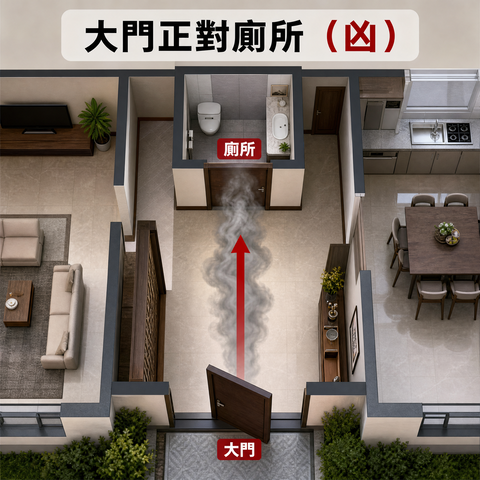
Case 6 · Door Facing Toilet
Does your front door open directly to a toilet? This is a highly detrimental "door-facing-toilet" sha qi that severely impacts your home's energy. Hong Kong Feng Shui Master Andrew Chan meticulously explains the dual impact of this layout on wealth and health, offering simple feng shui remedies that don't require demolition.
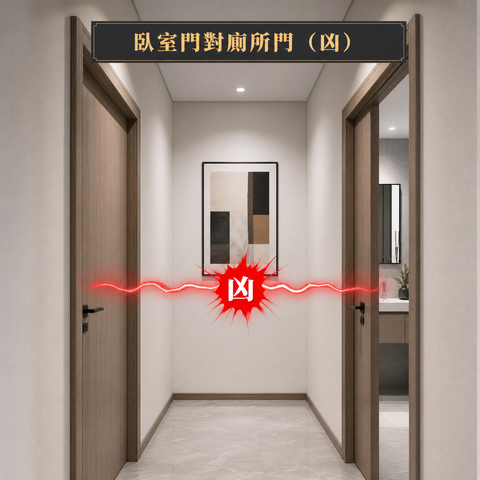
Case 7 · Bedroom Door Facing Toilet Door
When a bedroom door directly faces a toilet door, it can expose occupants to damp and impure qi during sleep. Renowned Hong Kong Feng Shui Master Andrew Chan explains how this opposing layout harms bone health and immunity, and shares authoritative solutions using door curtains and plants.
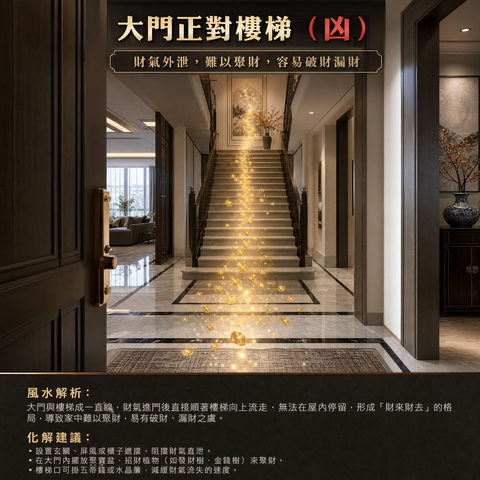
Case 8 · Main Door Facing Stairs
A main door directly facing downward stairs is known in feng shui as "Qian Niu Sha" (Ox Leading Away Sha), which can cause household wealth to drain away like flowing water. Hong Kong Feng Shui Master Andrew Chan clearly reveals the mechanism of this financial loss and teaches how to perfectly lock in wealth luck by setting up an entryway and raising the threshold.
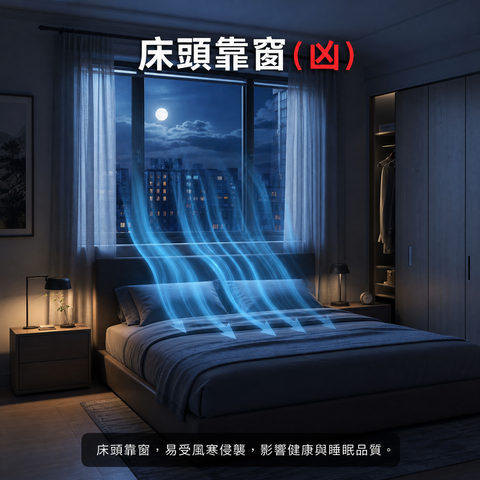
Case 9 · Bed Head Against Window
When the bed head is placed directly against a window, it's susceptible to drafts at night and, in feng shui, represents a major taboo of "no backing." Hong Kong Feng Shui Master Andrew Chan explains how this layout can harm health and hinder support from benefactors, providing authoritative solutions for a stable bedroom "backing" in your home.
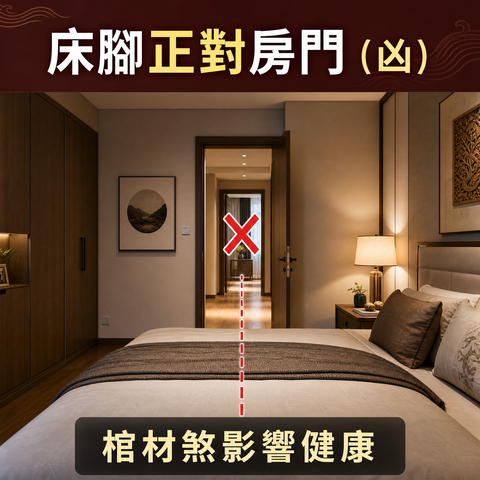
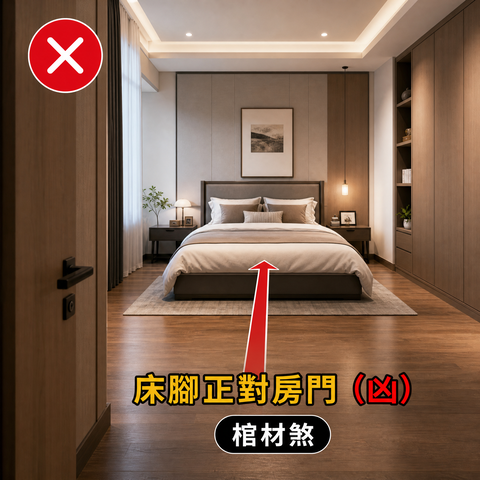
Case 10 · Bed Feet Facing Door
Having the foot of your bed directly facing the bedroom door is considered an extremely inauspicious 'coffin sha' in feng shui. Renowned Hong Kong Feng Shui Master Andrew Chan reveals how this 'sha qi' can chronically damage leg health and family fortune, and teaches you the most reliable methods to mitigate its negative effects.
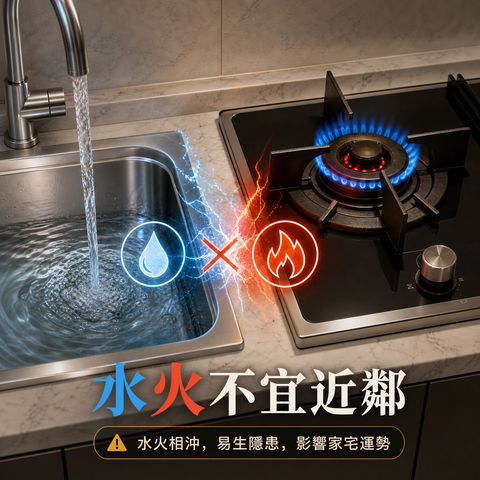
Case 11 · Water and Fire Should Not Be Neighbors
What happens when a kitchen sink and stove are too close? Hong Kong Feng Shui Master Andrew Chan points out that water and fire in close proximity can lead to family discord and financial loss. This article also provides an in-depth analysis of how to remedy the ominous layout of a bathroom at the end of a corridor.
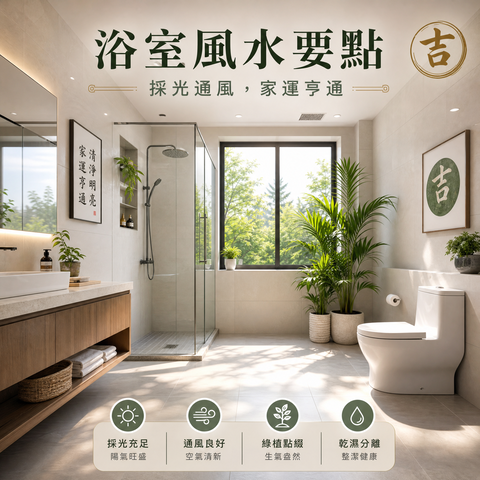
Case 12 · Bathroom Lighting and Toilet Direction
How to determine the auspiciousness or inauspiciousness of bathroom feng shui? Hong Kong Feng Shui Master Andrew Chan provides a detailed analysis of the importance of natural light in bathrooms and emphasizes a crucial point: the toilet's direction must never align with the main entrance of the residence, as this can lead to severe financial leakage!
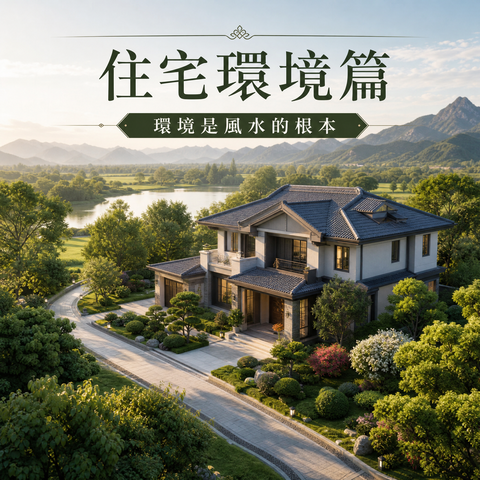
Case 13 · Residential Environment Overview
Environment is the foundation of feng shui. Renowned Hong Kong Feng Shui Master Andrew Chan brings you an overview of external home feng shui environments: an in-depth analysis of the profound impact of common external landforms such as high walls, houses built too close to walls, and superficial weeding on a residence's qi field.
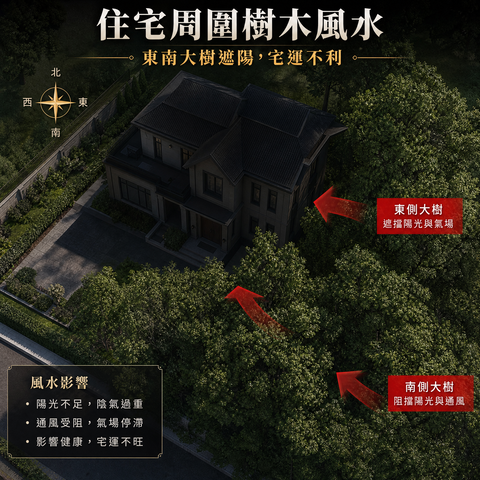
Case 14 · Residential Trees
What are the benefits and drawbacks of trees around a home in feng shui? Hong Kong Feng Shui Master Andrew Chan deeply analyzes the harm of large trees shading the east and south, and the impact of planting fruit trees on a home's fortune, teaching you how to plant trees in the correct positions to protect your home's peace.
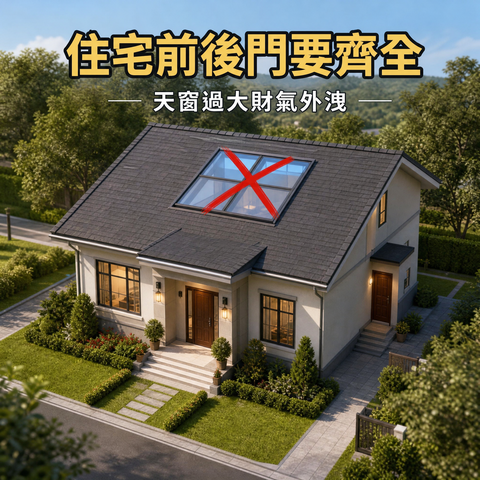
Case 15 · Residential Front and Back Doors Must Be Complete
Why must independent houses have a back door? Hong Kong Feng Shui Master Andrew Chan reveals the critical role of complete front and back doors for family harmony and smooth qi flow, and warns against the financial misfortune caused by excessively large roof skylights.
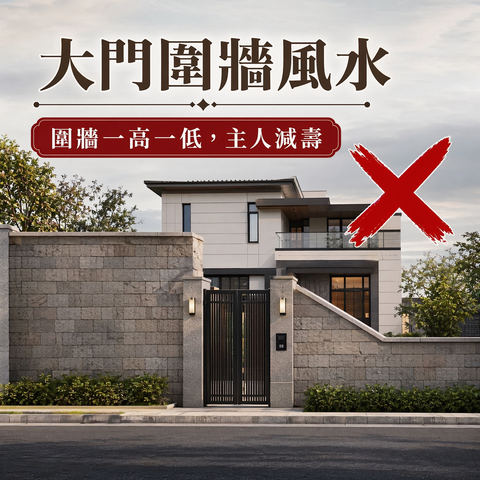
Case 16 · Gate and Wall Feng Shui
What are the dangers of uneven gate and wall heights? Hong Kong Feng Shui Master Andrew Chan deeply analyzes the metaphysics of gate and wall heights, and reveals how a "house foundation higher than the wall" and "a main road to the west" can help you attract wealth.
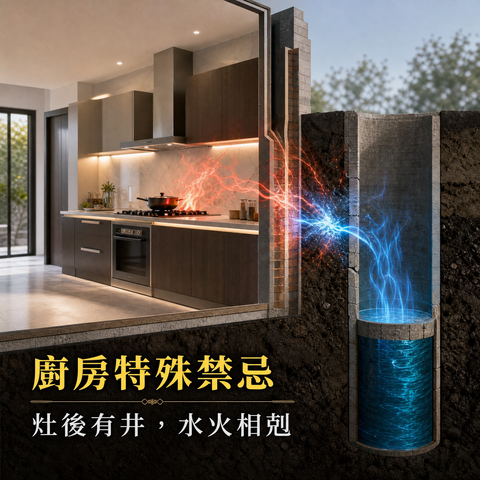
Case 17 · Kitchen Special Taboos
As the treasury and source of sustenance for the home, the kitchen harbors many little-known special taboos. Hong Kong Feng Shui Master Andrew Chan warns you about the fatal impact of having a well or pump behind the kitchen, or a stove placed over water, on the mistress's health and family wealth.
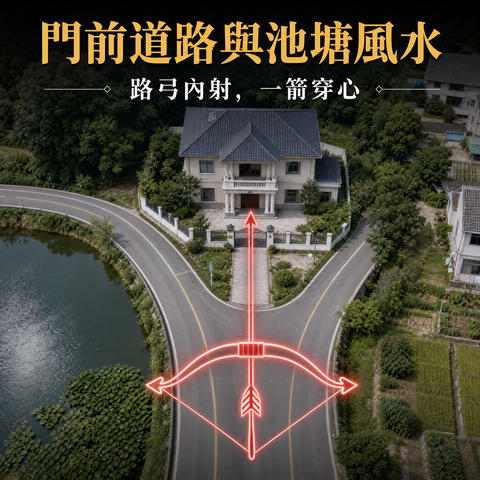
Case 18 · Road and Pond Feng Shui in Front of the House
The road and pond in front of a residence can directly influence the overall feng shui of the home. Hong Kong Feng Shui Master Andrew Chan provides an in-depth analysis of the "arrow piercing the heart" and "reverse bow" road formations, detailing their fatal harm to women and careers, and imparts the auspicious and inauspicious principles of "front pond, back pond."
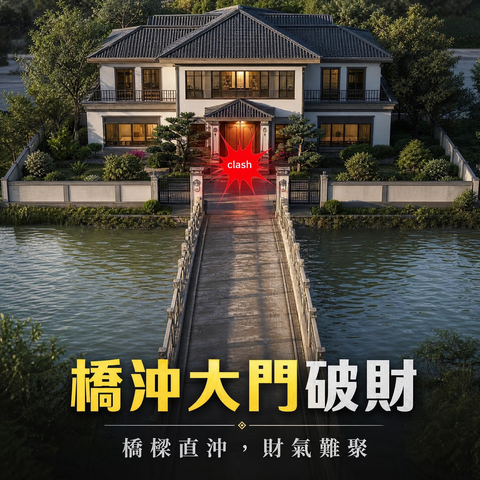
Case 19 · Bridge Rushing Towards Main Door Causes Financial Loss
Is there a bridge rushing towards your main door, or are your surrounding walls triangular? Hong Kong Feng Shui Master Andrew Chan warns: these are severe external sha qi that can lead to financial loss and disputes. This article provides practical feng shui remedies, teaching you how to effectively use elm trees to protect your home and ensure peace.
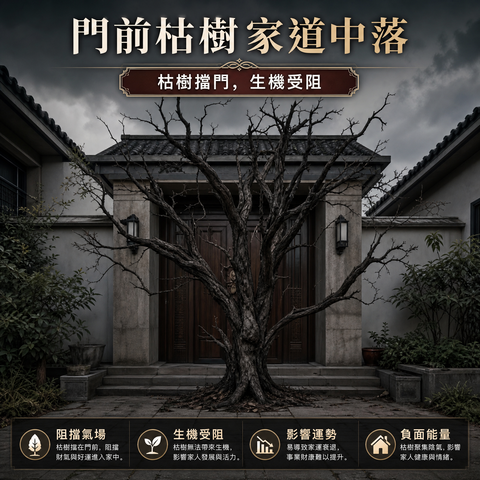
Case 20 · Dead Tree at the Door, Family Decline
Could even a small dead tree in front of your door secretly signal the decline of your family's fortunes? Hong Kong Feng Shui Master Andrew Chan meticulously analyzes the feng shui hidden dangers of dead trees at the entrance and homes at the end of dead-end alleys, and reveals why 'an open space to the south of a residence' is considered an auspicious and noble benefactor pattern.
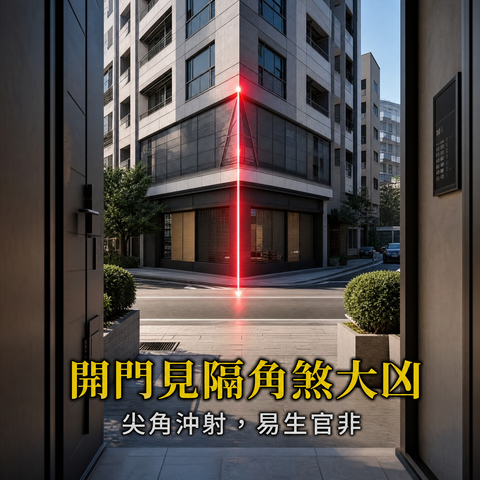
Case 21 · Facing Corner Sha is Ominous
Is your main entrance facing a neighbor's sharp corner? Hong Kong Feng Shui Master Andrew Chan deeply analyzes the 'Corner Sha' and 'Facing a Mountain' — two major feng shui afflictions that obstruct qi flow, and teaches you how to mitigate the vibration and noise damage from overhead bridges and elevated structures.
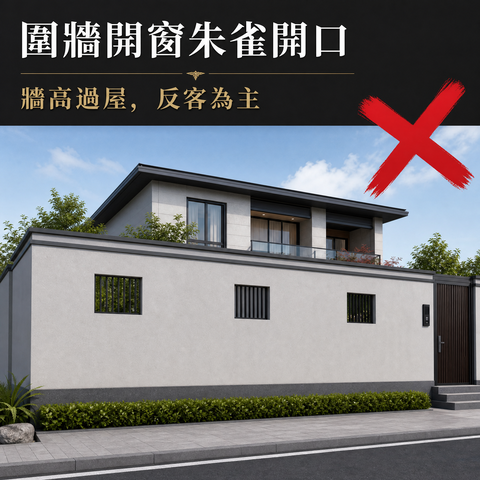
Case 22 · Wall Windows and the Vermilion Bird's Open Mouth
Not only should perimeter walls not be taller than the main house, but windows should absolutely not be opened in them. Hong Kong Feng Shui Master Andrew Chan explains the ominous 'Vermilion Bird's Open Mouth' formation and deeply warns about the terrifying karmic consequences of building on abandoned wells and facing the 'Great Arrow Piercing the House' sha qi.
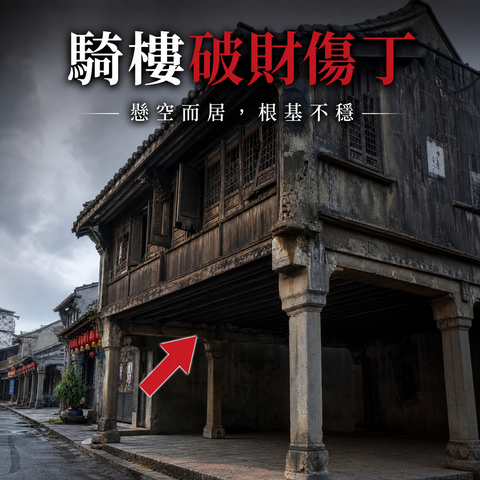
Case 23 · Arcade House – Wealth Loss and Harm to Descendants
Why is the arcade house layout considered a dwelling that leads to 'wealth loss and harm to descendants'? Hong Kong Feng Shui Master Andrew Chan elaborates on the negative impact of commercial ground floors and residential upper floors on children and financial luck, and warns about the dangerous signal of a bent door frame, which can easily trigger accidents.
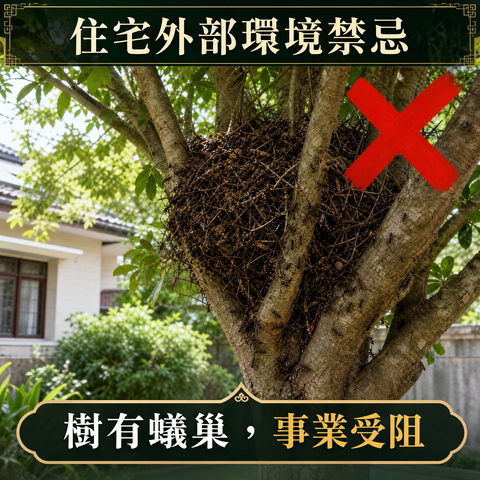
Case 24 · Residential Exterior Environment Taboos
What are the easily overlooked hidden taboos in a home's exterior environment? Hong Kong Feng Shui Master Andrew Chan reveals how ant nests on trees in front of the door can attract backstabbers, and the qi field crisis caused by large, detached villas having garages in the same basement.
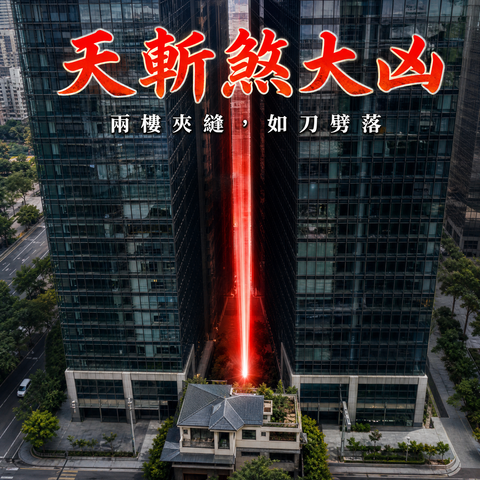
Case 25 · Heaven Cleaving Sha
Why is Heaven Cleaving Sha considered the most ominous sha qi for a residence? Renowned Hong Kong Feng Shui Master Andrew Chan deeply analyzes the Heaven Cleaving Sha formed by gaps between two buildings, the reasons why triangular homes lead to divorce, and warns against the feng shui hidden dangers of low-lying, flood-prone areas. Andrew Chan Feng Shui provides expert insights.
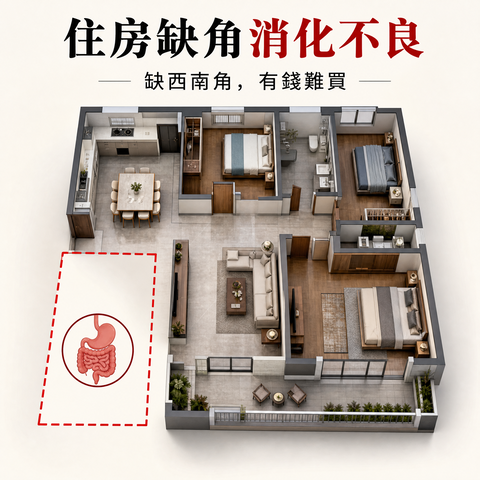
Case 26 · Missing Southwest Corner and Digestive Issues
Does a missing corner in a house always bring bad luck? Hong Kong Feng Shui Master Andrew Chan offers a unique feng shui dialectic: a detailed analysis of how a "missing southwest corner" can lead to digestive problems yet paradoxically boost one's career. He also warns about the dangers of left-right asymmetry for one's wife and children.
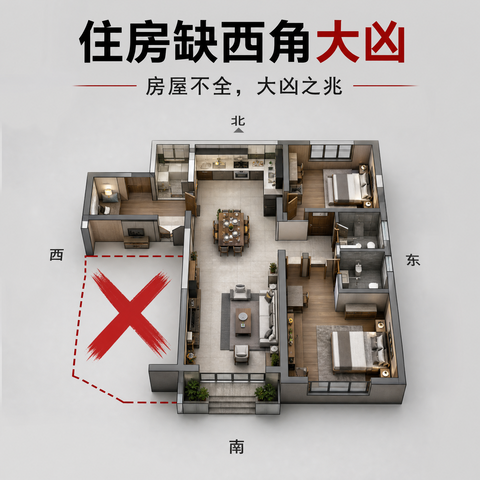
Case 27 · Missing West Corner is Ominous
When buying a home, absolutely avoid layouts with a missing west corner! Hong Kong Feng Shui Master Andrew Chan solemnly warns: a home missing its west corner is an extremely inauspicious dwelling that should never be inhabited. This article deeply analyzes the devastating impact of missing corners in the Western Dui Trigram and Southern Li Trigram on a family's destiny.
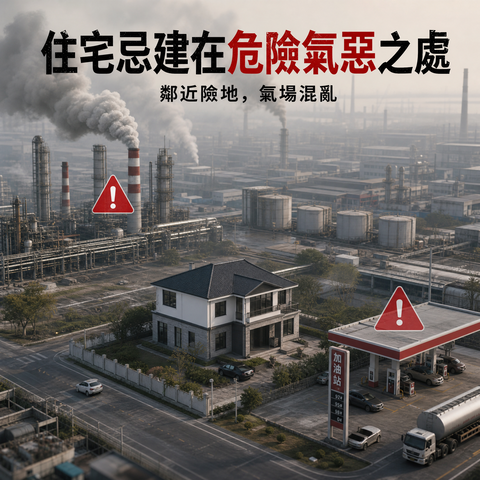
Case 28 · Residential Properties Near Dangerous Locations
The public facilities surrounding a residence directly determine the purity of its qi. Hong Kong Feng Shui Master Andrew Chan warns you about the feng shui hazards near gas stations, chemical plants, prisons, and temples, and teaches you how to mitigate inauspicious forms like rivers facing the main door, alleyway rushes, and road rushes.
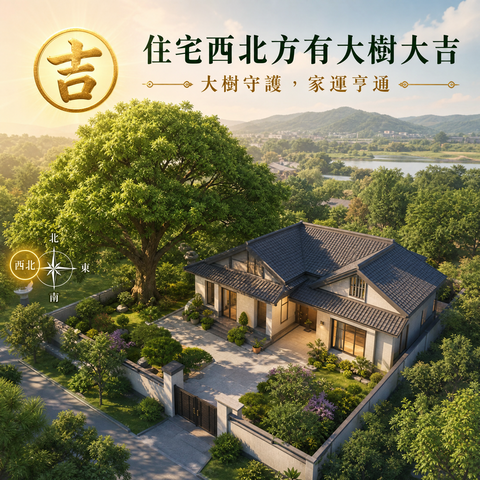
Case 29 · Northwest Big Tree Brings Great Fortune
Why is a large tree in the northwest of a residence considered auspicious? Hong Kong Feng Shui Master Andrew Chan exclusively reveals the protective power of a large tree in the Qian position (northwest) and teaches you how to avoid the dangers of an 'isolated yang' house and skillfully use winding paths in front of the door to neutralize sha qi and welcome good fortune.
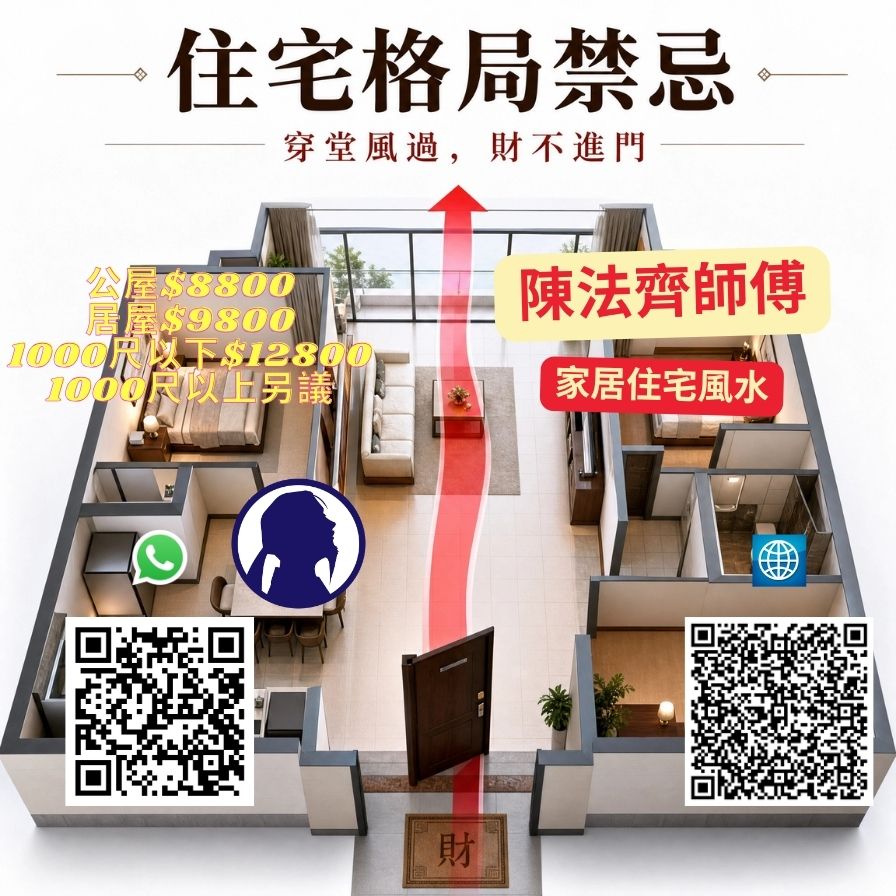
Case 30 · Piercing Hall Sha (Living Room Directly to Rear Balcony)
Hong Kong Feng Shui Master Andrew Chan points out that 'Piercing Hall Sha' is one of the most common negative feng shui formations in homes. Its core cause is when the main entrance door, and the rear balcony door or windows, are in a direct line, allowing external airflow to pass straight through without circulating indoors. This creates a 'straight in, straight out, no qi retention' pattern. Traditional feng shui believes that 'where qi gathers, wealth gathers; where qi disperses, wealth disperses,' and this direct airflow can dissipate the auspicious and wealth-generating qi accumulated indoors. From a modern living perspective, excessive air convection can lead to significant fluctuations in indoor temperature and humidity, reducing comfort. Prolonged exposure to strong drafts can also cause respiratory discomfort. Furthermore, the lack of transitional space makes it difficult for family members to experience a sense of relaxation.
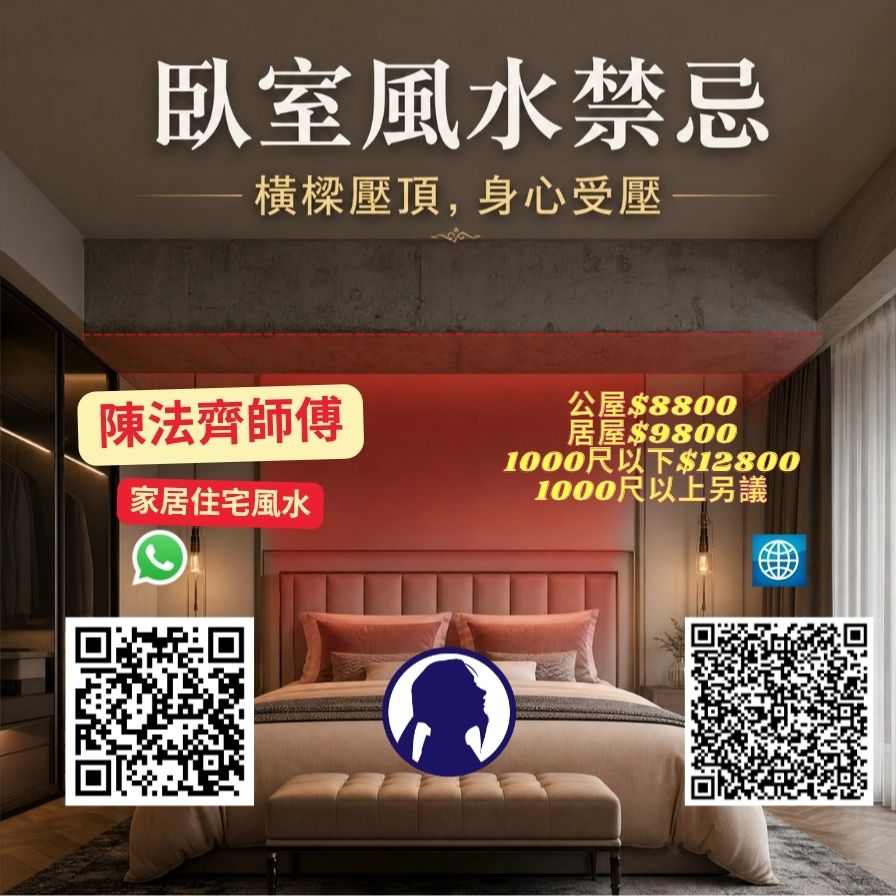
Case 31 · Beam Over Bed
Hong Kong Feng Shui Master Andrew Chan's home feng shui insights highlight that beams symbolize 'suppressive force' in feng shui. If a bed is directly beneath a beam, prolonged sleep under it subjects individuals to continuous downward qi pressure, creating a 'beam over bed' sha qi formation. Traditional feng shui considers a beam overhead to suppress one's luck and health, making it a major taboo in bedroom feng shui. From an environmental psychology perspective, the visual presence of a beam creates a subconscious sense of oppression, and even during sleep, the brain continues to perceive the obstruction above, affecting deep sleep quality.
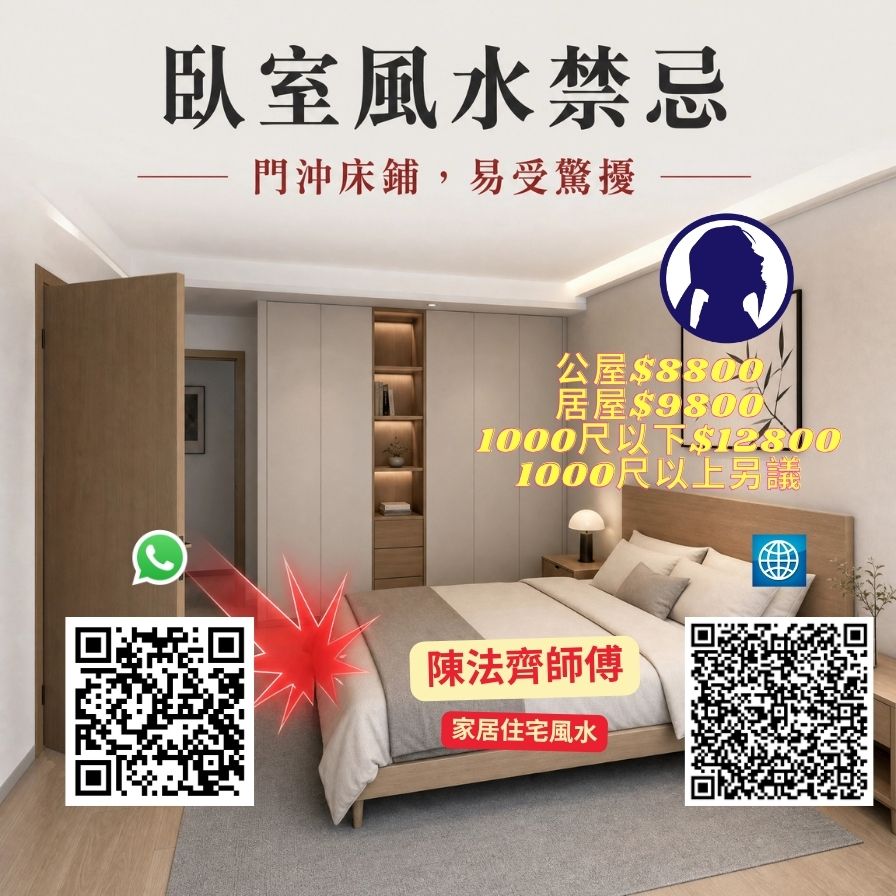
Case 32 · Door Facing Bed (Bedroom Door Directly Facing the Bed)
Hong Kong Feng Shui Master Andrew Chan's home feng shui insights highlight that a bedroom door is a conduit for qi flow and the boundary between external and private bedroom energies. If the bedroom door directly faces the bed, the qi flow will directly 'rush' towards the bed, creating a 'door-facing sha qi'. During sleep, a person's energy field is at its weakest and defenses are lowest. This direct rush of qi continuously disturbs the sleeper's personal energy field, preventing effective energy restoration.
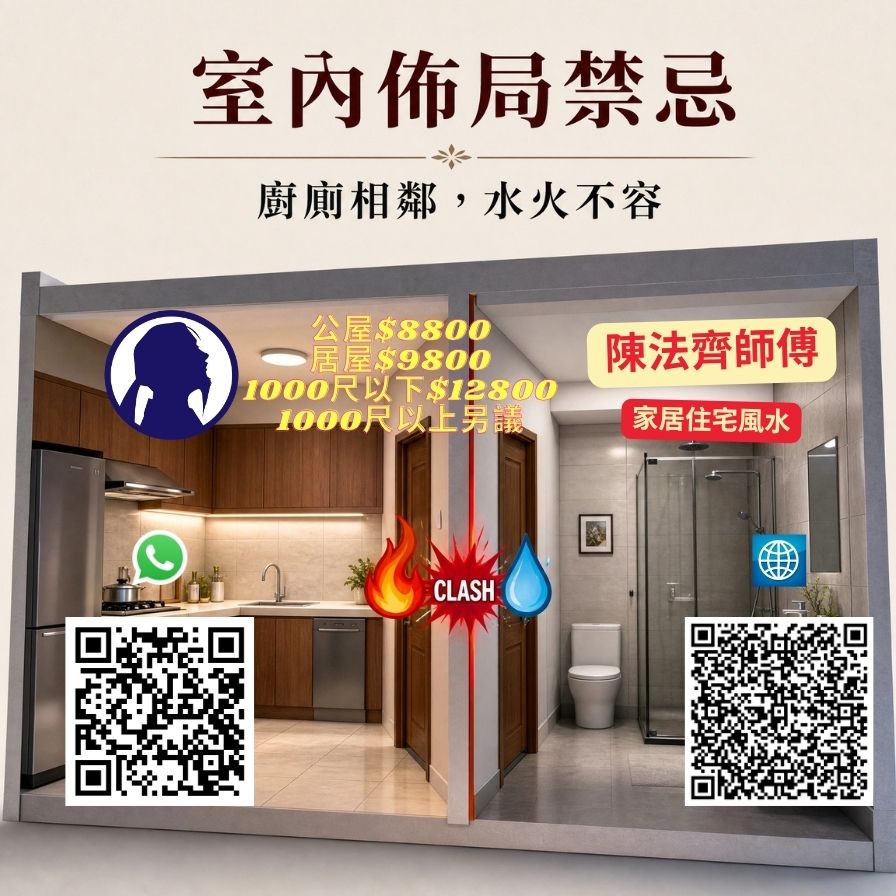
Case 33 · Stove Against Toilet Wall
Hong Kong Feng Shui Master Andrew Chan's home feng shui insights highlight that the stove, belonging to the Fire element, is the heart of the kitchen, symbolizing family health and wealth. The toilet, belonging to the Water element, is a place where sha qi accumulates. If the stove is placed directly against a toilet wall, the Water and Fire elements clash through the wall. Furthermore, the toilet's sha qi and dampness can permeate the wall and affect the stove, creating an unfavorable 'stove against toilet wall' feng shui configuration.
Case 34 · Shared Kitchen and Toilet Door (or Doors Facing Each Other)
Hong Kong Feng Shui Master Andrew Chan's home feng shui insights highlight that the kitchen is a clean area for eating and food storage, representing wealth and health. The toilet, conversely, is a dirty area for excretion and waste, symbolizing turbid qi and decline. When these two areas share an entrance or have doors directly facing each other, the toilet's foul qi can directly enter the kitchen, contaminating food and the kitchen's energy field, creating a severe "shared kitchen and toilet door" sha qi formation. From a hygiene perspective, bacteria and odors from the toilet can easily spread to the kitchen, directly affecting food safety and endangering family health.
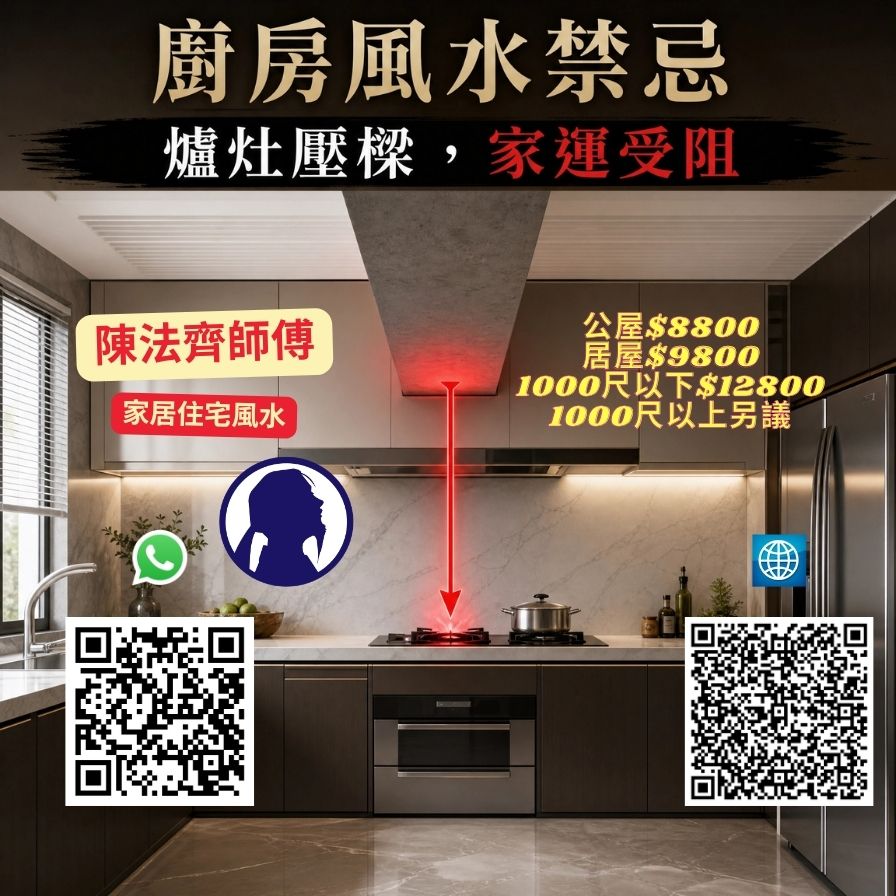
Case 35 · Stove Under Beam
Hong Kong Feng Shui Master Andrew Chan's home feng shui insights highlight that the stove is the household's treasury and source of health. If a beam directly presses down on it, forming a “stove under beam” configuration, the oppressive qi from the beam will directly suppress the stove's fire and wealth qi. This, in turn, suppresses the family's health and financial luck, with a particularly noticeable impact on the female homeowner's fortune.
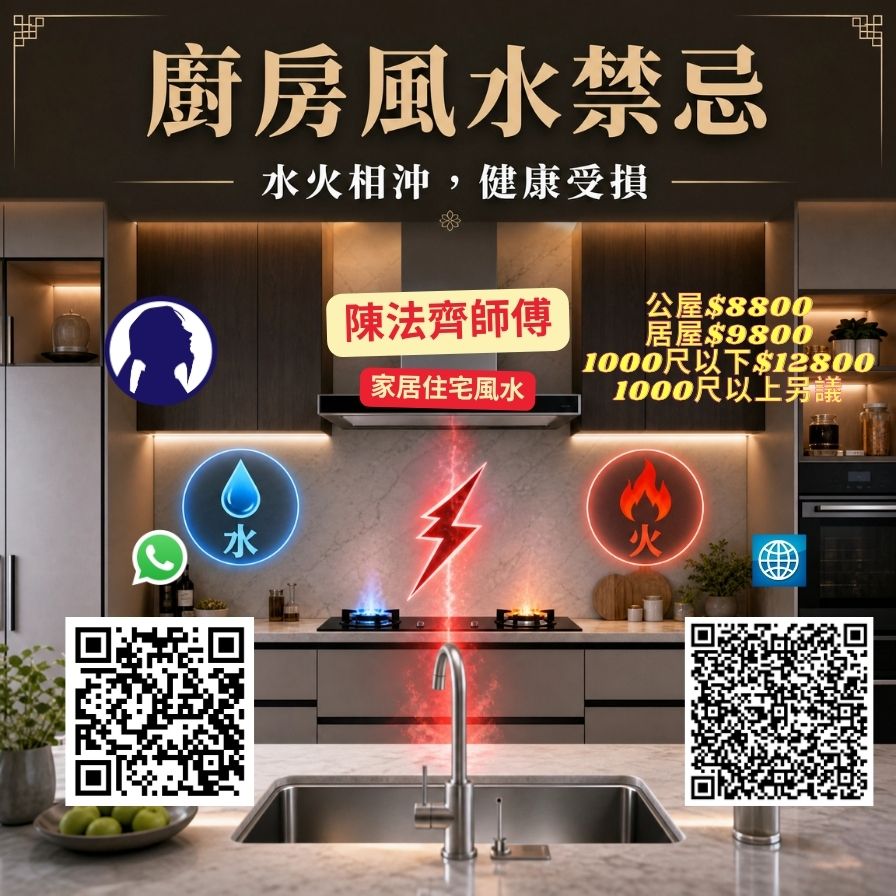
Case 36 · Kitchen Water-Fire Clash (Stove Opposite Sink)
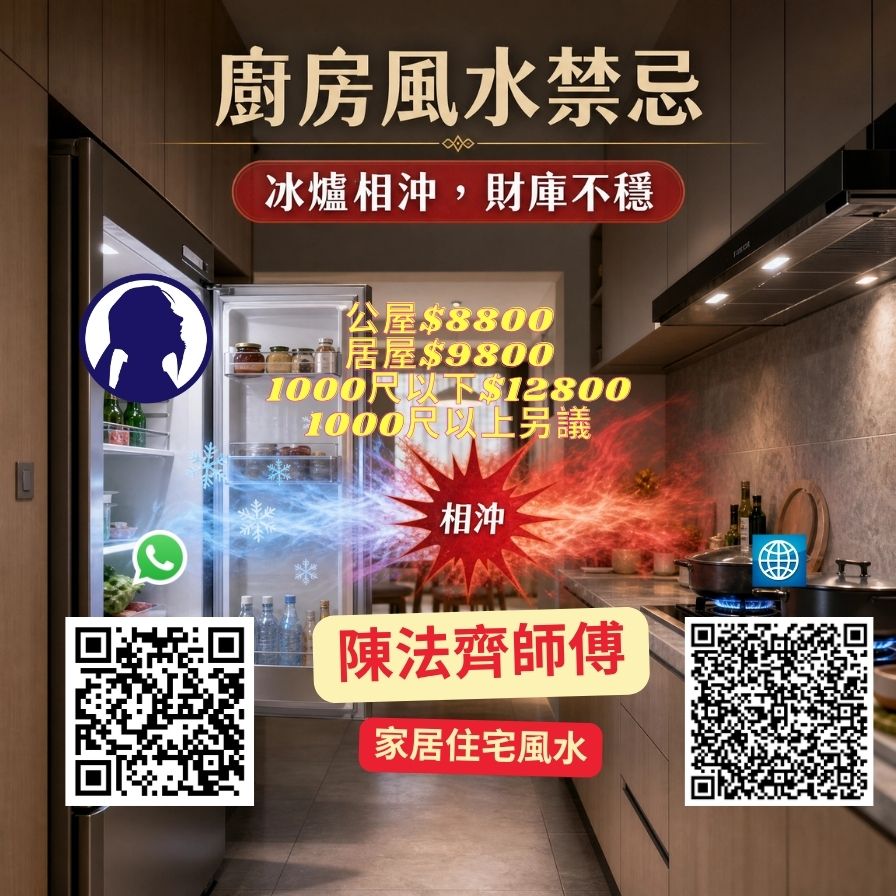
Hong Kong Feng Shui Master Andrew Chan's home feng shui insights highlight that in the kitchen, the stove belongs to the Fire element, while the sink and refrigerator belong to the Water element. If these are placed directly opposite each other or in close proximity, they create a "water-fire clash" feng shui pattern. The incompatibility of water and fire leads to an imbalance in the kitchen's qi, subsequently affecting family relationships, health, and wealth. Traditional feng shui emphasizes "water and fire in harmony" (水火既济), meaning a balanced and non-confrontational arrangement of water and fire elements is auspicious for a kitchen layout.
Case 37 · Living Room Sofa Lacks Backing (No Solid Wall Behind Sofa)
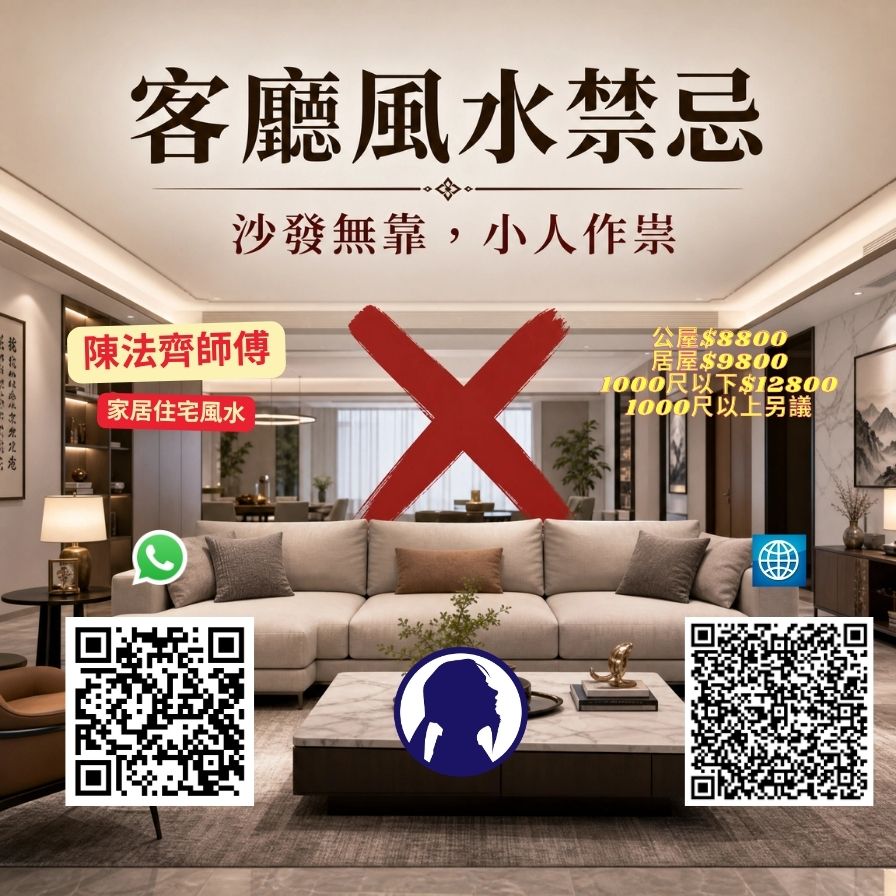
Hong Kong Feng Shui Master Andrew Chan's home feng shui insights highlight that feng shui emphasizes 'having backing, stable as Mount Tai.' The sofa is the core seating area in the living room, governing the homeowner's career and benefactor luck. If the sofa lacks a solid wall for support, and behind it is a hallway, window, or empty space, it forms a 'no backing' pattern, symbolizing a lack of support and unstable foundations. From a psychological perspective, having no cover behind can subconsciously keep people on alert, preventing full relaxation. Over time, this can lead to anxiety and affect decision-making stability.
Case 38 · Cluttered Wealth Corner in the Living Room
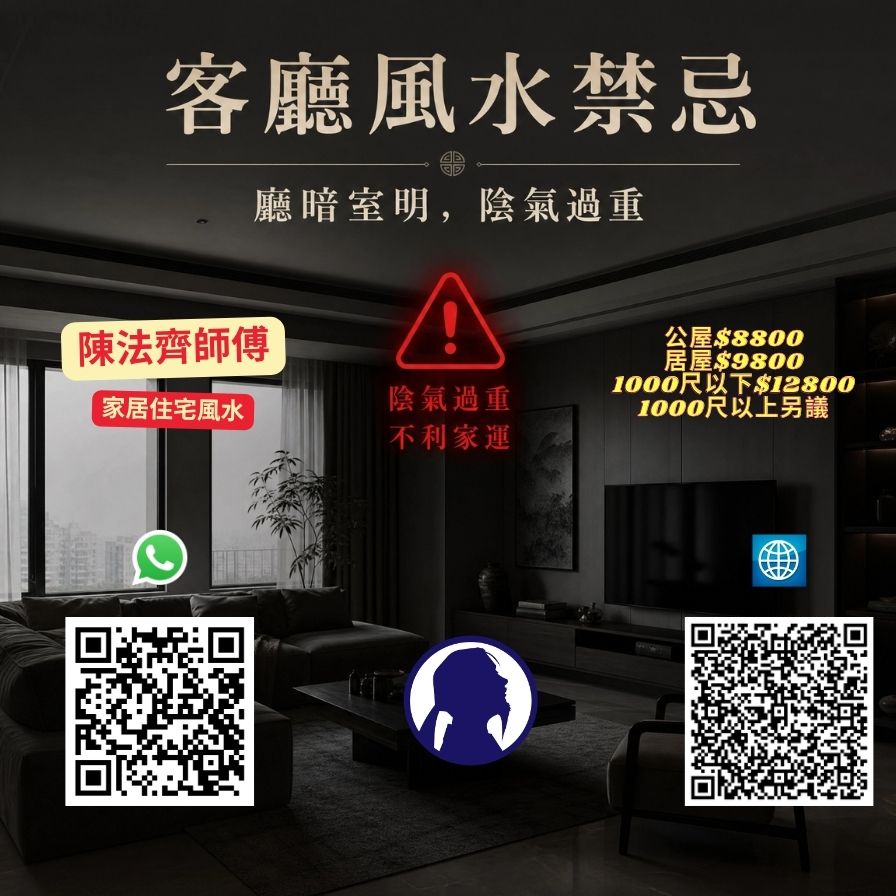
Hong Kong Feng Shui Master Andrew Chan's home feng shui insights highlight that the living room's 'bright wealth corner' is located at the diagonal corner from the main entrance. This area is where wealth qi most easily gathers in a home and must be kept clean, bright, and stable. If this wealth corner is cluttered with miscellaneous items, trash, cleaning tools, or if items like fish tanks, air conditioners, or sharp objects are placed there, it will directly suppress or scatter wealth qi, forming a 'broken wealth corner' pattern.
Case 39 · Bedroom Headboard Against Toilet Wall
Hong Kong Feng Shui Master Andrew Chan points out that the toilet is the area with the heaviest 'sha qi' (negative energy) and dampness in a home. Its five elements attribute is water, and its energy field is turbid and downward-flowing. If the bed's headboard is directly against a toilet wall, the sleeper's head will be continuously exposed to this turbid 'qi' and dampness, forming an unfavorable 'headboard against toilet' feng shui configuration. From a practical living perspective, the sound of water flowing through pipes and the humidity from the toilet can also penetrate the wall, affecting sleep. Long-term dampness can easily lead to mold growth on the wall, impacting respiratory health.
Case 40 · Cluttered Balcony
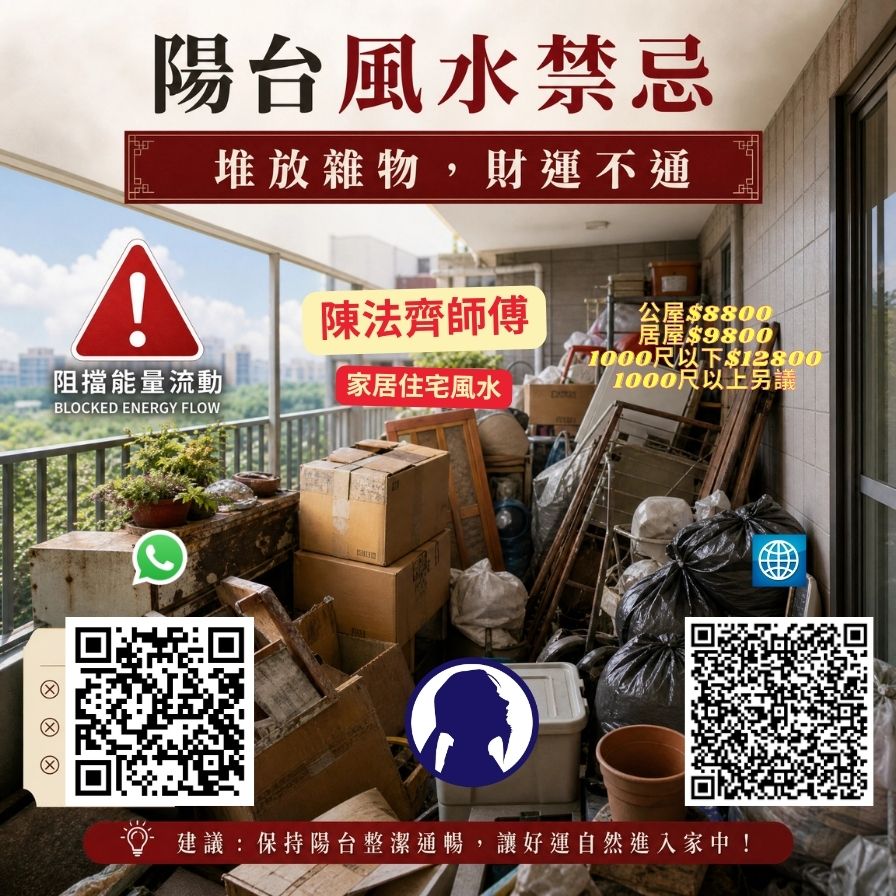
Hong Kong Feng Shui Master Andrew Chan points out that the balcony is the 'qi' intake opening connecting the residence to the outside world. External 'sheng qi' (positive energy) and sunlight enter the interior through the balcony, acting as the 'entry channel' for the home. If the balcony is perpetually cluttered with old items, rubbish, unused furniture, or if excessive laundry is hung, blocking light and airflow, it will obstruct this 'qi' intake opening. This prevents positive external 'qi' from entering smoothly and makes it difficult for stagnant indoor 'qi' to dissipate.
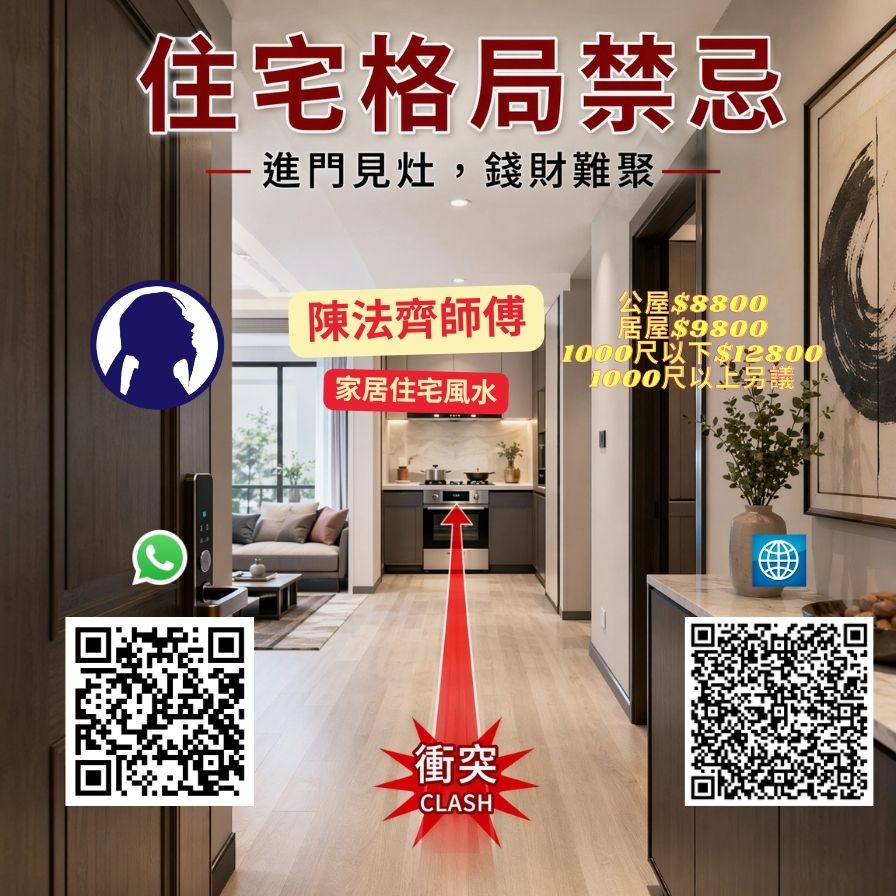
Case 41 · Kitchen in the Northwest (Fire Burning Heaven's Gate)
Hong Kong Feng Shui Master Andrew Chan's home feng shui insights reveal that in the Later Heaven Bagua, the Northwest sector corresponds to the Qian trigram, which belongs to the Metal element. This sector relates to the male head of the household, career, wealth, and head health. The kitchen, being of the Fire element, if located in the Northwest of a residence, creates a 'Fire burning Heaven's Gate' sha qi formation. This classic sha qi pattern, where Fire clashes with Metal, scorches the Qian trigram's energy field, making it one of the most impactful feng shui configurations for the male homeowner's fortune.
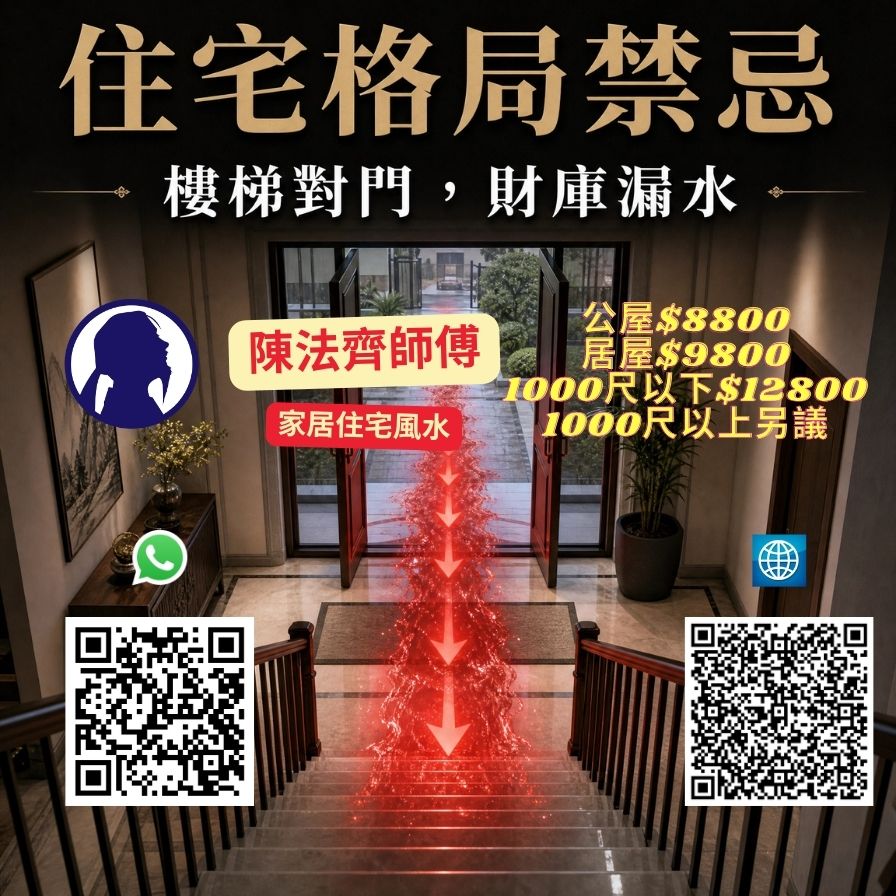
Case 42 · Bedroom Doors Facing Each Other (Two Bedroom Doors Opposite)
Hong Kong Feng Shui Master Andrew Chan's home feng shui insights highlight that when two bedroom doors directly face each other, it creates a 'door-to-door sha' or 'quarrelsome door sha'. The direct clash of qi between the two spaces can lead to mutual interference in the rooms' energy fields, causing friction in the occupants' emotions and fortunes. If it's the master bedroom facing a child's room, it can easily lead to generational gaps and communication issues; if two secondary bedrooms face each other, family members living together are prone to disputes.
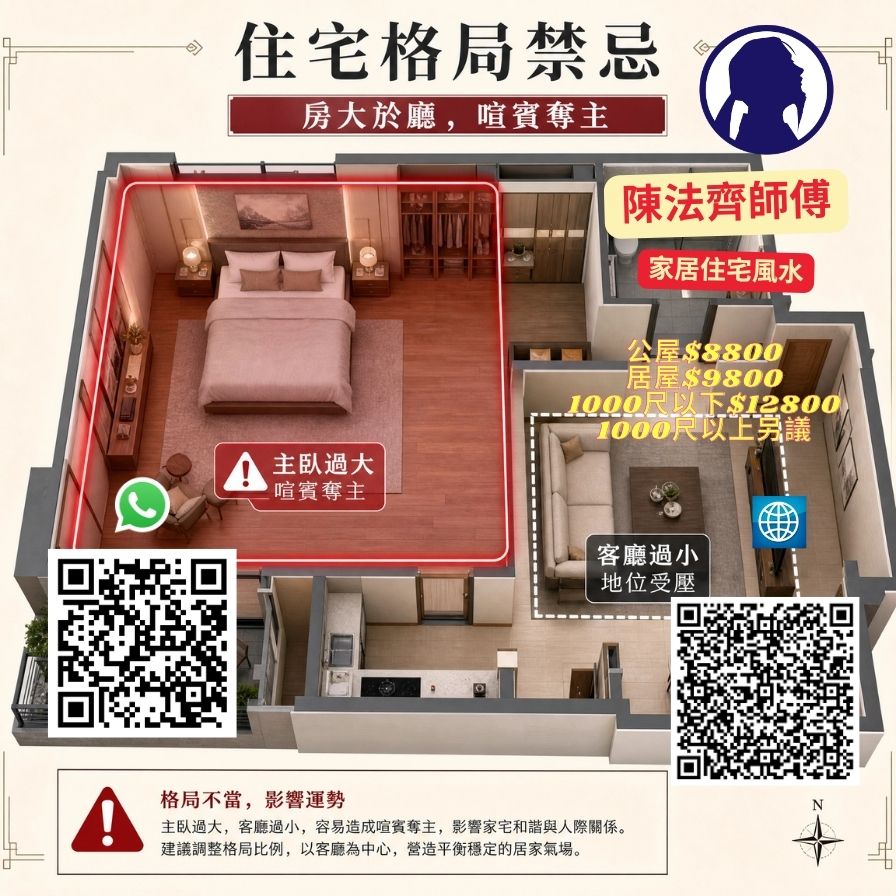
Case 43 · Bedhead Without Backing (Bedhead Not Against a Solid Wall)
Hong Kong Feng Shui Master Andrew Chan's home feng shui insights highlight that the bedhead is where one's head rests during sleep, and in feng shui, it corresponds to a person's 'backing' and foundation. If the bedhead is suspended, against a window, or next to a walkway, not flush against a solid wall, it forms a 'bedhead without backing' configuration. This symbolizes a lack of support, an unstable foundation, and difficulty in achieving a sufficient sense of security during sleep.
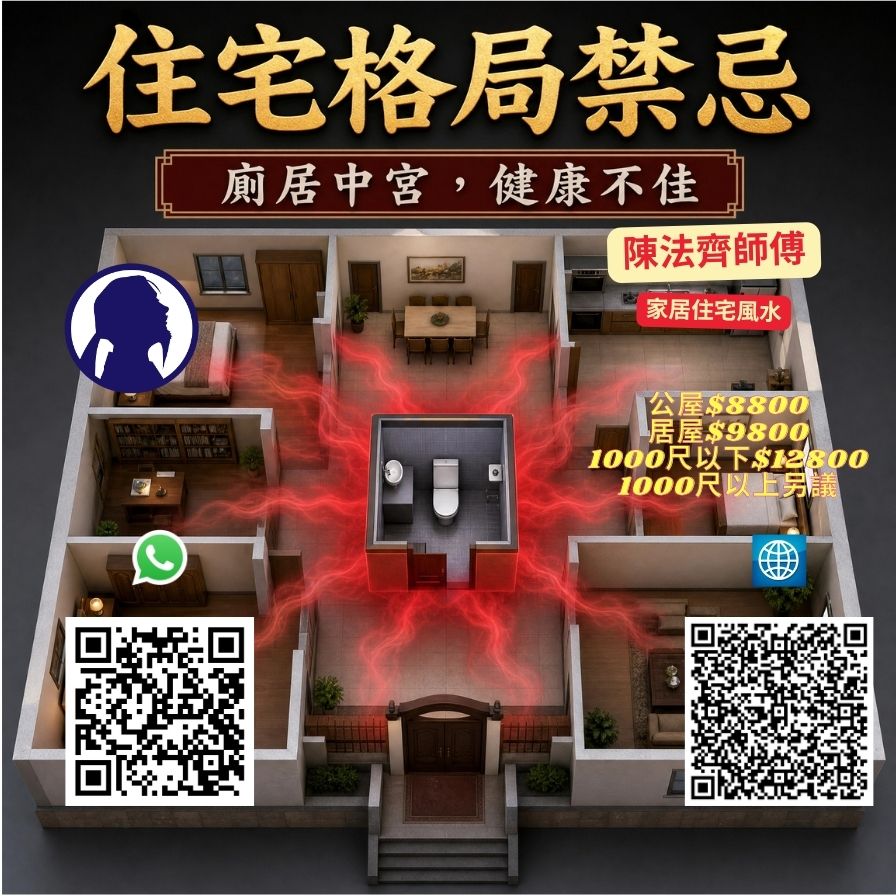
Case 44 · Kitchen Door Facing Toilet Door
Hong Kong Feng Shui Master Andrew Chan's home feng shui insights highlight that the kitchen governs sustenance and wealth, embodying clean fire. The toilet, conversely, represents filth and excretion, embodying turbid water. When these two doors directly face each other, the toilet's sha qi (negative energy) flows directly into the kitchen, contaminating the food and dining environment. This creates an unfavorable 'kitchen-toilet confrontation, harming wealth and health' pattern, similar to the dangers of a kitchen and toilet sharing a wall, and is a classic taboo in home feng shui.
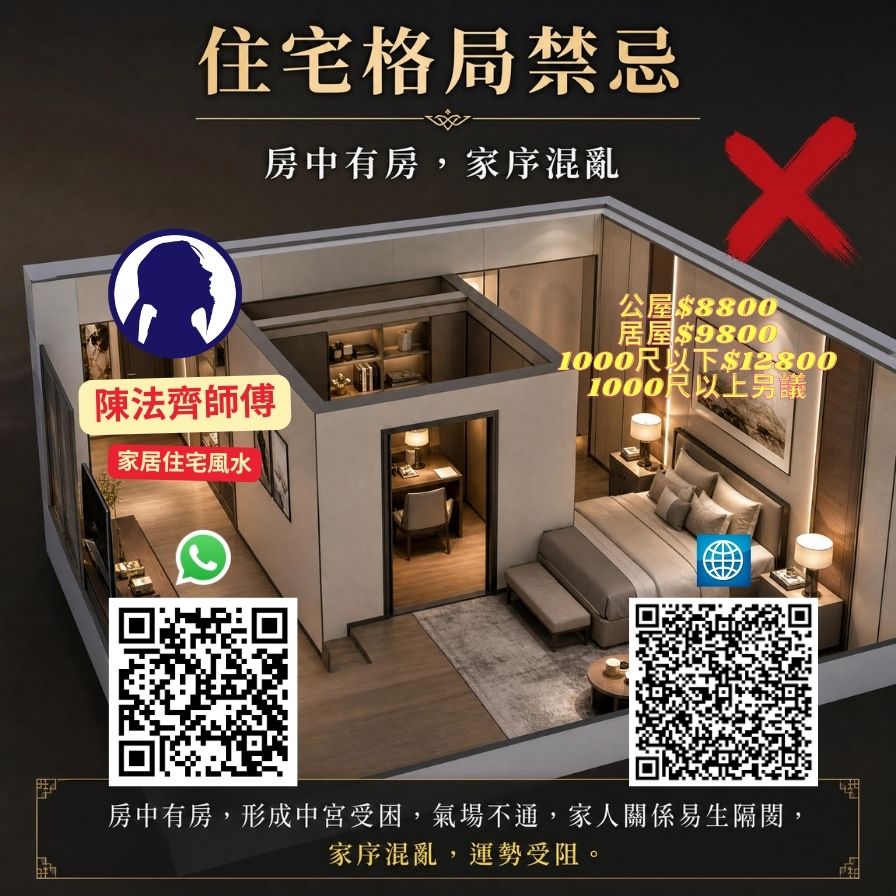
Case 45 · Bedroom Door Facing Main Door
Hong Kong Feng Shui Master Andrew Chan points out that the main entrance door is the primary 'qi' mouth of the entire residence, where all external air currents and energy enter. The bedroom is a private space for rest and recuperation, requiring a stable and tranquil 'qi' field. When the bedroom door directly faces the main entrance door, external 'qi' currents will rush straight into the bedroom in a direct line, forming a 'straight sha qi' (直冲煞), completely disrupting the bedroom's 'qi' balance. From a living experience perspective, being able to see directly into the bedroom upon entering severely infringes on privacy, keeping residents in a state of subconscious alertness and unable to truly relax.
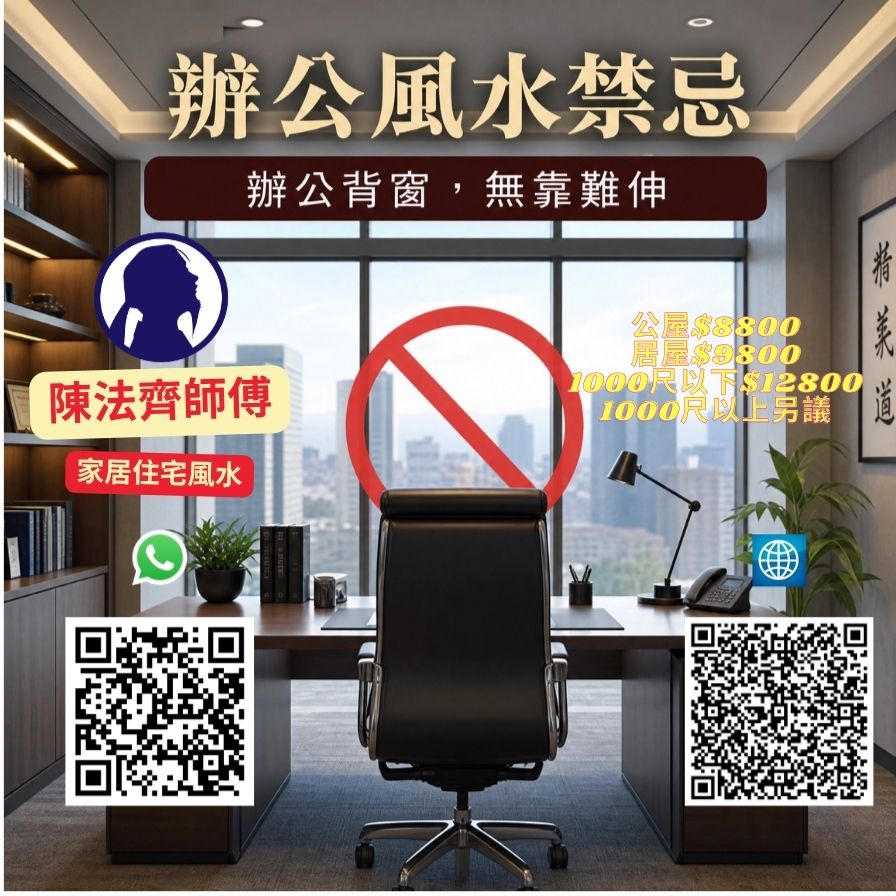
Case 46 · Desk Back to Window
Hong Kong Feng Shui Master Andrew Chan's home feng shui insights highlight that office feng shui also emphasizes the principle of 'sitting solid, facing open.' This means the seat should have a solid wall behind it, symbolizing a stable foundation and support from benefactors. If a desk is placed with its back to a window, the area behind becomes a 'void' or 'qi' opening, causing 'qi' to disperse without support. This creates a 'lack of backing' formation, a typical taboo in workplace feng shui. From a psychological perspective, having a window behind can subconsciously make one worry about movements behind them, preventing full concentration on work and leading to a lack of security...
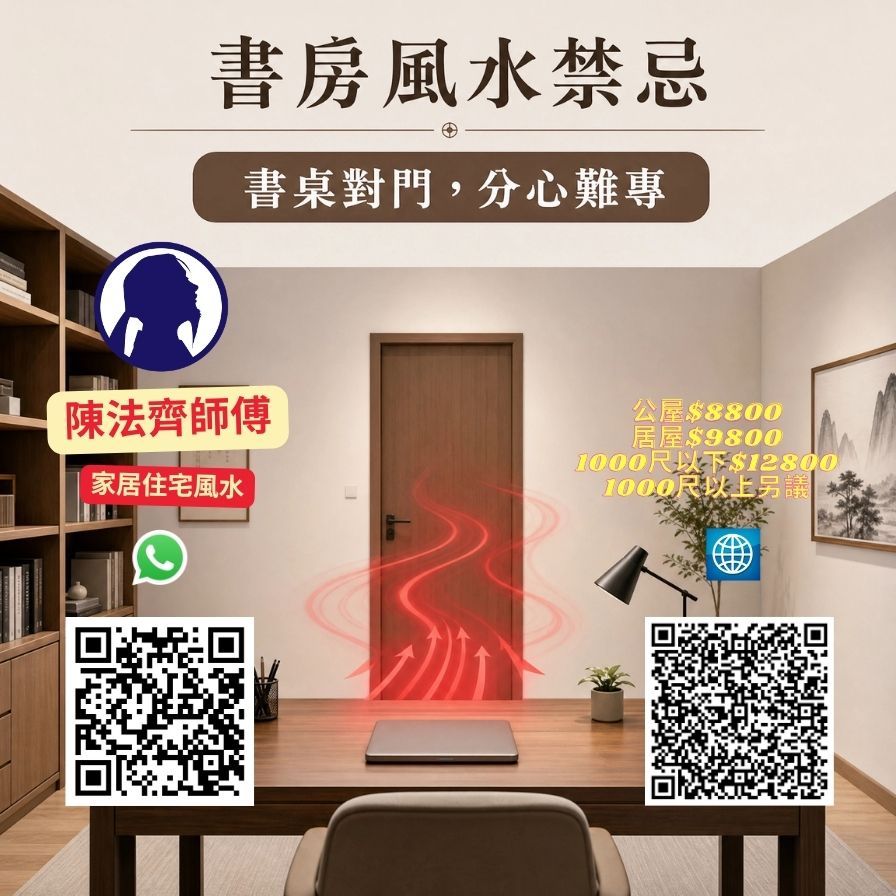
Case 47 · Desk Facing Door
Hong Kong Feng Shui Master Andrew Chan's home feng shui insights highlight that office doors are primary conduits for people and qi flow, leading to frequent energy fluctuations. If a desk directly faces an office door, the occupant will be directly exposed to all incoming and outgoing qi and foot traffic, creating a "door clash sha qi." This constant external disturbance prevents the occupant's qi field from stabilizing. From a work experience perspective, facing the door leads to frequent distractions from outside movements, making it hard to concentrate. Furthermore, all work activities are exposed to passersby, causing significant psychological pressure.
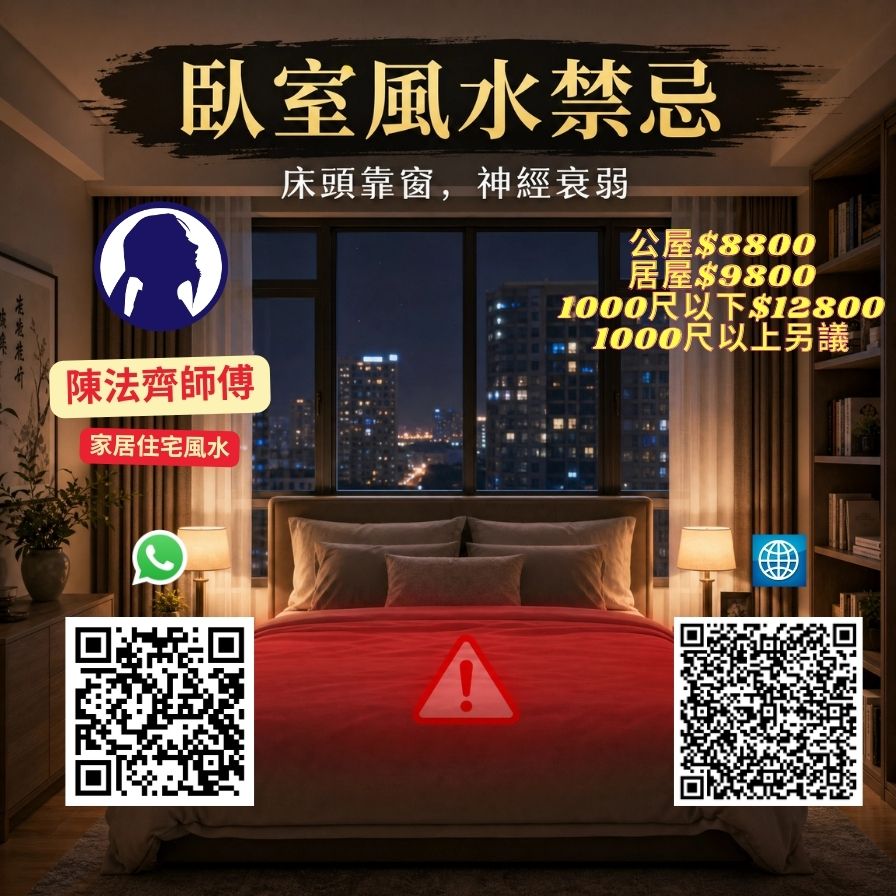
Case 48 · Bedhead Against Window
Hong Kong Feng Shui Master Andrew Chan's home feng shui insights point out that windows are the 'mouth of qi' for a residence and symbolize 'emptiness,' unable to provide the stable support of a solid wall. Placing a bedhead directly against a window means the sleeper lacks support behind their head. External airflow, light, and noise will continuously disturb sleep through the window, making it difficult for the bedroom's qi field to stabilize. From a scientific perspective, significant temperature differences and noise near windows, along with glass reflections, can affect deep sleep, potentially leading to long-term nervous system fatigue.
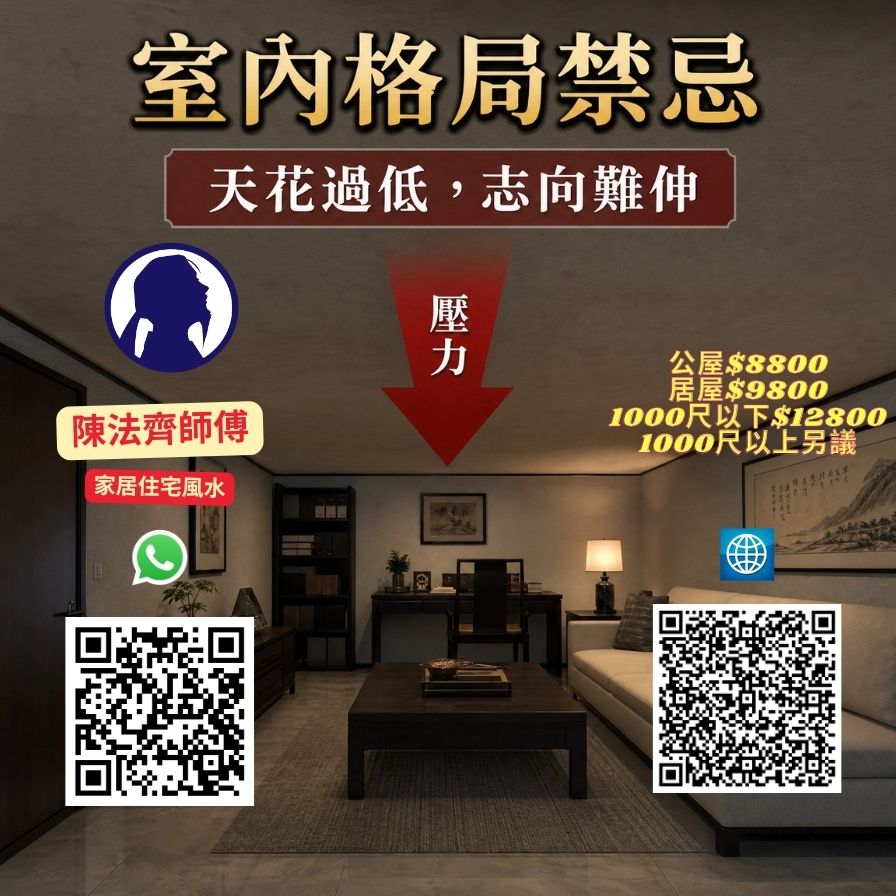
Case 49 · Ceiling Too Low
Hong Kong Feng Shui Master Andrew Chan points out that in Feng Shui theory, the ceiling corresponds to 'heaven,' symbolizing career development, breadth of mind, and upward mobility. A ceiling that is too low in a residence or office creates a strong sense of oppression, as if being suppressed by the heavens, preventing qi from flowing freely and forming 'heavenly suppression sha qi.'
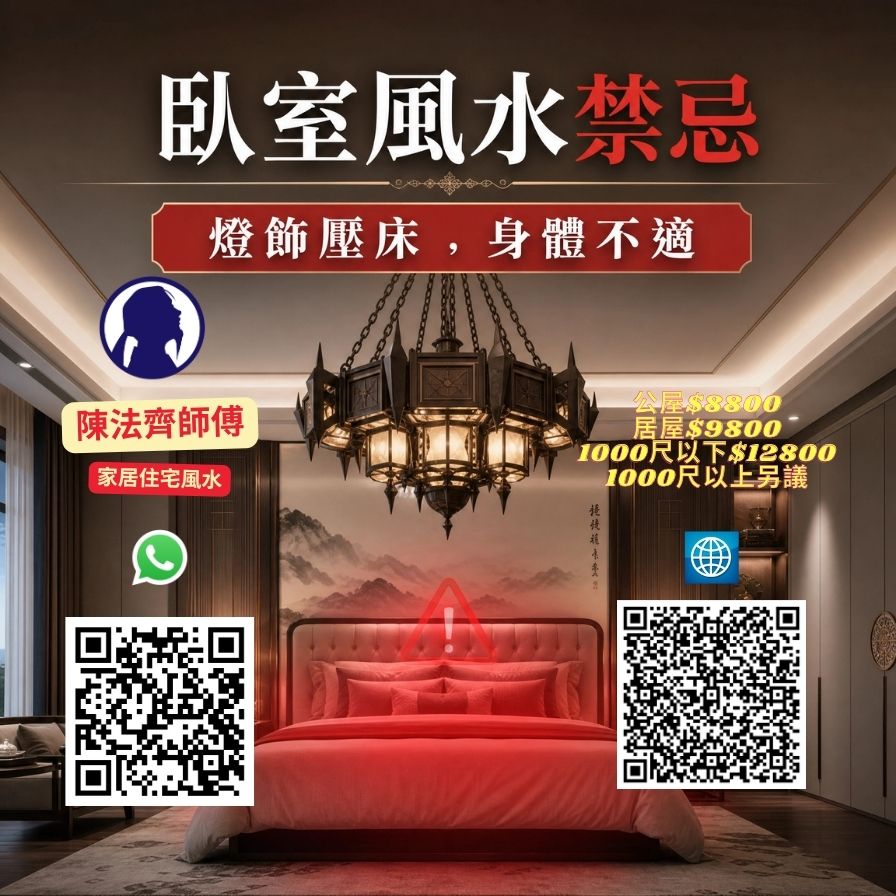
Case 50 · Light Fixture Over Bed (Bedroom Light Fixture Directly Above Bed)
Feng Shui Master Andrew Chan's home feng shui insights highlight that a light fixture over the bed is an extension of the 'beam pressing down' sha qi, referring to large light fixtures such as chandeliers or crystal lamps in the bedroom that are directly above the bed's vertical projection area. Traditional feng shui believes that heavy objects suspended overhead create a downward oppressive energy field, continuously disturbing the sleeper's personal qi. From a psychological and safety perspective, heavy objects overhead can induce subconscious anxiety and fear of falling. Additionally, the changing light and shadow from complex fixtures can disrupt sleep patterns. If the light fixture has sharp edges or pointed, downward-hanging elements, the oppressive and clashing effects are amplified, leading to more significant negative impacts on sleep and mood.
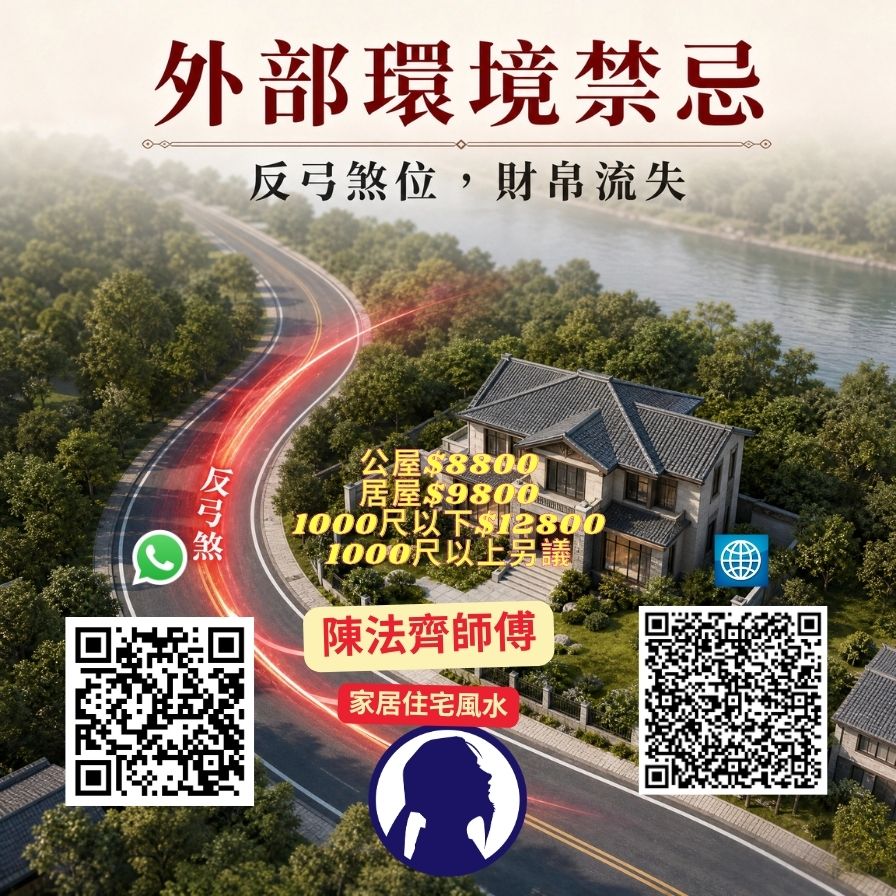
Case 51 · Reverse Bow Sha (Residence at the Outer Curve of a Road or River)
Hong Kong Feng Shui Master Andrew Chan's home feng shui insights highlight that Reverse Bow Sha refers to a residence located on the outer (convex) side of a curved road or river. The road/river forms a bow shape, with its back facing the residence, much like an arrow pointing at the house from a fully drawn bow. Feng shui emphasizes 'curves with affection' (曲则有情); an embracing road/river, known as 'Jade Belt Hugging the Waist' (玉带环腰), is auspicious. Conversely, a 'back-bow without affection' (背弓无情) is inauspicious, causing qi to dissipate outwards, preventing accumulation. From a modern perspective, vehicles on a curved road are prone to losing control and crashing into the residence. A river's outer curve is susceptible to erosion and flood risks, with increased noise and air current impact.
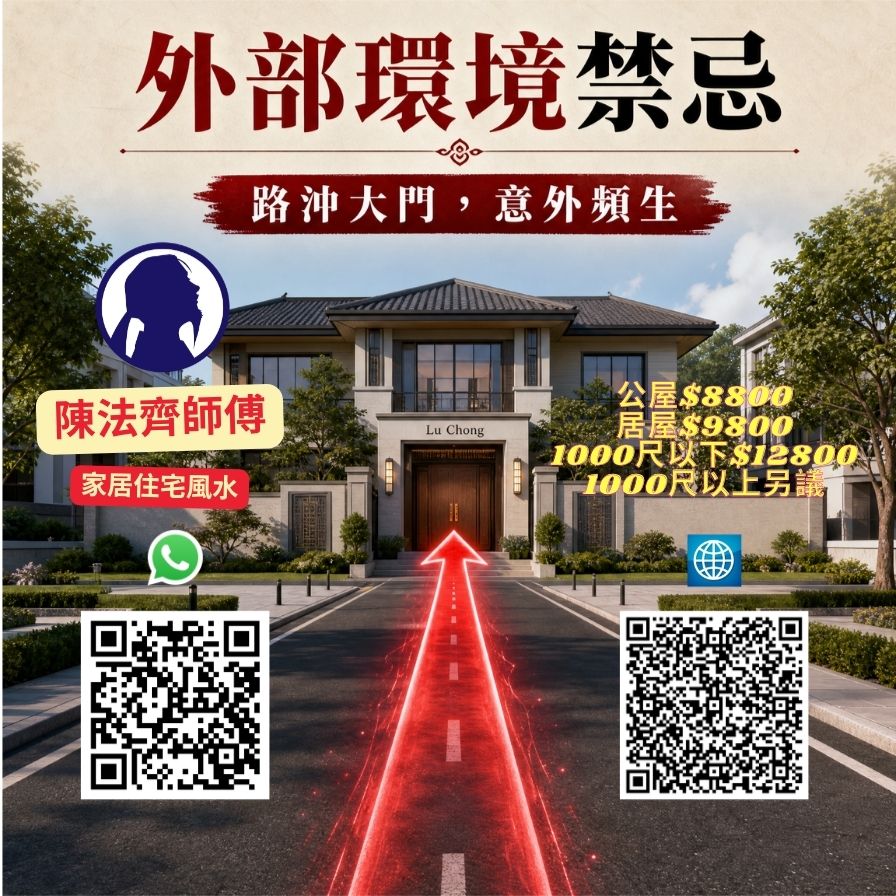
Case 52 · Road Rush Sha (Main Door Facing a Straight Road)
Hong Kong Feng Shui Master Andrew Chan points out that 'road rush sha' (路冲), also known as 'gun sha' (枪煞), refers to a straight road directly facing a home's main door or windows. The qi flows directly along the road, much like a spear shooting straight at the house. Traditional feng shui believes that 'straight roads lead to emptiness, financial loss, and harm to family members.' The fast-moving, aggressive qi generated by a straight road can disrupt the home's qi accumulation pattern. From a modern perspective, a straight road means significant vehicle noise, exhaust fumes, and traffic safety hazards. Long-term residence in such a location can easily lead to emotional irritability. The intensity of the road rush sha's impact is directly related to the road's width, traffic volume, and proximity: the wider the road, the more traffic, and the closer it is, the stronger the sha qi.
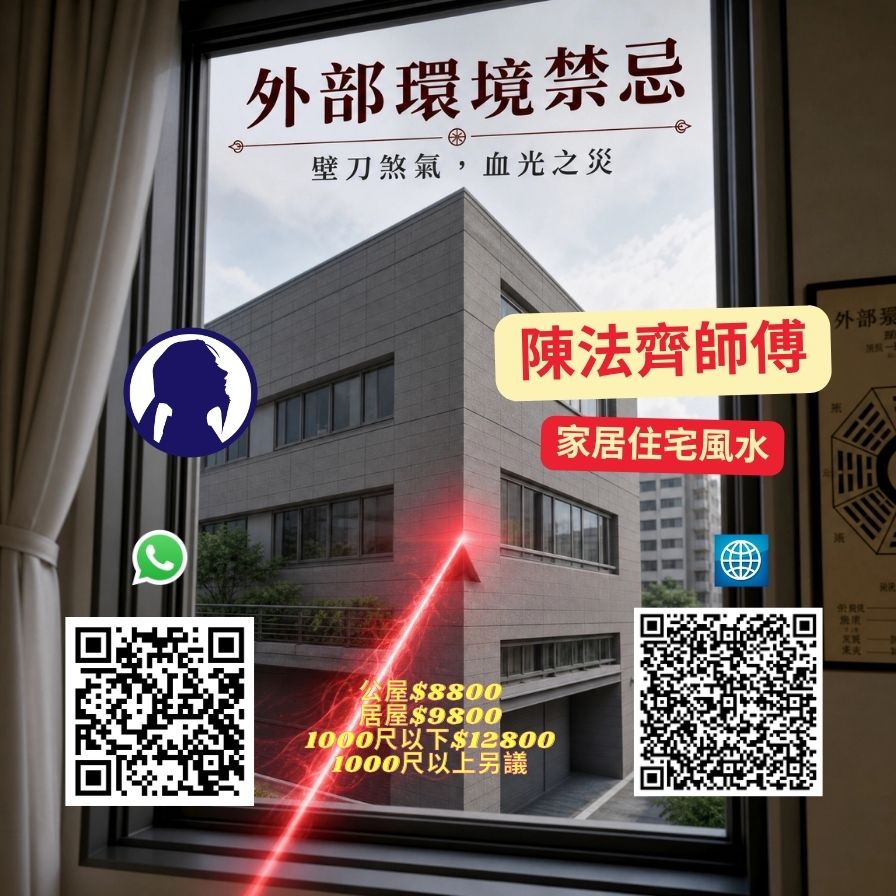
Case 53 · Wall Knife Sha (Residential Property Facing Neighbor's Wall Corner)
Hong Kong Feng Shui Master Andrew Chan's home feng shui insights highlight that 'Wall Knife Sha' refers to the sharp corners of adjacent buildings, or the edges of eaves, that directly face a home's doors, windows, or walls. This is akin to a blade striking the property and is a classic example of 'form sha'. The sharper the corner, the closer the distance, and the more central the position it faces (e.g., main entrance, master bedroom), the stronger the sha qi. Traditional feng shui believes that sharp edges cut through the qi field, creating a continuous冲射之力 (rushing and striking force), which can lead to residents experiencing external injuries or surgical health issues.
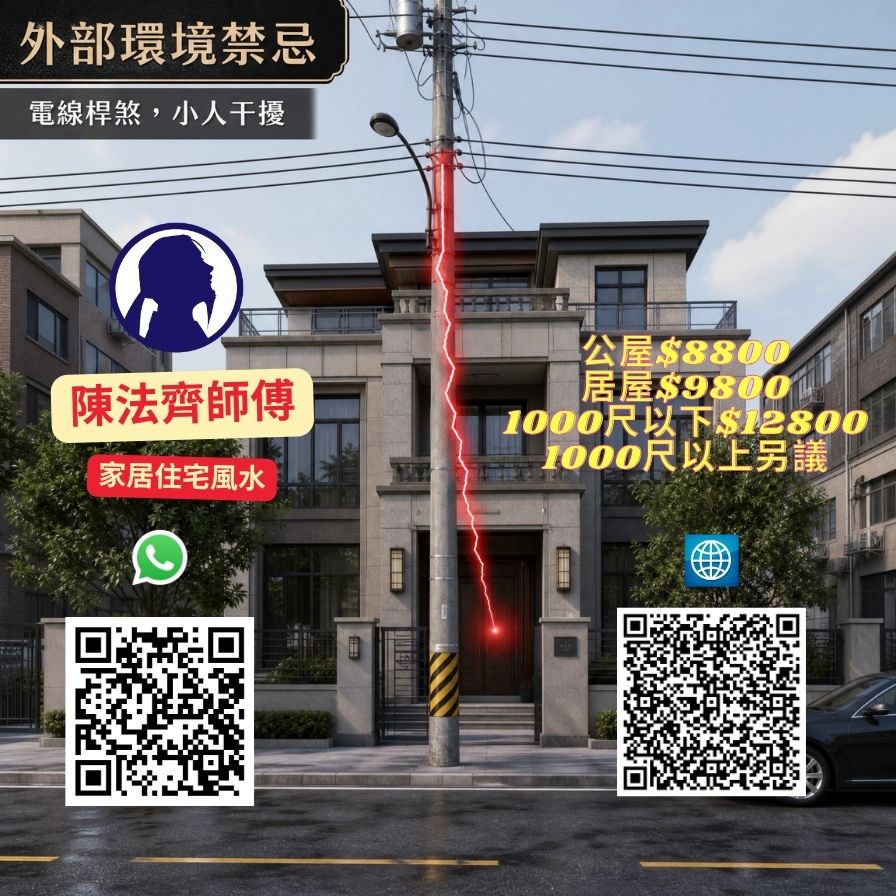
Case 54 · Utility Pole Sha (Main Door Facing Utility Pole)
Hong Kong Feng Shui Master Andrew Chan's home feng shui insights highlight that when a residential main door or windows directly face columnar objects such as utility poles, lampposts, or large tree trunks, it forms a 'Utility Pole Sha', also known as 'Piercing Heart Sha'. These columnar objects act like a piercing needle directly impacting the residence, blocking the flow of qi and creating a confrontational energy field. Additionally, utility poles carry electromagnetic fields that can disrupt the home's qi and the human body's biological rhythms. The closer the distance, the thicker the pole, and the more directly it faces a core area (main door, master bedroom), the stronger the sha qi.
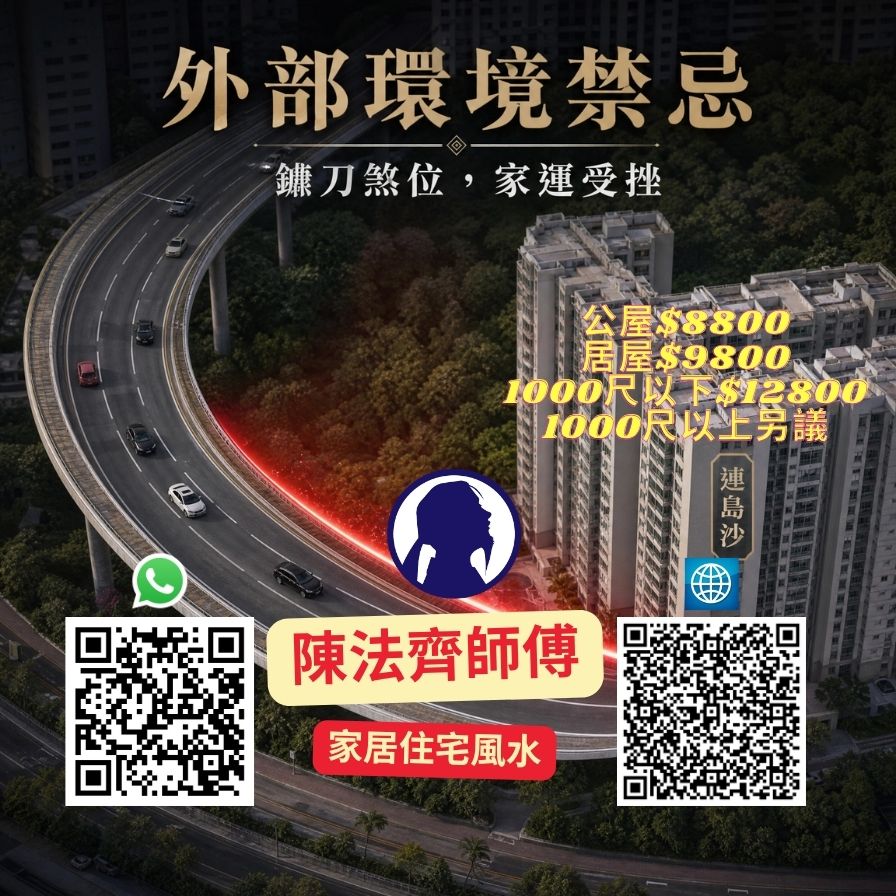
Case 55 · Sickle Sha (Residence at the Bend of an Elevated Road or Flyover)
Hong Kong Feng Shui Master Andrew Chan's home feng shui insights reveal that Sickle Sha is an urban upgrade of the Anti-Bow Sha, referring to the curved bend of an elevated road, flyover, or expressway directly facing a residence. Due to the high roadbed and fast vehicle speeds, the sha qi (negative energy) strikes like a horizontal sickle, with an intensity far greater than that of a regular road's Anti-Bow Sha. Because its form resembles a sickle cutting across the waist, it is also known as 'Waist-Cutting Sha'. Besides the impact of airflow, elevated roads also bring continuous noise, vibration, and exhaust pollution. Long-term residence in such locations can severely affect sleep quality and overall physical and mental health.
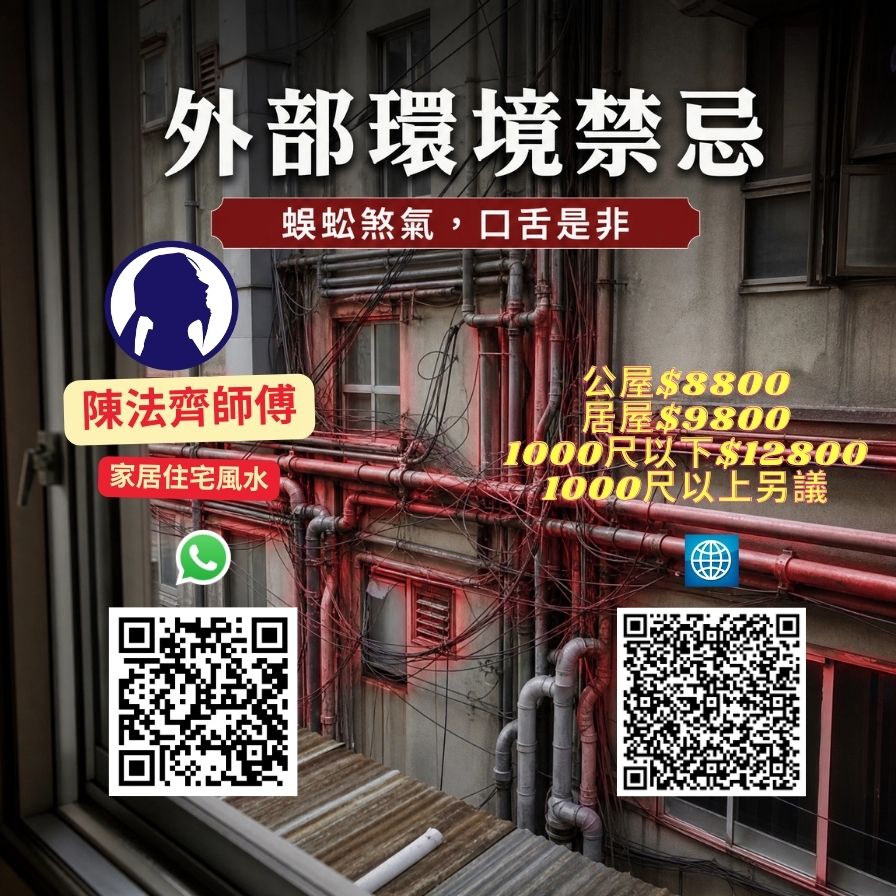
Case 56 · Centipede Sha (Dense External Wiring or Pipes)
Hong Kong Feng Shui Master Andrew Chan's home feng shui insights highlight that when dense, messy electrical wires, pipes, or barbed wire are visible outside a residence's windows or on its exterior walls, crisscrossing like the body of a centipede, this is known as "Centipede Sha." These cluttered lines create a chaotic qi field, disrupting the stable qi of the home. Furthermore, the visual clutter can negatively impact residents' emotions. Older communities and street-facing homes are more prone to this type of sha qi.
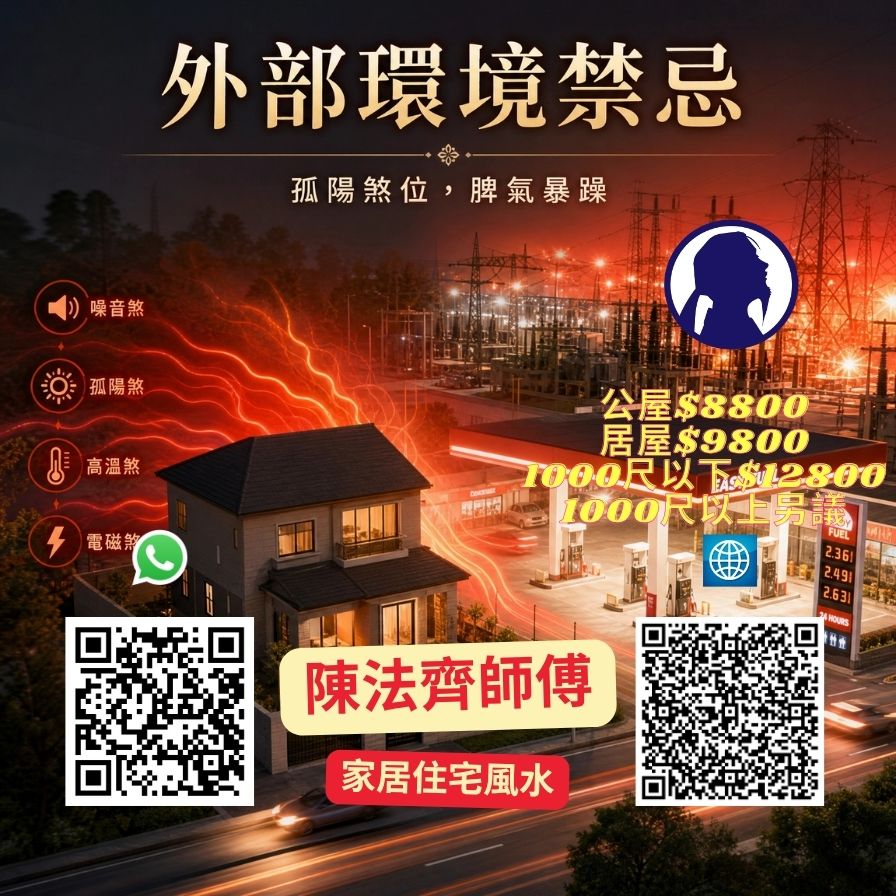
Case 57 · Lone Yang Sha (Residences Adjacent to High-Voltage Towers, Gas Stations, and Other Excessively Yang Locations)
Hong Kong Feng Shui Master Andrew Chan's home feng shui insights highlight that Lone Yang Sha refers to residences situated near high-voltage power towers, substations, gas stations, large power plants, boiler rooms, and other locations with excessive fire energy and yang qi. Feng shui emphasizes the balance of yin and yang; an excess of yang qi leads to 'lone yang, no life,' causing a hot, imbalanced energy field, akin to constantly being in a fiery environment.
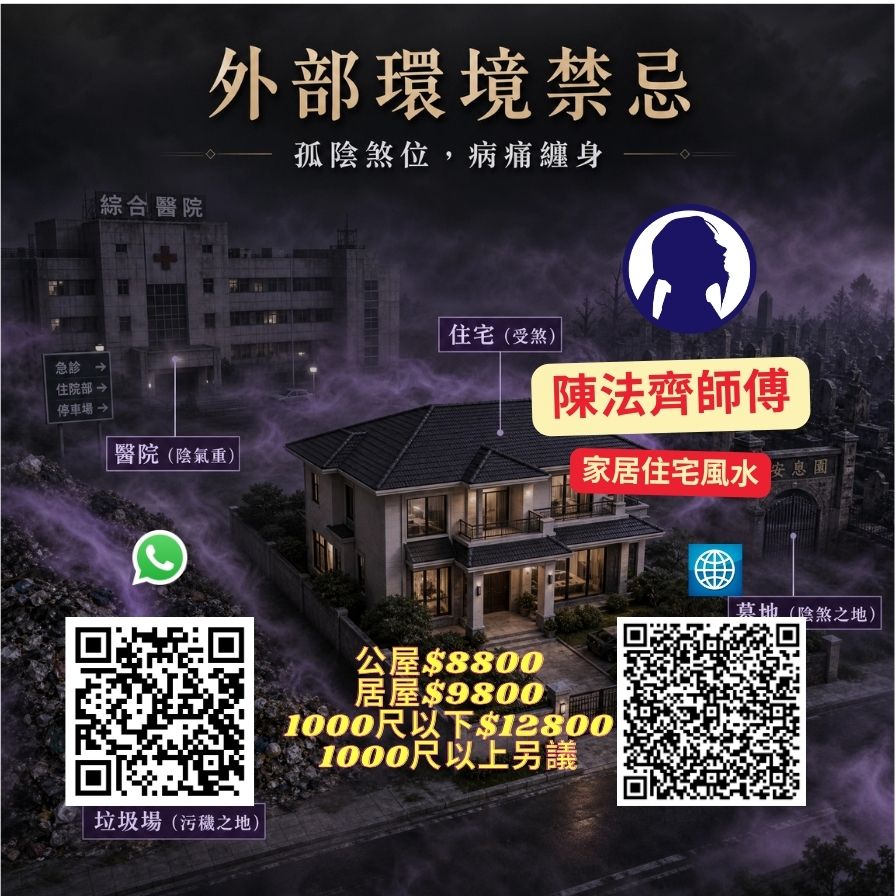
Case 58 · Lone Yin Sha (Residences Adjacent to Hospitals, Cemeteries, Landfills, and Other Places with Excessive Yin Qi)
Hong Kong Feng Shui Master Andrew Chan's home feng shui insights highlight that 'Lone Yin Sha' refers to residences located in close proximity to places with excessive yin qi and foul qi, such as hospitals, funeral homes, cemeteries, landfills, and slaughterhouses. 'Lone yin cannot thrive,' meaning an overabundance of yin qi can lead to insufficient yang qi in the home, resulting in a cold, murky energy field that negatively impacts the residents' health and fortune. From an environmental perspective, such locations are prone to bacteria, unpleasant odors, and negative emotional fields, which can subtly affect one's physical and mental state over time.
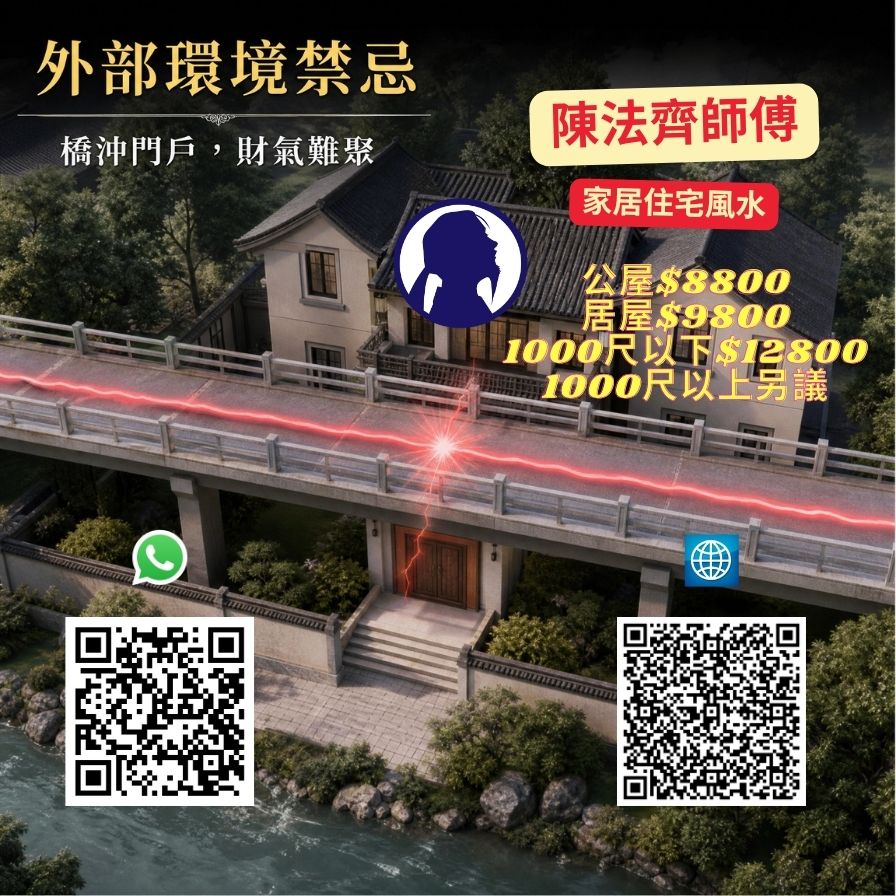
Case 59 · Bridge Rushing Door (Bridge Directly Facing Main Door or Window)
Hong Kong Feng Shui Master Andrew Chan points out that a bridge directly facing a residential main door or window forms a 'bridge rushing sha qi'. A bridge is an extension of a road, often elevated, causing strong qi flow to rush directly towards the residence. The qi field is intense; additionally, bridges connect two sides, gathering people and vehicle traffic, leading to chaotic qi. This direct rush into the home disrupts the stable living qi field. If the bridgehead directly faces the residence, the intensity of the sha qi is much higher than if the side of the bridge faces it, classifying it as a severe form of sha.
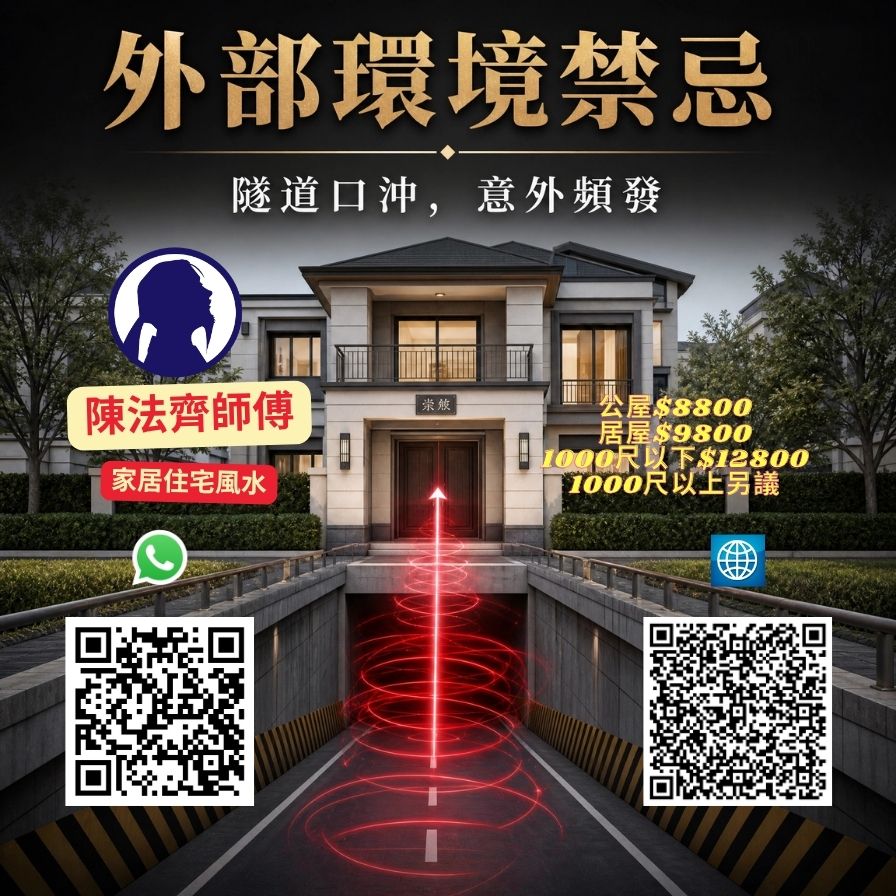
Case 60 · Tunnel Mouth Rush
Hong Kong Feng Shui Master Andrew Chan's home feng shui insights highlight that when a residential main door or window directly faces a tunnel entrance or an underground passage entrance, it forms a 'Tunnel Mouth Sha Qi'. The interior of tunnels is dark and damp, and air currents surge out from the tunnel mouth, creating a cold, chaotic, and strong qi field. This direct rush into a home brings in a large amount of yin and turbid qi, scattering the home's yang energy and vitality. From an environmental perspective, tunnel entrances are often congested with vehicles, leading to severe exhaust and noise pollution. Furthermore, entrances and exits are prone to traffic accidents, significantly negatively impacting the living experience.
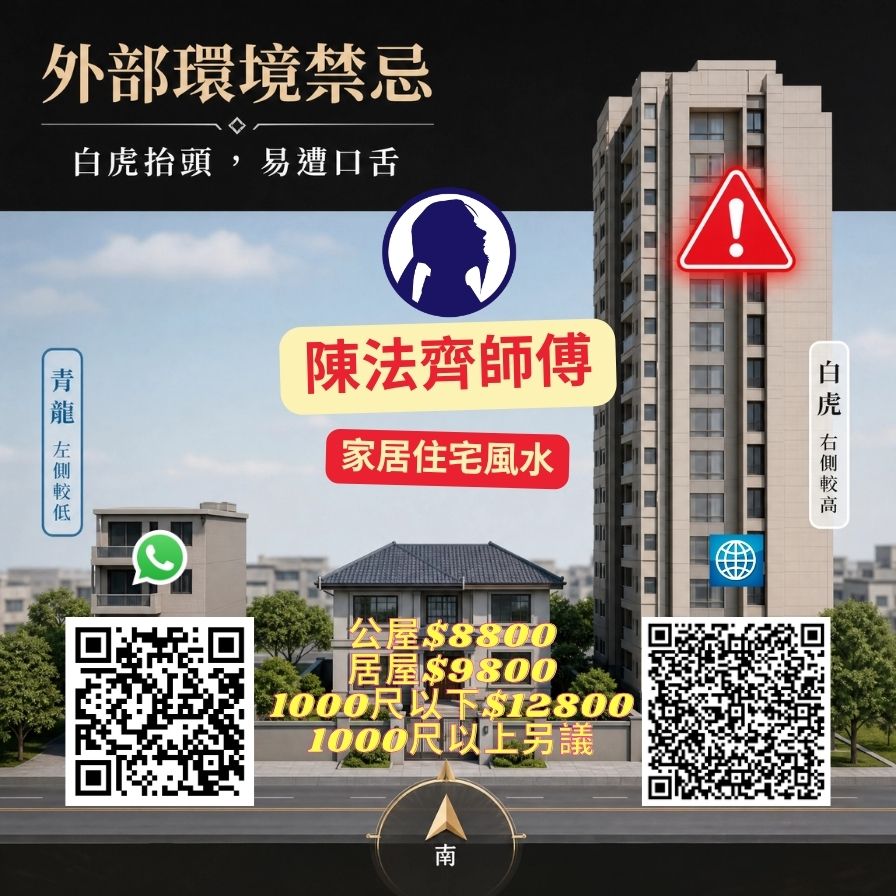
Case 61 · White Tiger Raised (Right Side of Residence Higher Than Left)
Hong Kong Feng Shui Master Andrew Chan's home feng shui insights explain that feng shui divides a property into 'Left Green Dragon, Right White Tiger.' Based on the residence's orientation, the left side is the Green Dragon position, representing benefactors, the male head of the household, and yang energy. It should ideally be high and active. The right side is the White Tiger position,
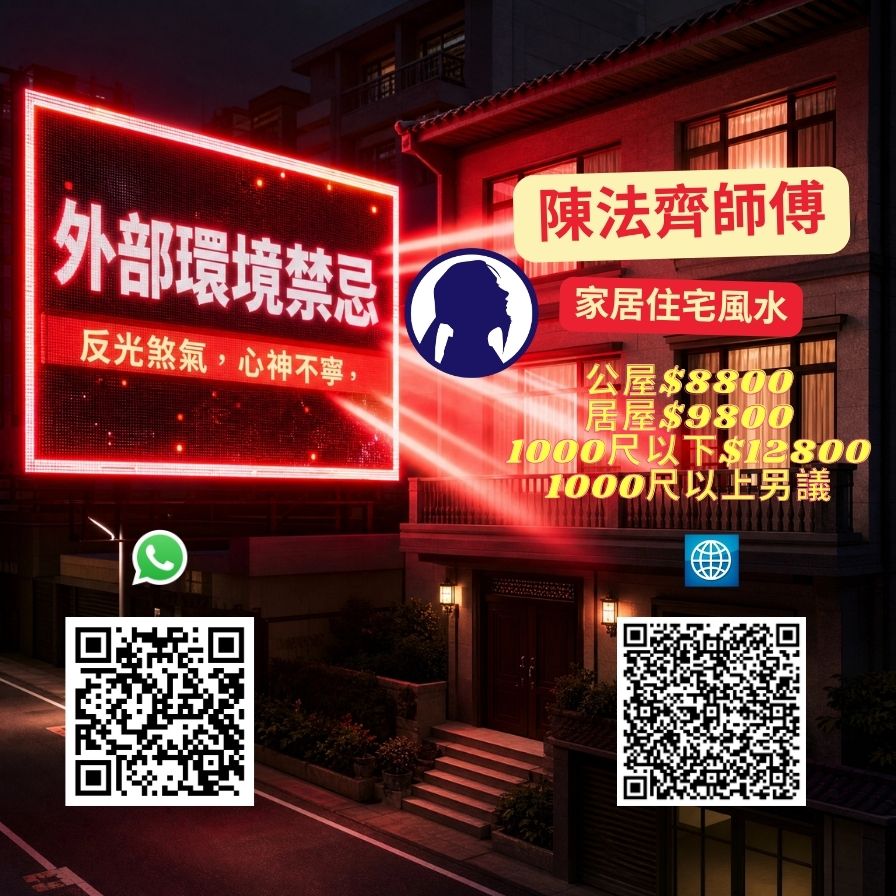
Case 62 · Reflection Sha (Residential Exposure to Direct Reflection from Opposite Building's Glass Curtain Wall)
Hong Kong Feng Shui Master Andrew Chan's home feng shui insights highlight that when a glass curtain wall, mirrored decoration, or smooth metal surface of an opposite building reflects sunlight directly into one's residence, creating intense glare, it is known as "Reflection Sha" or "Light Sha." This strong reflected light is a form of "light pollution" that can disrupt the indoor qi field and stimulate the visual and nervous systems. If the reflection directly hits core areas like the bedroom headboard or living room sofa, the impact will be even more severe.
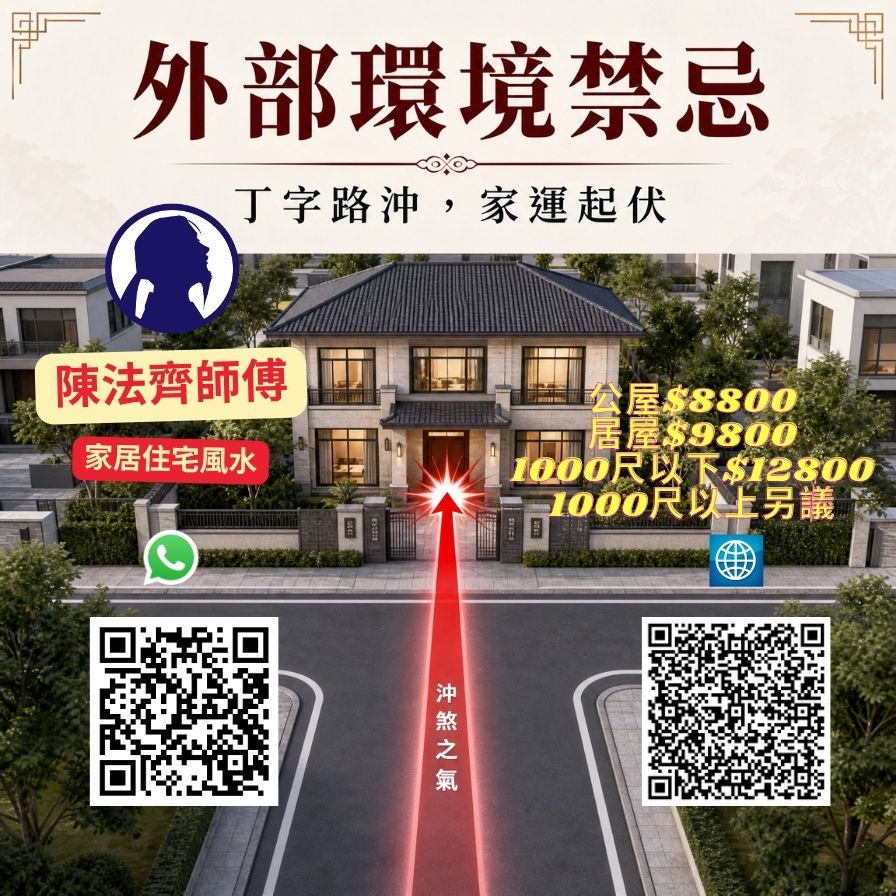
Case 63 · T-Junction Sha (Residence at the End of a T-Junction)
Hong Kong Feng Shui Master Andrew Chan's home feng shui insights reveal that a T-junction sha is an intensified version of a road冲 (road冲), where a residence is located directly at the end of a 'T'-shaped intersection. The qi from three directions converges and rushes straight towards the house, making the sha qi significantly stronger than a typical road冲, classifying it as a severe form of sha. In traditional feng shui, a residence at the end of a T-junction is also known as a 'road冲 house' and is considered one of the typical inauspicious patterns for a yang dwelling. In modern cities, T-junctions experience heavy traffic and a higher probability of accidents, along with more severe noise and exhaust pollution, which significantly impacts living experience and health...
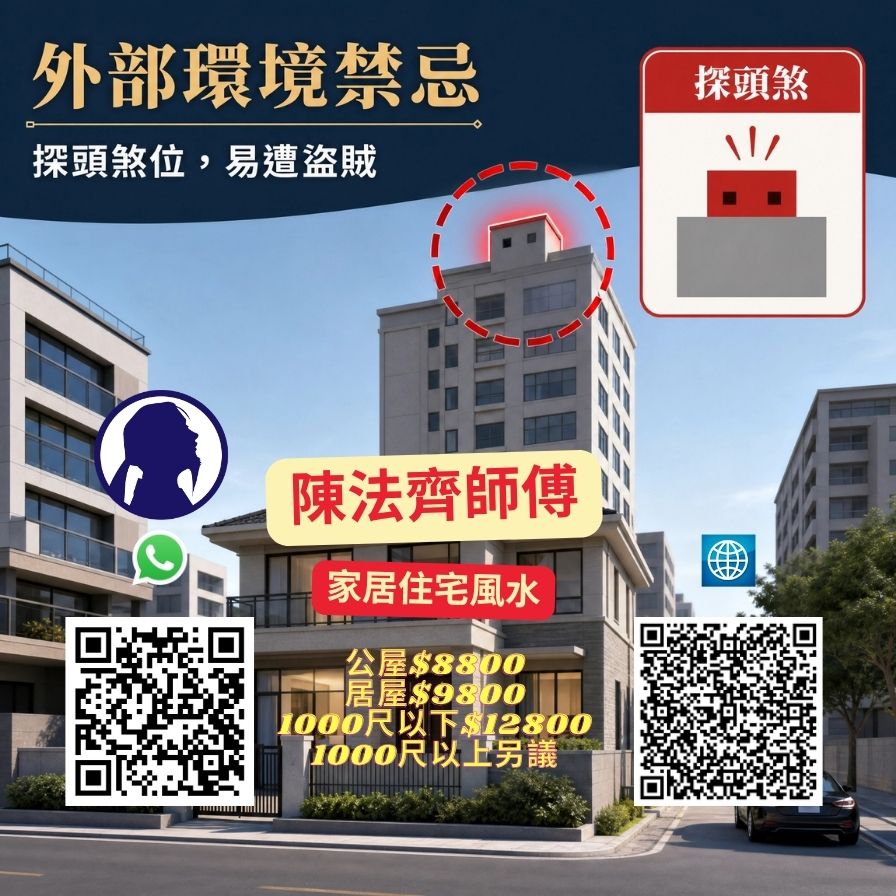
Case 64 · Peeping Head Sha (Building Peeking from Behind the Residence)
Hong Kong Feng Shui Master Andrew Chan's home feng shui insights highlight that 'Peeping Head Sha' refers to a situation where part of a building's structure behind a residence protrudes from its roof or side, resembling someone hiding and peeking. It is also known as 'Ghost Peeping Head Sha'. This often occurs in residential complexes where rear buildings are taller than front ones and have protruding structures. In feng shui, a peeking head from behind signifies being spied upon by petty individuals, risk of theft and financial loss, easy leakage of household privacy, and an abundance of backstabbing and gossip.
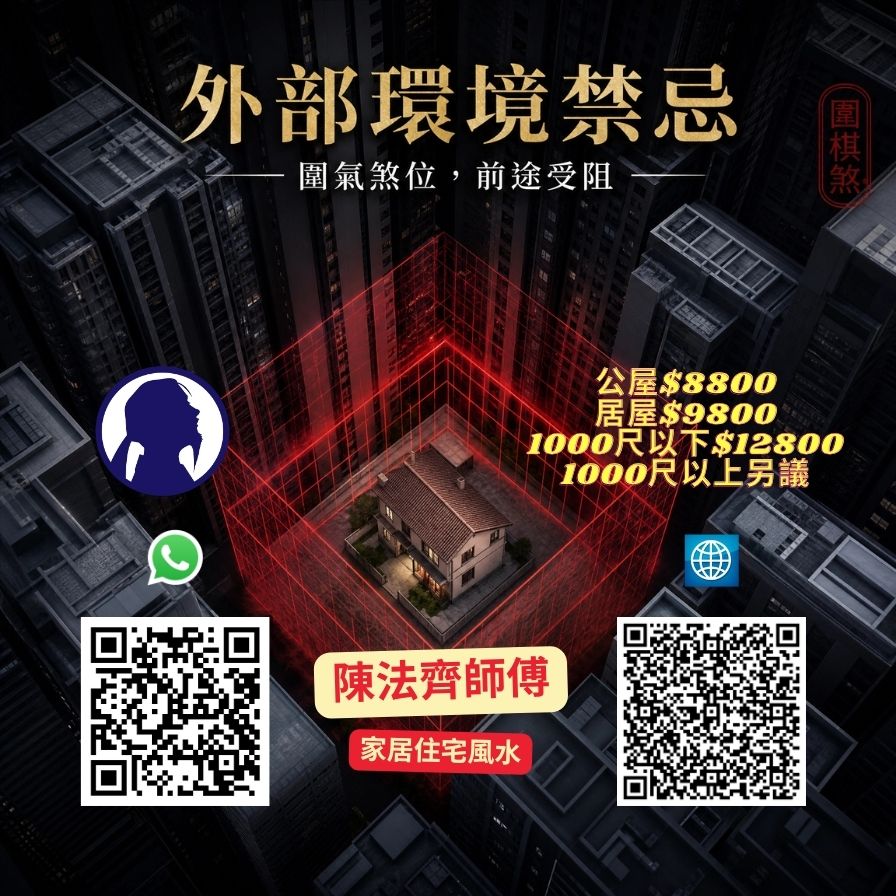
Case 65 · Surrounding Qi Sha (Residential Building Encircled by High-Rises)
Hong Kong Feng Shui Master Andrew Chan's home feng shui insights highlight that 'Surrounding Qi Sha', also known as 'Basin Sha', refers to a residence completely encircled by high-rise buildings much taller than itself. The dwelling is entirely enclosed, with natural light and ventilation obstructed, akin to being trapped at the bottom of a well. Feng shui emphasizes an 'open bright hall' (明堂开阔). When the front and surroundings are blocked, it leads to stagnant qi, insufficient vital energy, and difficulty for family fortunes to flourish. In modern cities, many older, lower-rise residential areas surrounded by newly built high-rises often form this pattern.
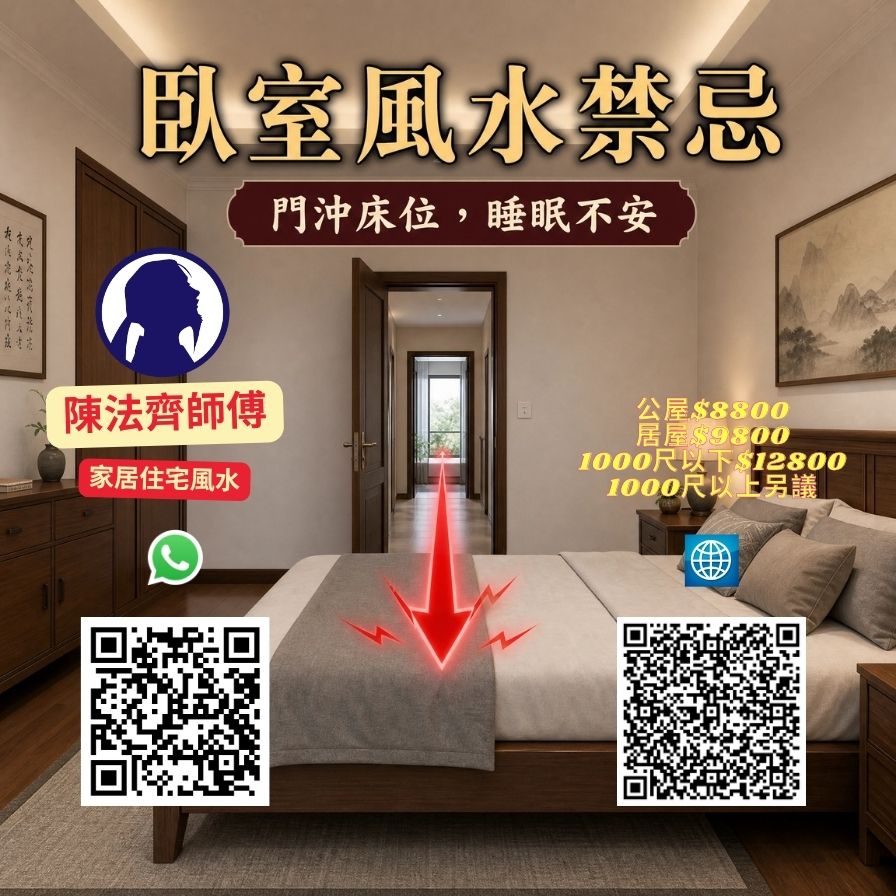
Case 66 · Bedroom Door Facing Bed
Hong Kong Feng Shui Master Andrew Chan's home feng shui insights highlight that a bedroom door directly facing the bed creates a "door-facing-bed" (门冲床) formation. The bedroom door acts as an opening for qi, and during sleep, the human body's own qi field is at its weakest, with defenses at their lowest. This alignment causes a direct rush of airflow towards the bed, continuously disturbing the sleeper's qi field and preventing mental tranquility. From a living experience perspective, when the door is open, the bed is fully exposed, severely compromising the bedroom's sense of privacy and security.
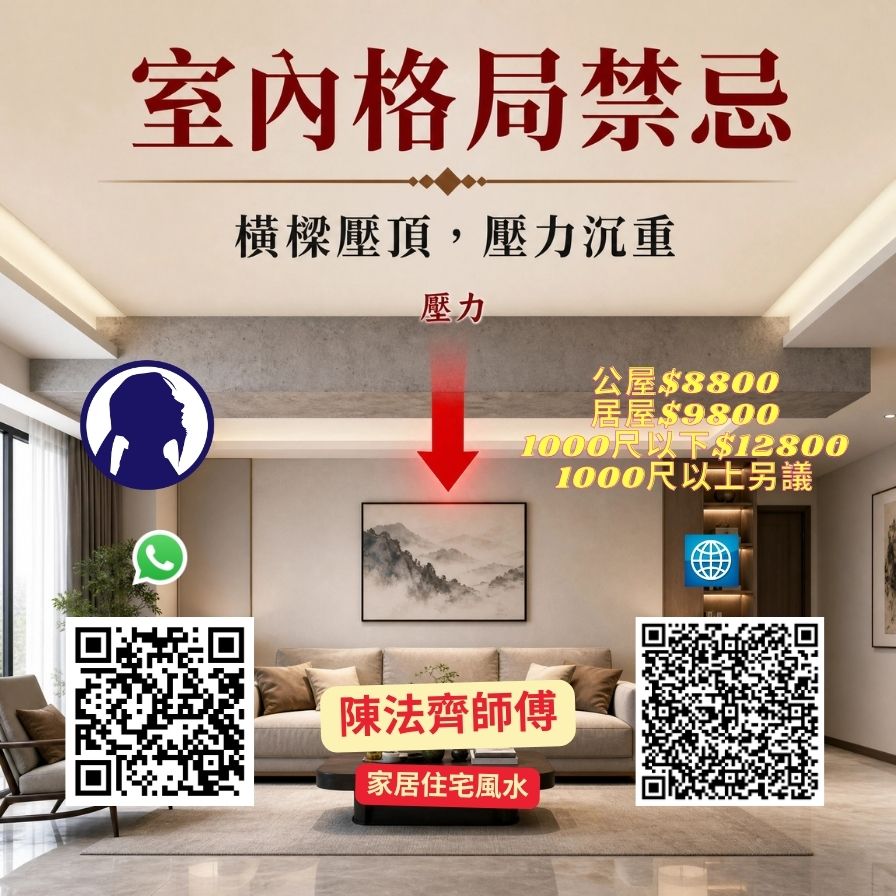
Case 67 · Overhead Beam Pressure (Seating or Bed Under Beam in Living Room or Bedroom)
Hong Kong Feng Shui Master Andrew Chan's home feng shui insights highlight that an overhead beam above a living room sofa, dining table, or bedroom bed creates a 'beam pressure' (横梁压顶) formation, one of the most classic sha qi configurations in residential feng shui. In terms of qi, an overhead beam represents a downward oppressive force. Long-term sitting or sleeping directly under a beam leads to continuous exposure to this oppressive qi, which in turn suppresses one's fortune and health. As load-bearing beams in modern apartments cannot be removed, this is one of the most common indoor feng shui problems.
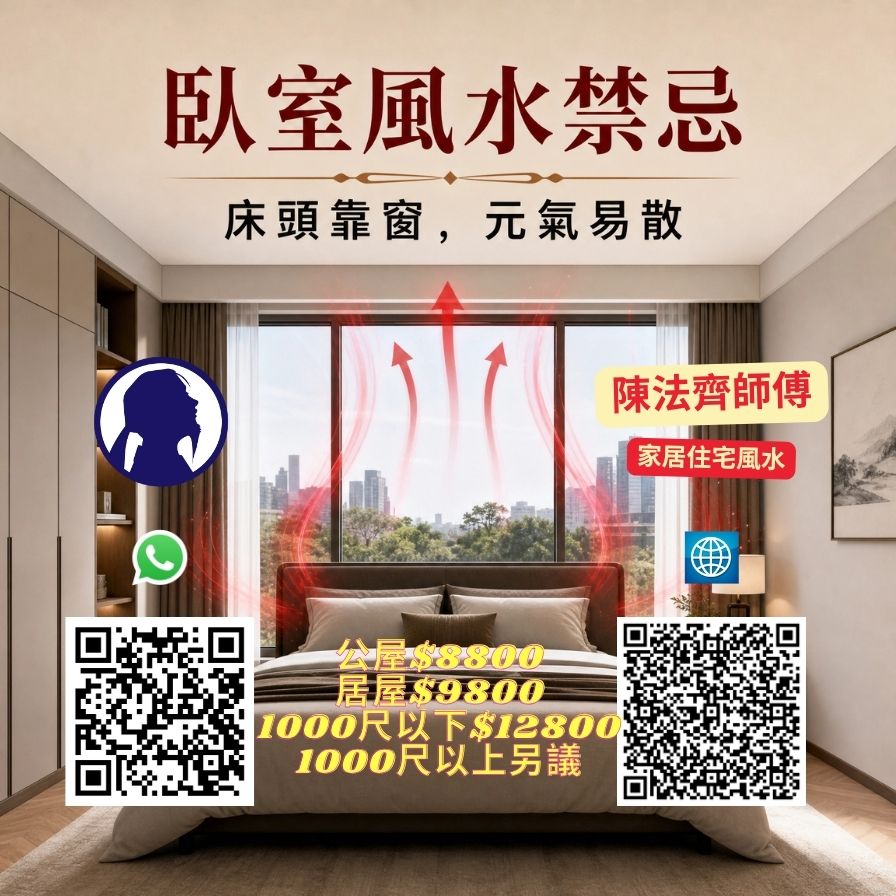
Case 68 · Bedhead Against Window (Bedroom Bedhead Adjacent to Window)
Hong Kong Feng Shui Master Andrew Chan's home feng shui insights highlight that a bedhead placed directly against a window in the bedroom creates a "bedhead against window" configuration. Windows are the 'qi' entry points of a residence, allowing air currents, light, and sound to pass through. A bedhead against a window means the sleeper's head lacks solid support, directly facing external 'qi' flows and disturbances, thus failing to establish a stable 'backer' energy field. From a scientific perspective, areas near windows experience greater temperature fluctuations and more noise, and glass cannot provide the same sense of support as a solid wall, significantly reducing deep sleep quality.
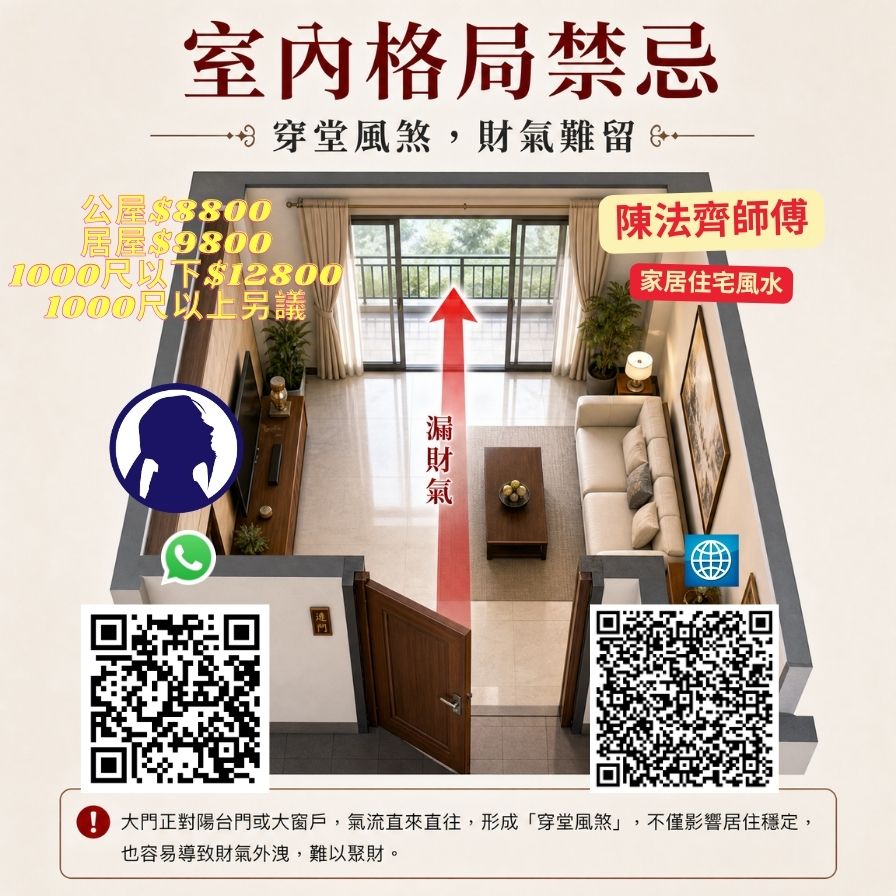
Case 69 · Through-Draft Sha Qi (Main Door Directly Facing Balcony or Back Door)
Hong Kong Feng Shui Master Andrew Chan points out that when the main door of a residence is in a straight line with the balcony door or back door, air flows straight in and out, unable to circulate and linger indoors, forming a 'through-draft sha qi', often called 'through-draft'. Traditional feng shui believes that 'where qi gathers, wealth gathers; where qi disperses, wealth disperses'. This straight-through layout causes wealth qi and vital qi to flow out directly, preventing accumulation in the home. From a modern living perspective, excessive convection can lead to significant fluctuations in indoor temperature and humidity, reducing human comfort, and over time, may affect respiratory health.
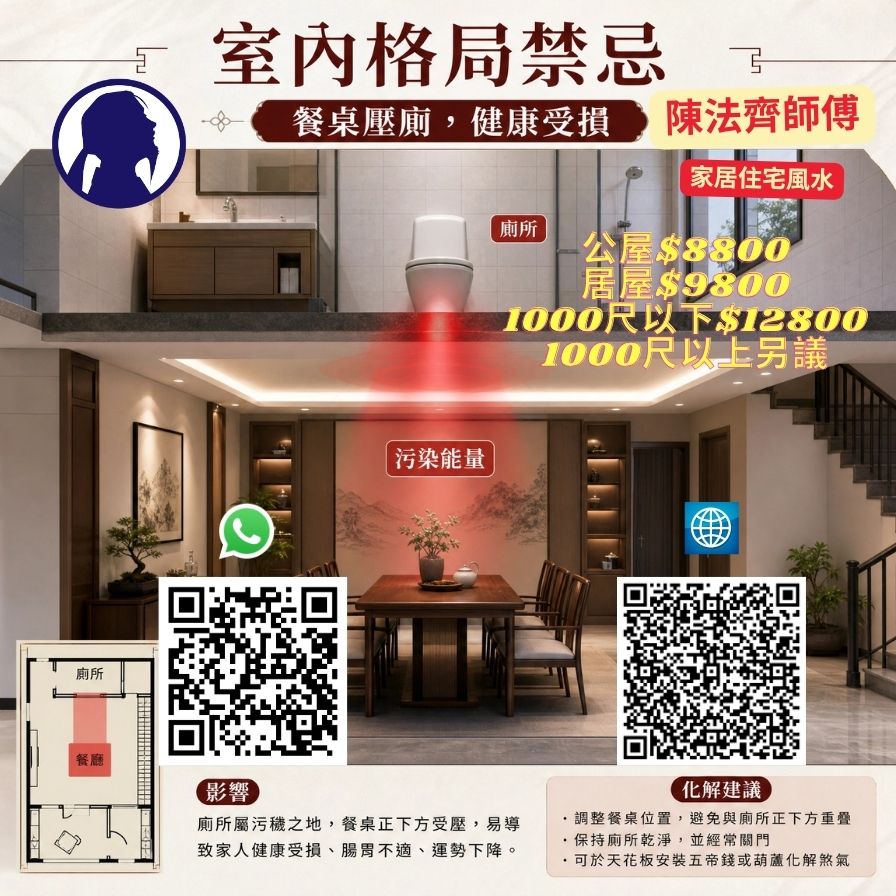
Case 70 · Dining Table Under Toilet (Dining Table Below Upstairs Toilet)
Hong Kong Feng Shui Master Andrew Chan's home feng shui insights highlight that this layout, where a dining table is directly beneath an upstairs toilet, constitutes a 'sha qi' (negative energy) oppression from vertical space. Traditional feng shui posits that 'food and fortune should be clean, not defiled.' The dining table is where families gather to eat and accumulate qi, representing a household's sustenance and good fortune. Conversely, a toilet is a place where 'sha qi' and dampness converge, creating a turbid, downward-sinking energy field. This 'sha qi' pressing down on the dining table from above forms an inauspicious 'upper filth, lower food' configuration, which directly pollutes...
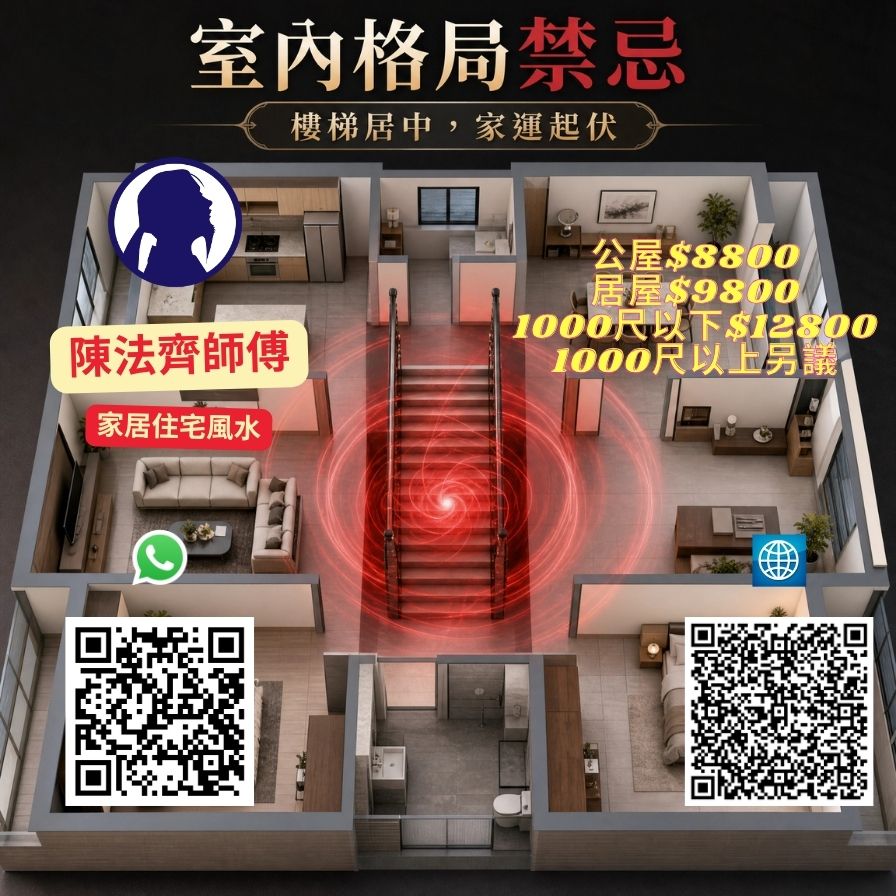
Case 71 · Staircase in the Center of the Home
Hong Kong Feng Shui Master Andrew Chan's home feng shui insights highlight that the geometric center of a residence is known in feng shui as the “Central Palace” or “Tai Chi Position.” Much like the human heart, it is the core hub of the entire house's qi field. As stated in 'The Yellow Emperor's Classic of Dwellings,' 'The Central Palace is the heart of the dwelling; when still, qi gathers; when disturbed, qi disperses.' The Central Palace should ideally be quiet, empty, and clean, and is most sensitive to frequent disturbances. If a staircase is located precisely in the center of a residence, the daily movement of people ascending and descending will continuously agitate the core qi field, creating a 'dynamic qi piercing the heart' formation, also known as 'piercing heart sha.' The vertical airflow of the staircase directly cuts through the qi-gathering structure of the Central Palace, causing the entire house's qi field to scatter and fail to coalesce. This has historically been considered a major taboo in residential feng shui, with an ancient saying: 'Staircase in the center, family wealth scatters.' From a modern living perspective, a central staircase can fragment spatial flow, leading to cramped and dim functional areas, and noise permeating the entire house, severely impacting living comfort.
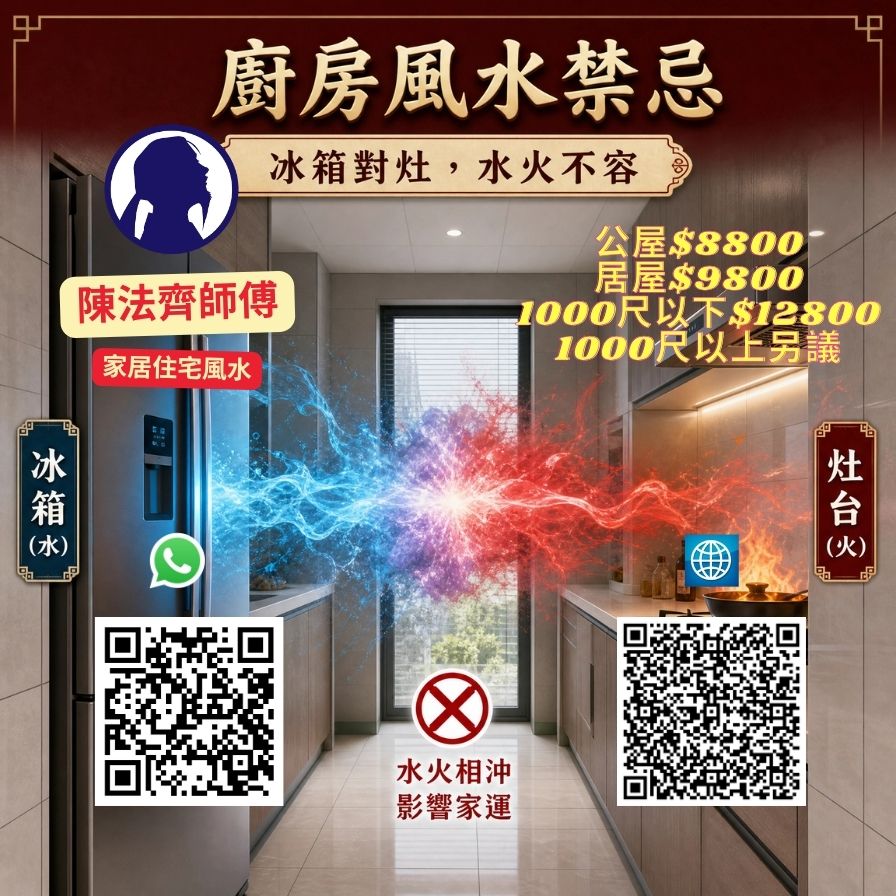
Case 72 · Refrigerator Facing Stove (Fridge Opposite Stove)
Hong Kong Feng Shui Master Andrew Chan's home feng shui insights highlight that this layout is a typical sub-scenario of water-fire clash in the kitchen: the stove, belonging to the 'bright fire' element, signifies heat and rising energy; the refrigerator, belonging to the 'cold water' element, signifies coldness and sinking energy. When placed directly opposite each other, they create a 'water-fire battle' formation, where conflicting hot and cold qi fields are incompatible, disrupting the kitchen's balanced qi and subsequently affecting family relationships, health, and wealth. Traditional feng shui emphasizes 'water-fire harmony' (水火既济), meaning a balance and orderly interaction between water and fire, rather than direct opposition. If the refrigerator and stove are too close or directly facing each other, this clashing effect is exacerbated.
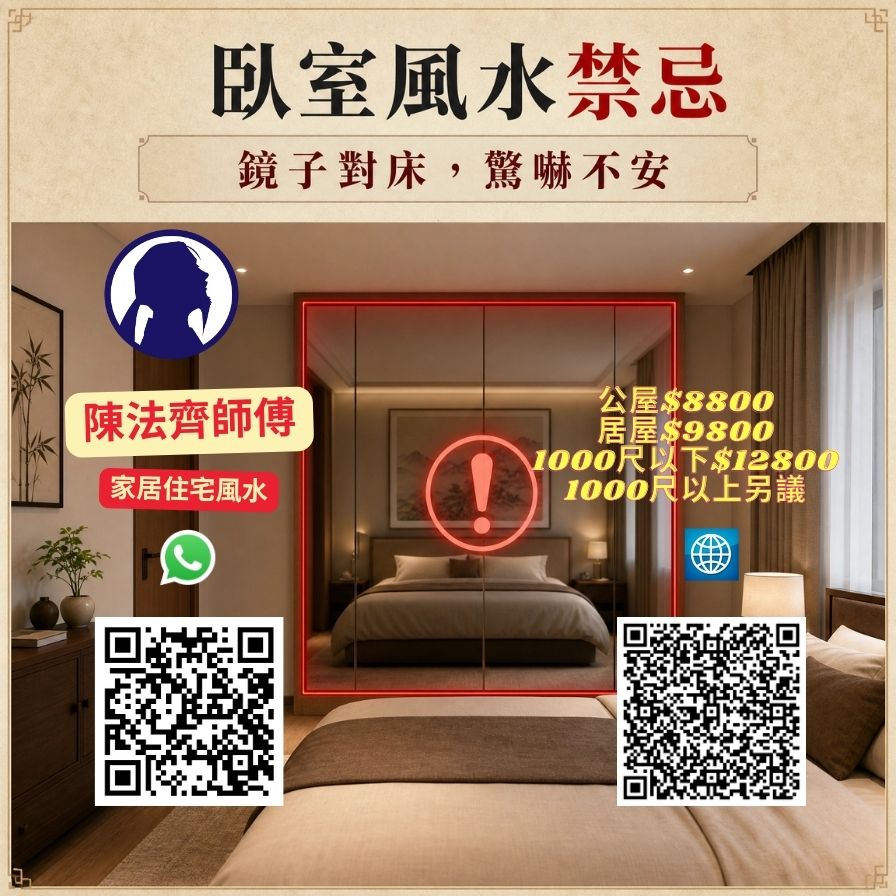
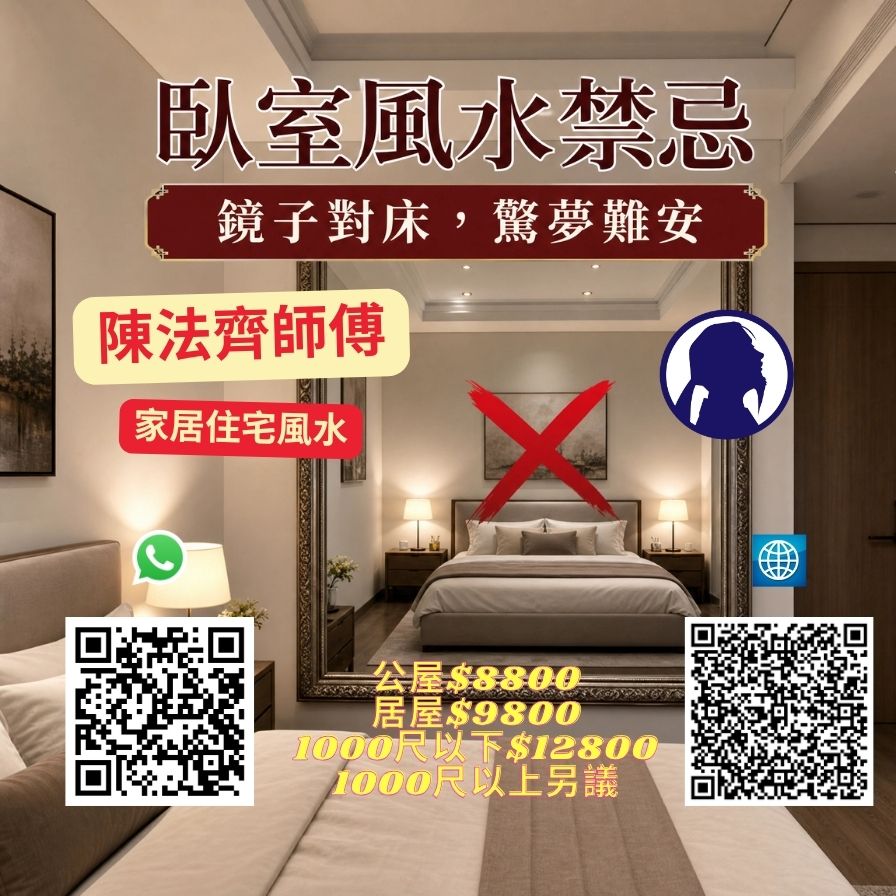
Case 73 · Mirror Facing Bed (Bedroom Mirror Directly Facing Bed)
Hong Kong Feng Shui Master Andrew Chan's home feng shui insights highlight that traditional feng shui considers mirrors to be yin, possessing the ability to reflect and refract qi. There's a common saying, 'A mirror facing the bed unsettles the spirit.' During sleep, a person's qi field is at its weakest, and defenses are lowest. If a mirror directly faces the bed, it continuously reflects the sleeper's energy, preventing the qi field from stabilizing and making it difficult for the mind to calm, thus forming an unfavorable 'mirror facing bed' configuration. From a modern psychological perspective, when waking up at night, the reflection and image in a mirror in a dim environment can easily cause visual fright, triggering subconscious tension and anxiety, which over time can disrupt deep sleep and affect one's mental state.
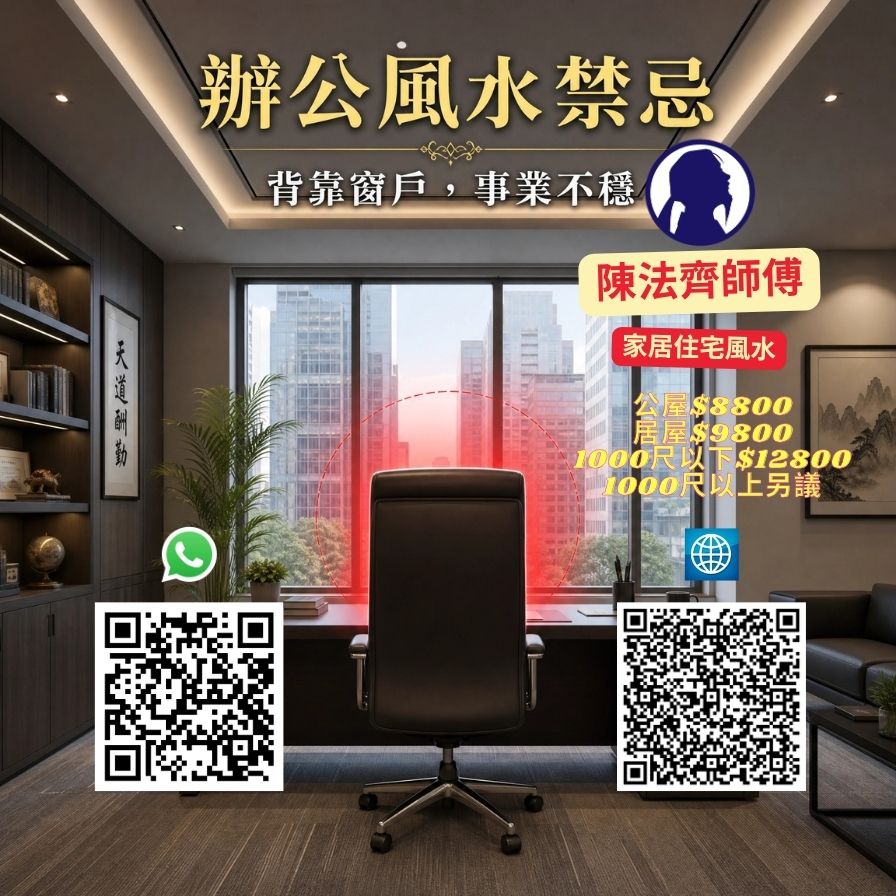
Case 74 · Office Desk Backing a Window (No Solid Wall Behind Desk)
Hong Kong Feng Shui Master Andrew Chan's home feng shui insights highlight that office feng shui adheres to the core principle of 'sitting solid, facing open.' This means having a solid wall behind your seat, symbolizing a stable foundation, support from benefactors, and a strong career base. If an office desk is placed with its back to a window, the 'empty' space behind acts as an opening, causing qi to disperse without support. This creates a 'no backing' situation, a classic taboo in workplace feng shui. From a psychological perspective, a window behind one's back can subconsciously make individuals worry about movement behind them, hindering full work concentration...
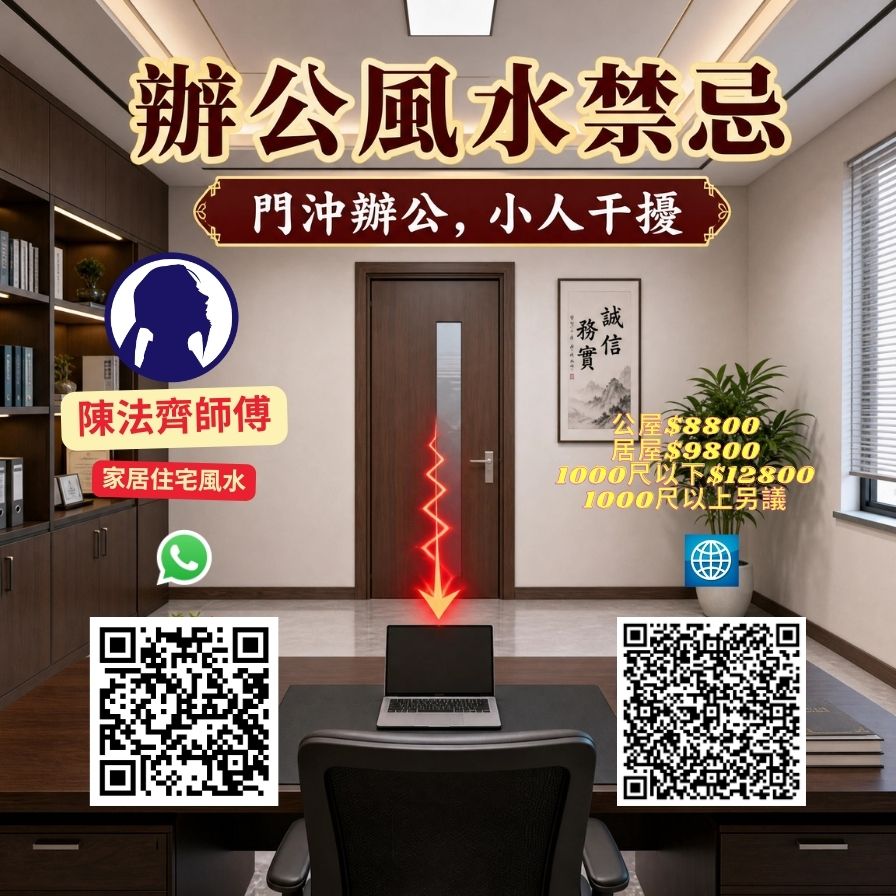
Case 75 · Office Desk Facing Door (Office Desk Facing Office Door)
Hong Kong Feng Shui Master Andrew Chan's home feng shui insights highlight that the office door is a crucial channel for the flow of people and qi, leading to frequent changes in the energy field and classifying it as a "dynamic position." If an office desk directly faces the office door, the occupant will directly confront all incoming and outgoing qi and foot traffic, forming a "door clash sha qi." This continuously disturbs one's personal energy field, making it difficult to settle down and concentrate. From a work experience perspective, facing the door frequently leads to distractions from outside movements, easy dispersion of attention, and all work activities being exposed to passersby, causing significant psychological pressure and a sense of tension.
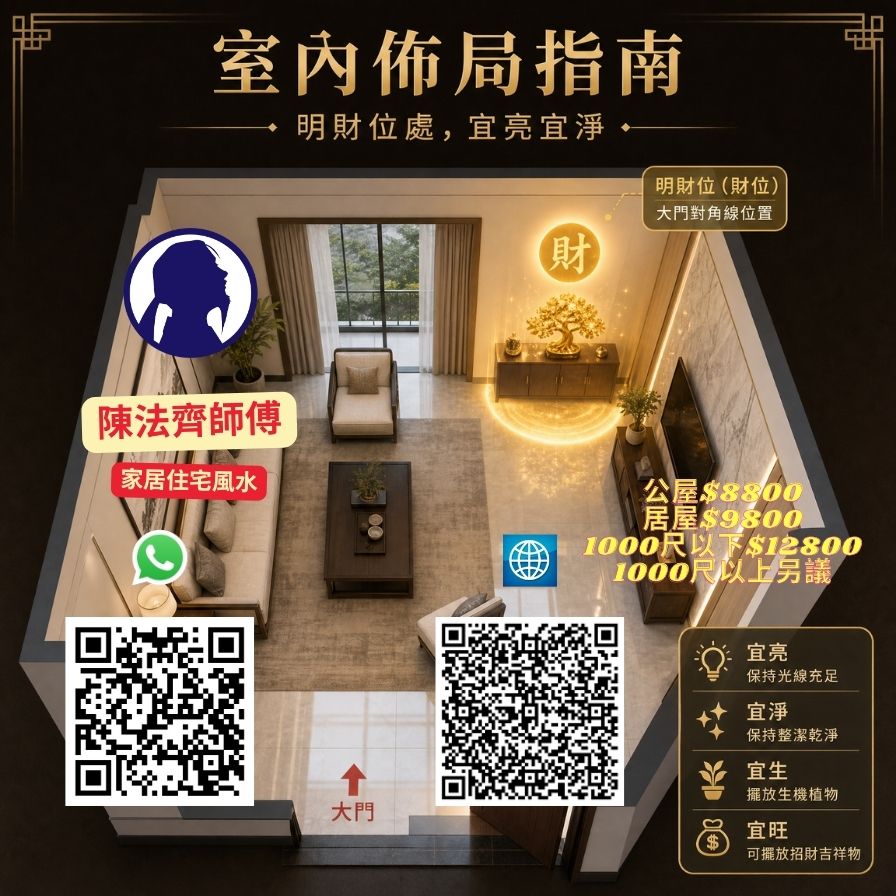
Case 76 · Bright Wealth Corner (Living Room Wealth Spot Should Be Bright and Clean)
Hong Kong Feng Shui Master Andrew Chan points out that the 'Bright Wealth Corner' (明财位) is the most fundamental and universal qi-gathering spot in residential feng shui. Its core positioning logic is the 'diagonal corner from the entrance.' This means, standing at the main entrance facing inwards, the furthest diagonal corner from the door is the living room's Bright Wealth Corner. This location is a quiet spot where qi circulates and gathers after entering the room. It corresponds to the household's treasury and governs the family's primary income and career wealth. Traditional feng shui holds that the wealth corner should be 'bright, clean, stable, and have a solid backing.' Maintaining a stable and abundant qi field here can effectively accumulate wealth qi and enhance the family's overall financial fortune. If the main door opens centrally, both diagonal corners can be considered Bright Wealth Corners; prioritize the one backed by a solid wall, quiet, and without a passageway.
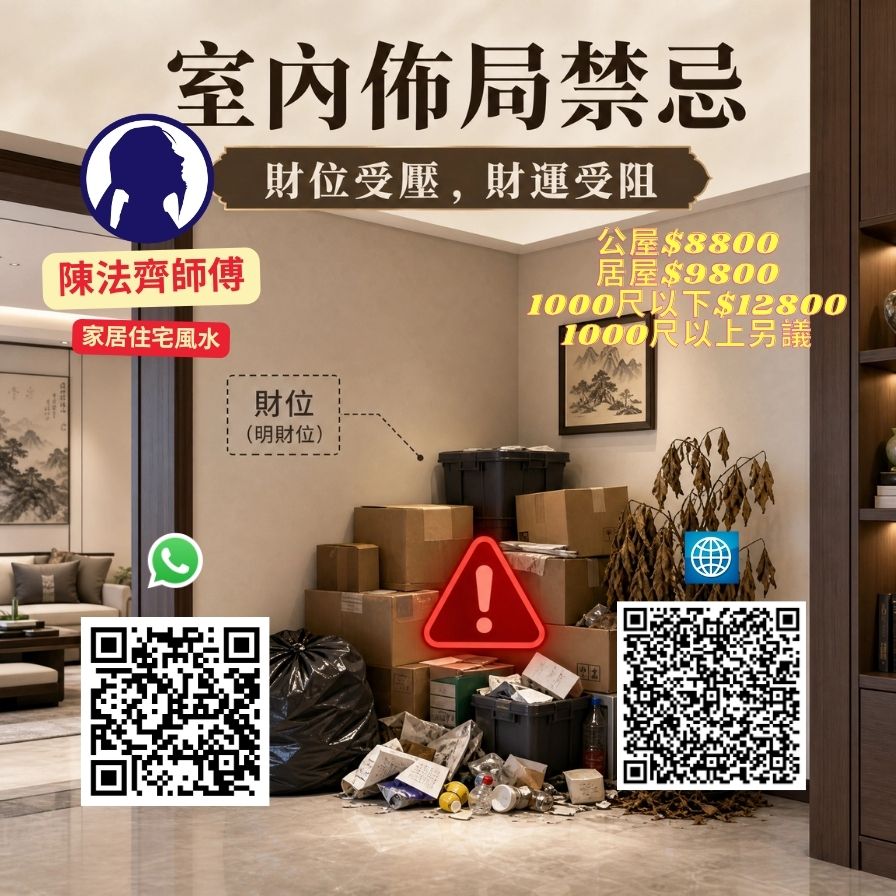
Case 77 · Wealth Corner Under Pressure (Heavy Objects or Clutter Piled on Wealth Position)
Hong Kong Feng Shui Master Andrew Chan's home feng shui insights reveal that the 'ming cai wei' (bright wealth position) is a static area where wealth qi gathers, with the core requirements being "stable and unpressured, quiet and undisturbed." If heavy objects, idle clutter, or taboo items like fish tanks, air conditioners, or sharp objects are placed in the wealth position, it will suppress or scatter the accumulated wealth qi, forming a 'wealth corner under pressure' or 'damaged wealth corner' pattern, directly harming the household's financial luck. Specifically, pressure from heavy objects prevents wealth qi from rising, scattered airflow causes wealth qi to dissipate, and dirty items deplete wealth qi, all of which are major taboos in wealth position layout.
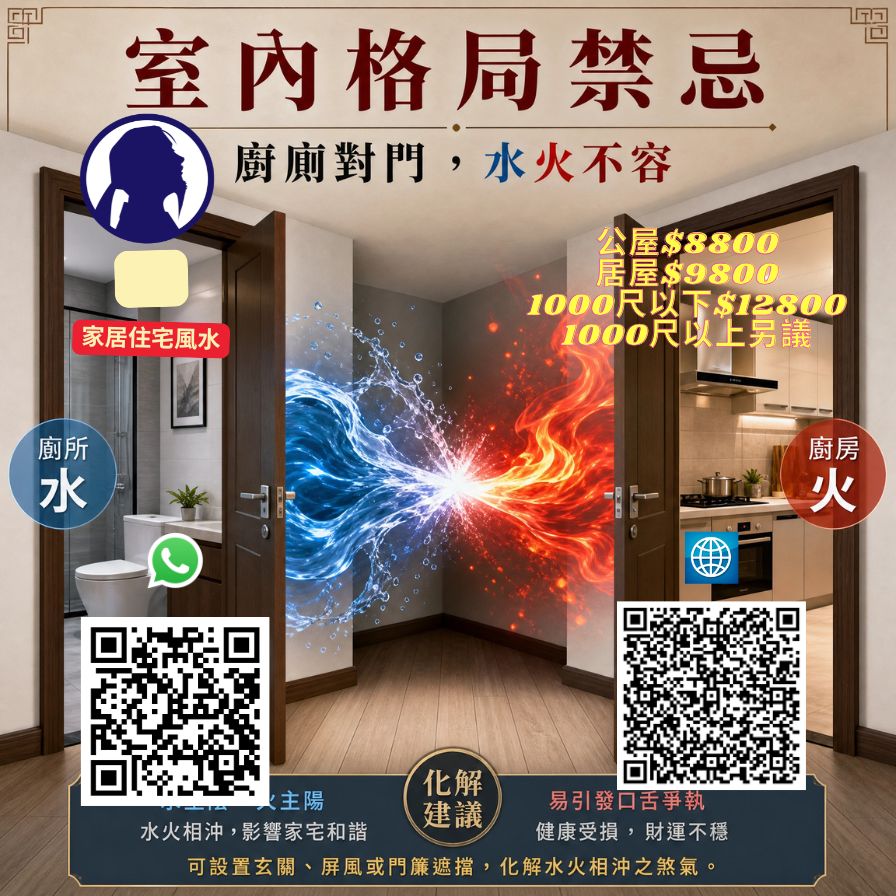
Case 78 · Kitchen and Toilet Doors Facing Each Other
Hong Kong Feng Shui Master Andrew Chan's home feng shui insights highlight that the kitchen governs sustenance and wealth, embodying clean fire qi. The toilet, conversely, manages excretion and impurities, representing damp water qi. When these two doors directly face each other, the toilet's sha qi (foul energy) directly rushes into the kitchen with the airflow, contaminating both the dining and wealth qi fields. This creates an unfavorable 'kitchen-toilet facing, wealth and health diminished' pattern, a classic taboo in home feng shui. This configuration simultaneously carries the double negative impacts of 'water-fire clash' and 'clean-dirty clash.' The impure qi, mixed with water qi, directly assaults the fire source, not only jeopardizing dietary health but also disrupting the household's financial balance.
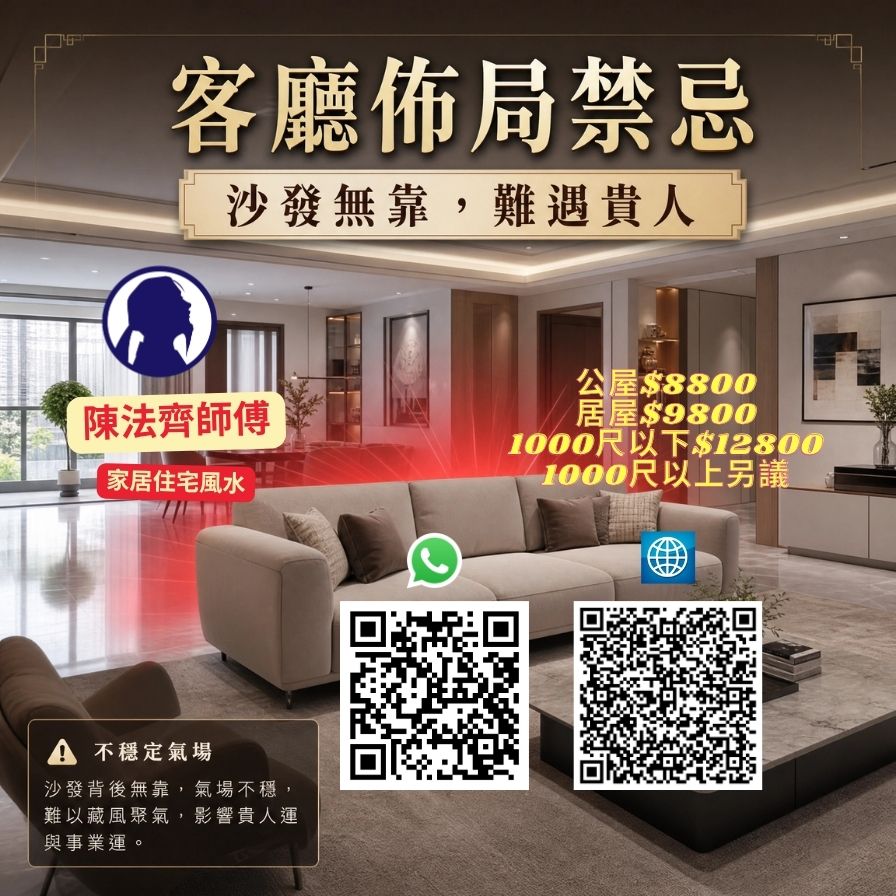
Case 79 · Sofa Without Solid Backing (No Solid Wall Behind Living Room Sofa)
Hong Kong Feng Shui Master Andrew Chan emphasizes that feng shui values “solid backing for stability.” The sofa is the core seating area in the living room, corresponding to the homeowner's career, benefactors, and family foundation. If the sofa lacks a solid wall behind it,
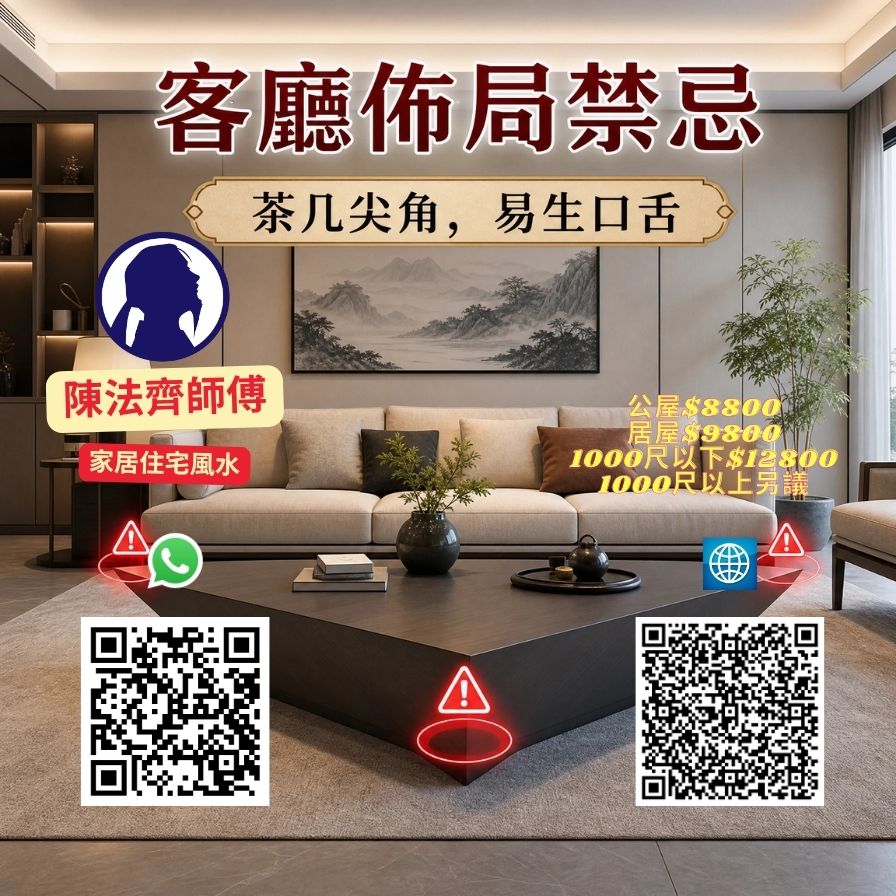
Case 80 · Tea Table Sharp Corners (Sharp Edges on Living Room Coffee Table)
Hong Kong Feng Shui Master Andrew Chan's home feng shui insights highlight that if a living room coffee table has sharp corners directly facing a sofa or seating area, it forms a "sharp corner sha" (尖角煞), a type of indoor 'form sha'. Traditional feng shui believes that sharp edges carry a cutting and attacking qi, like invisible blades, continuously emitting sha qi towards where people are seated, disturbing the local energy field. From a practical home safety perspective, sharp corners can easily cause bumps and scratches, significantly increasing the risk of accidental injury, especially for those with limited mobility such as the elderly and children.
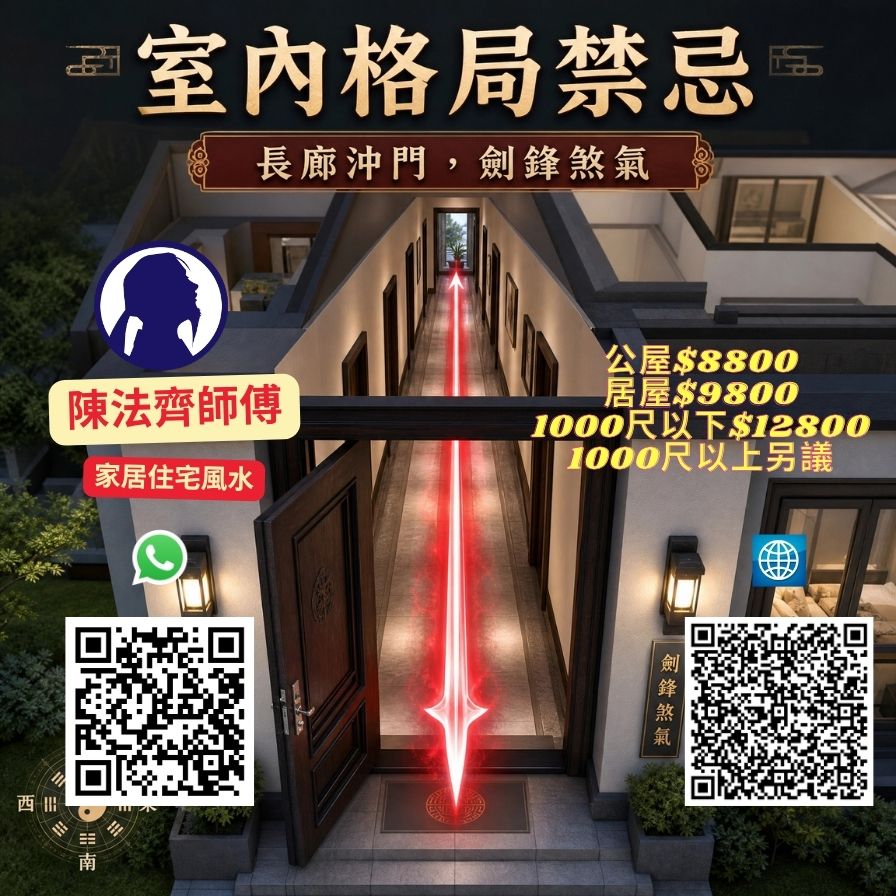
Case 81 · Long Corridor Facing Door (Main Entrance Directly Facing a Long, Straight Corridor)
Hong Kong Feng Shui Master Andrew Chan's home feng shui insights reveal that this layout is an indoor version of 'road-facing sha' (路冲), also known as 'long spear sha' (长枪煞). When the main entrance directly faces a long and straight corridor, the qi flow accelerates along the corridor, rushing straight towards the door like a spear. This creates a strong, aggressive, and rapid qi field, which directly disperses auspicious qi entering the home, forming a powerful sha qi. The longer, narrower, and straighter the corridor, the higher the intensity of the sha qi. If there are windows at the end of the corridor, creating a 'through-draft' effect, the sha qi will be further exacerbated.
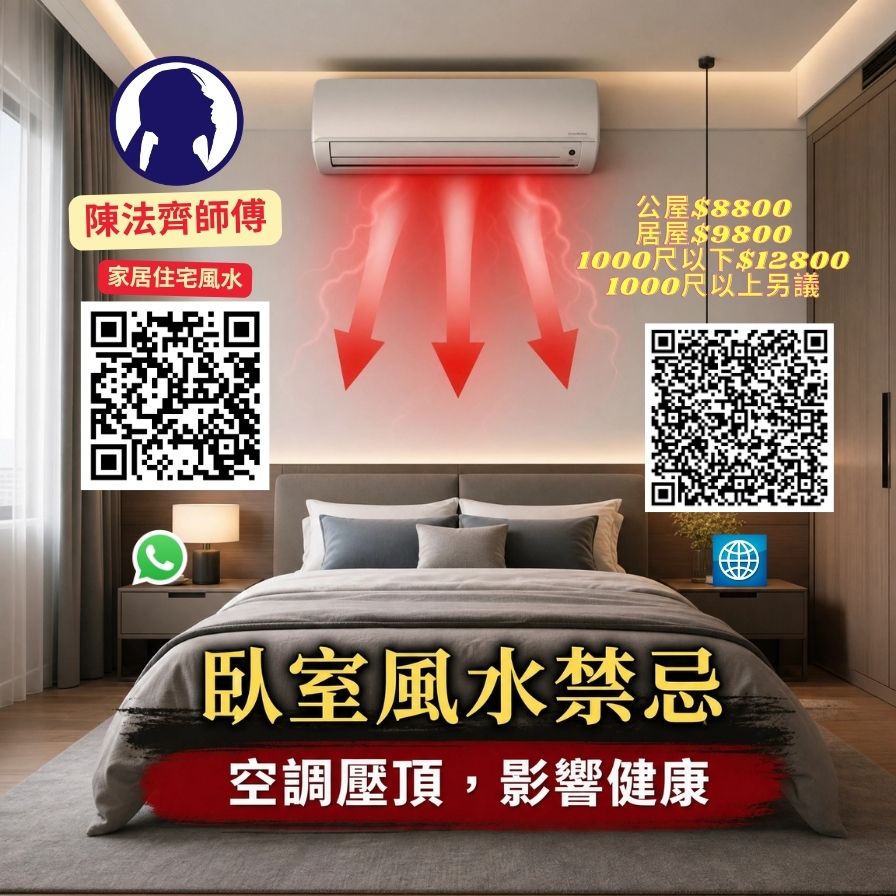
Case 82 · Air Conditioner Directly Above (AC Installed Directly Above Bed or Seat)
Hong Kong Feng Shui Master Andrew Chan's home feng shui insights highlight that installing an air conditioner directly above a bed in a bedroom, or above a sofa or seat in a living room or office, creates a modern 'air conditioner pressing down' sha qi. On one hand, the continuous cold air blowing directly on the head and shoulders can directly harm health. On the other hand, the airflow and vibration from the air conditioner operating from top to bottom create a downward-pressing qi field effect, similar to the negative impact of a beam pressing down.
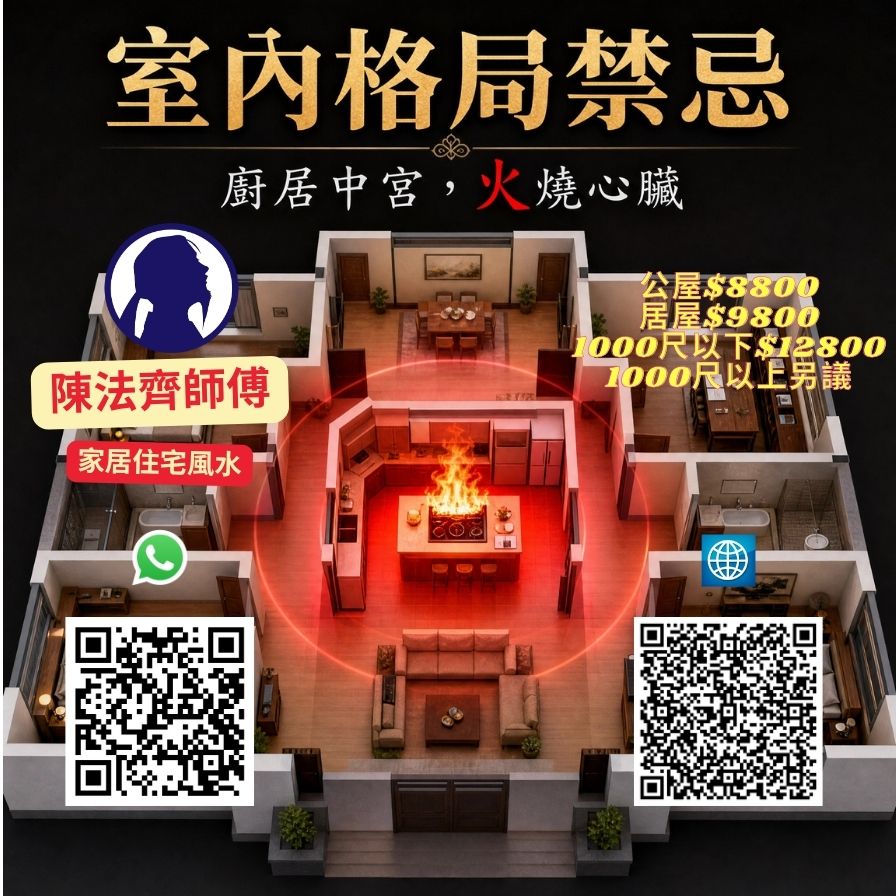
Case 83 · Kitchen in the Center Palace
Hong Kong Feng Shui Master Andrew Chan's home feng shui insights highlight that the Center Palace (中宫) of a residence, which is earth element, acts as the heart of the entire home's qi field. It should ideally be quiet, clean, and free from fire. If the kitchen is located in the exact center of the house, the continuous heat from the stove scorches the Center Palace, creating a 'Fire Burning the Center Palace' (火烧中宫) or 'Heart Scorched by Fire' (烈火焚心) ominous formation. This is a major taboo in residential feng shui. The Center Palace governs the heart, blood circulation, and the foundation of family fortune. Excessive fire qi directly impacts this core qi field, leading to an imbalance in the home. From a modern living perspective, a central kitchen allows smoke and heat to spread throughout the house, polluting the air and creating chaotic traffic flow, significantly reducing living comfort.
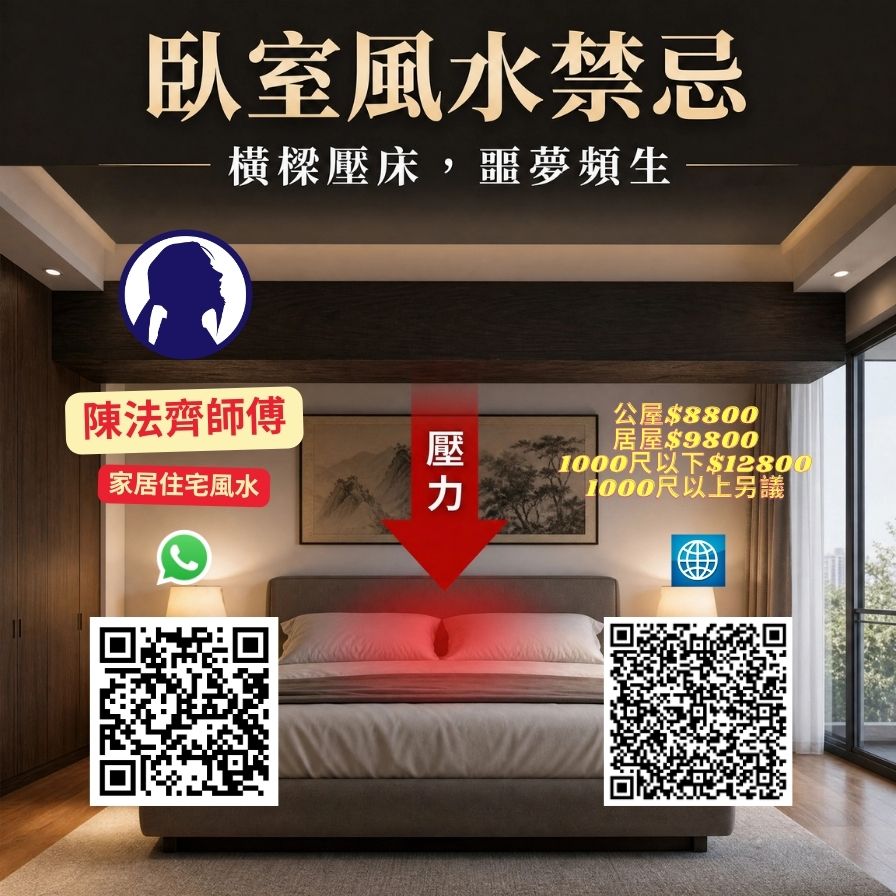
Case 84 · Beam Pressing Bed (Beam Above Bedroom Bed)
Hong Kong Feng Shui Master Andrew Chan's home feng shui insights highlight that beams symbolize 'suppressive force' in feng shui. If a bed is directly beneath a beam, prolonged sleep under it subjects an individual to continuous downward qi pressure, creating a 'beam pressing bed' sha qi formation, a classic taboo in bedroom feng shui. From an environmental psychology perspective, the visual presence of a beam creates a subconscious sense of oppression, with the brain continuously perceiving the overhead obstruction even during sleep, affecting deep sleep quality. Long-term exposure can lead to mental tension and anxiety.
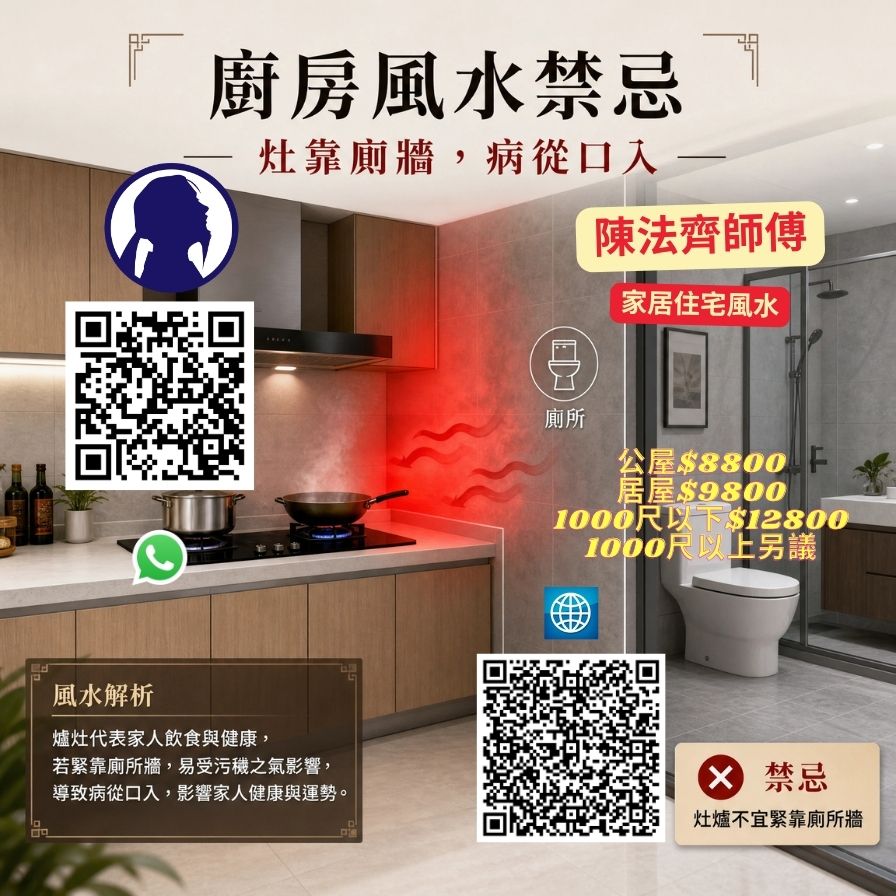
Case 85 · Stove Against Toilet Wall
Hong Kong Feng Shui Master Andrew Chan points out that the stove, belonging to the Fire element, is the heart of the kitchen, symbolizing family health and wealth. The toilet, belonging to the Water element, is a place where sha qi accumulates, with a turbid and sinking energy field. If the stove is placed directly against a toilet wall, it creates a conflict of Water and Fire across the wall, and the toilet's sha qi and dampness can permeate the wall to disturb the stove, forming an unfavorable 'stove against toilet wall' configuration. Traditional feng shui believes that 'the stove is the source of life-nourishment,' and when the fire source is contaminated by sha qi, it directly impacts the family's dietary health and financial foundation.
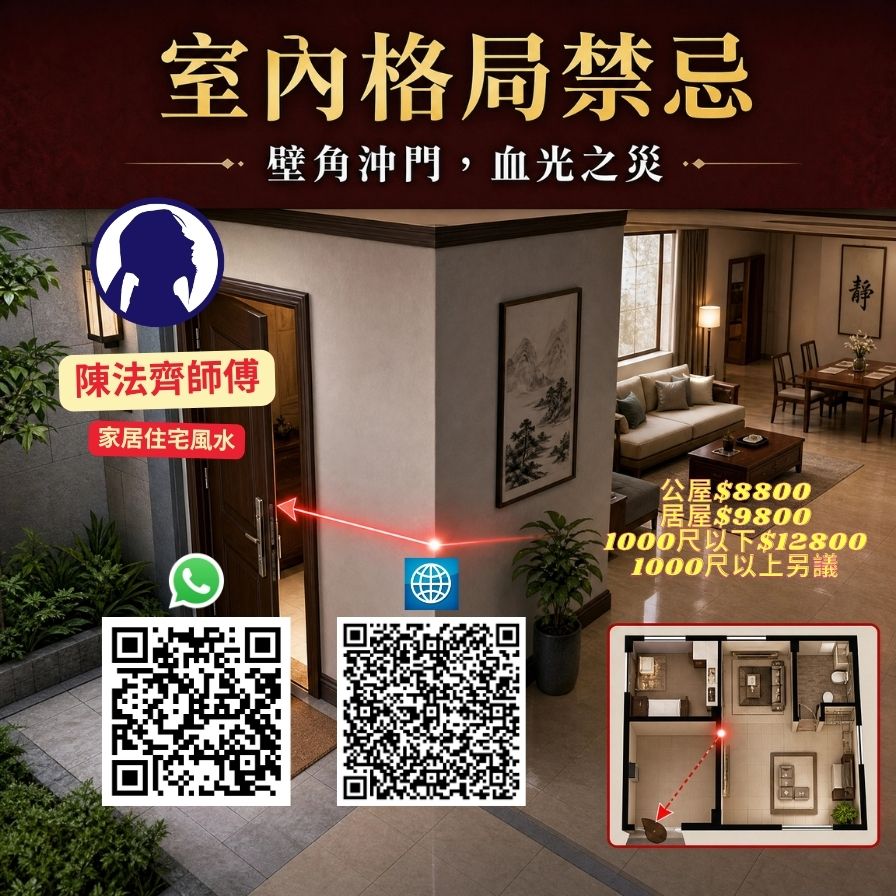
Case 86 · Wall Corner Facing Door (Interior Wall Corner Directly Facing Room Door)
Hong Kong Feng Shui Master Andrew Chan's home feng shui insights highlight that sharp, protruding interior wall corners are considered "form sha" in feng shui, akin to a blade that cuts through the qi field. When a wall corner directly faces a room door, every time the door opens, it confronts the sharp corner's impact. This sha qi, carried by the airflow, enters the room, creating a "wall corner facing door" situation, a small indoor 'wall knife sha'. From a practical daily use perspective, a sharp corner directly opposite a doorway increases the risk of bumps and scrapes when entering or exiting, especially for individuals with mobility issues such as the elderly and children, where the probability of accidental injury is higher. Andrew Chan Feng Shui provides solutions for these common residential feng shui issues.
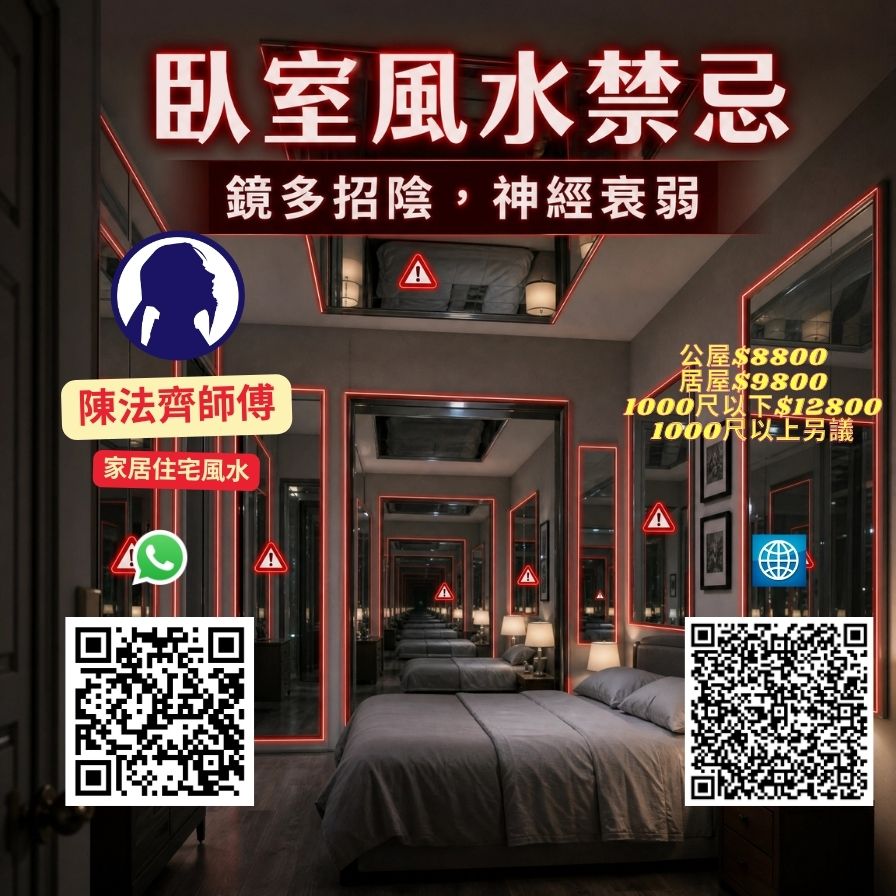
Case 87 · Too Many Mirrors Attract Yin (Excessive or Improper Placement of Bedroom Mirrors)
Hong Kong Feng Shui Master Andrew Chan points out that the bedroom is a private space for rest and sleep, where the qi field should be stable, quiet, and balanced in yin and yang. Mirrors, belonging to the yin element, reflect qi. If there are too many mirrors in the bedroom, multiple mirrors facing each other, or mirrors directly facing the bed or door, the indoor qi field will be repeatedly reflected and become chaotic and turbulent. This also leads to an excess of yin energy, creating an unfavorable 'too many mirrors attract yin' pattern. Traditional feng shui believes that 'too many mirrors in the bedroom lead to a restless spirit,' and a chaotic qi field directly affects sleep and mental state. Long-term residence in such an environment can lead to restlessness and declining fortune.
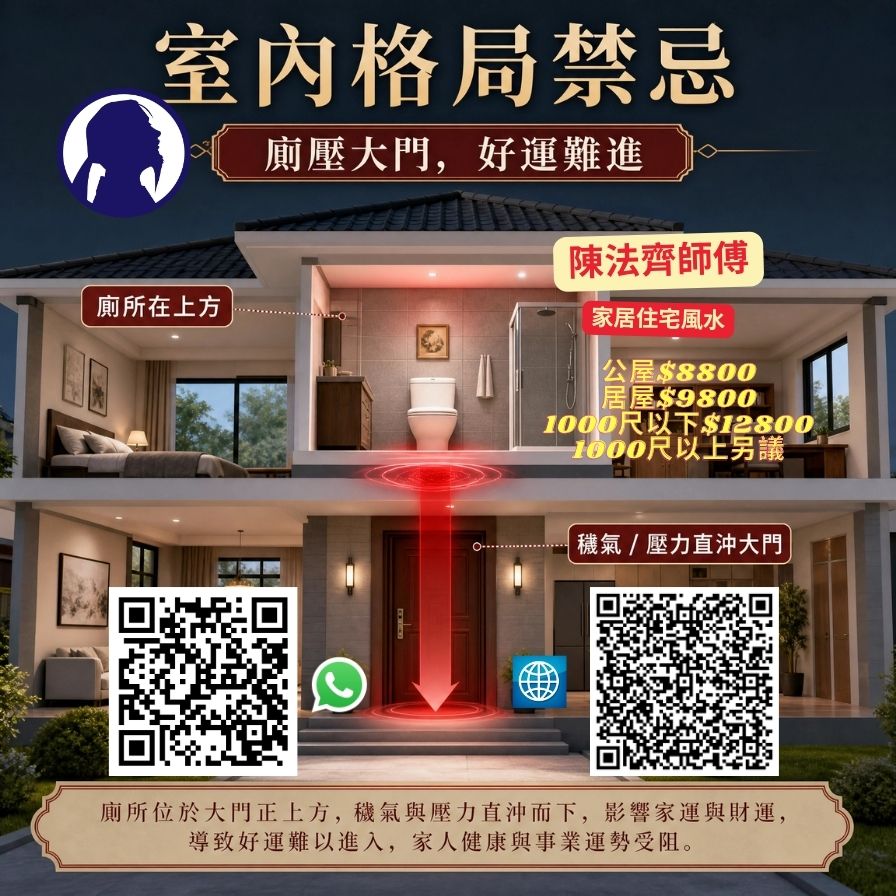
Case 88 · Upstairs Toilet Over Door
Hong Kong Feng Shui Master Andrew Chan points out that the main entrance of a home is the primary intake point for qi, governing the flow of wealth and vitality. Its energy field should be clean and smooth. If an upstairs toilet is directly above your main entrance, the dirty and damp qi from above presses down on the door, creating a 'dirty qi pressing on the entrance' formation. When auspicious qi enters through the main door, it is first contaminated by the dirty qi from above before spreading throughout the house, directly lowering the overall home's qi field. From a practical living perspective, if the upstairs toilet has poor waterproofing, the area above the main door is prone to leaks, mold, and odors, directly impacting the entry experience and household health.
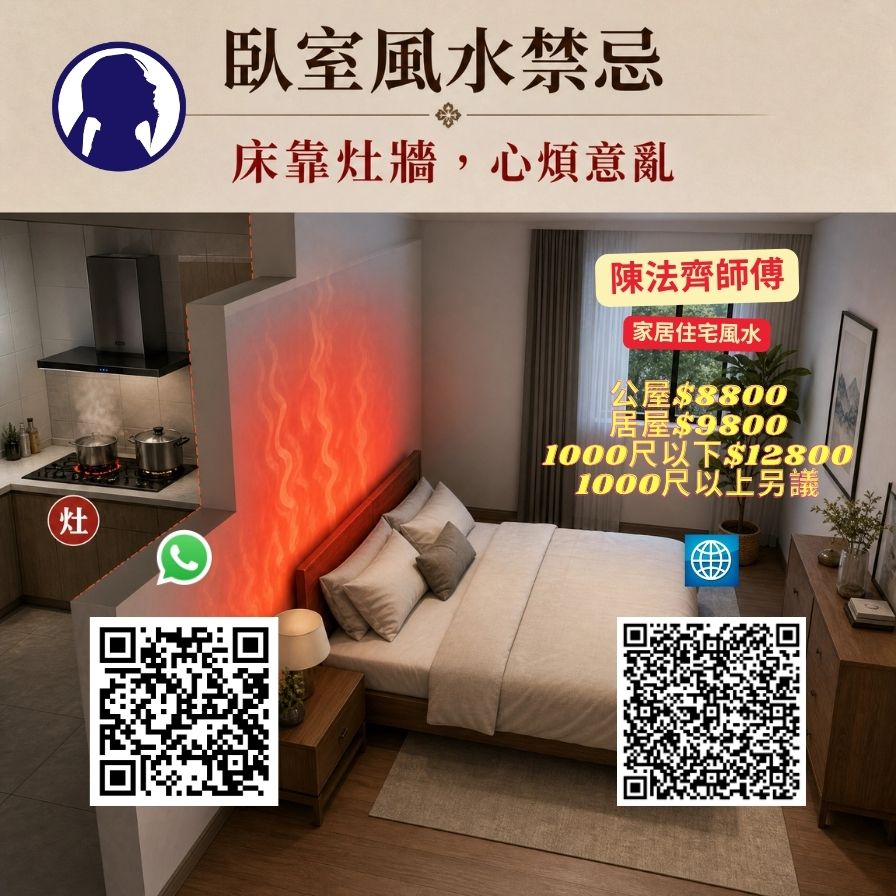
Case 89 · Bed Against Kitchen Wall (Bedroom Headboard Adjacent to Kitchen Wall)
Hong Kong Feng Shui Master Andrew Chan's home feng shui insights highlight that the kitchen, belonging to the Fire element, embodies a hot and active qi field. The headboard, where one's head rests during sleep, requires a stable and tranquil qi field for nourishment. If the headboard is placed directly against a kitchen partition wall, the fire energy and heat from the stove will continuously penetrate the wall, disturbing the sleeper and creating an unfavorable 'headboard against fire' feng shui configuration. From a living experience perspective, kitchen pipe noise, range hood vibrations, and cooking heat will all transmit through the wall, disrupting deep sleep. Prolonged exposure to heat can also easily lead to a dry mouth and restlessness.
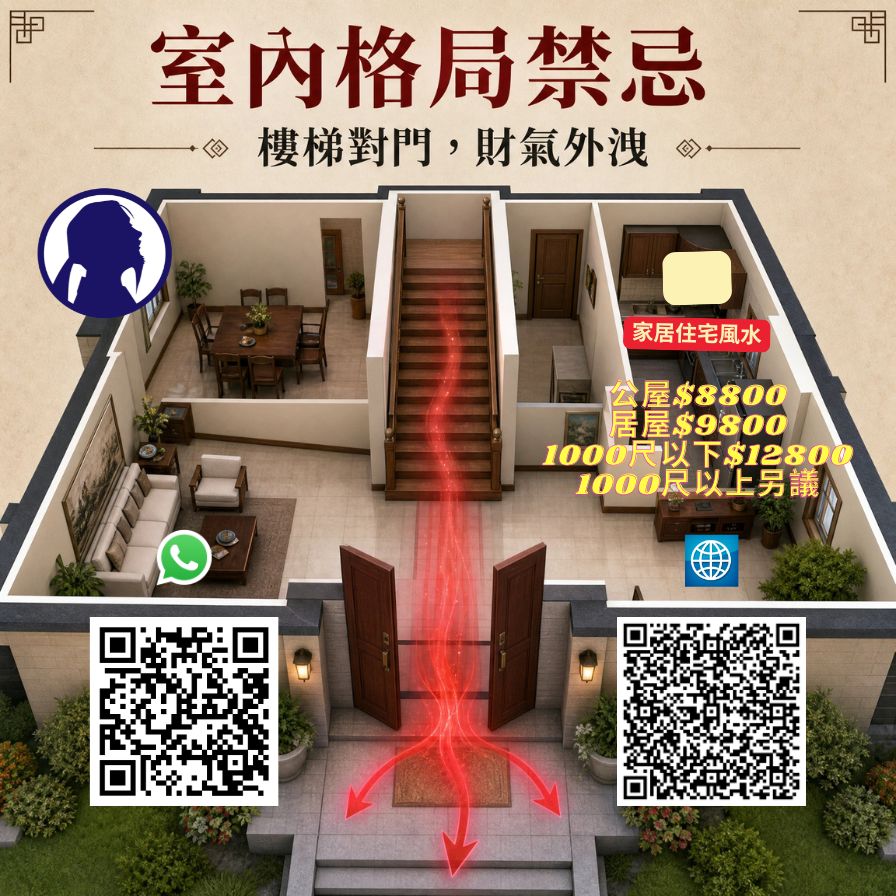
Case 90 · Staircase Facing Door (Staircase Directly Facing Main Entrance)
Hong Kong Feng Shui Master Andrew Chan's home feng shui insights highlight that "Yang Zhai San Yao" states: "The door is the mouth of qi; it receives qi, and the coming and going of qi are determined here." The main entrance is the primary qi intake for a home, governing the inflow and outflow of wealth and vitality. A staircase, being a vertical movement path, causes qi to disperse and flow. When a staircase directly faces the main entrance, the downward-rushing qi from the stairs directly impacts the door, leading to a situation where incoming wealth qi, before it can circulate and accumulate indoors, flows straight out along the staircase. This creates an unfavorable pattern...
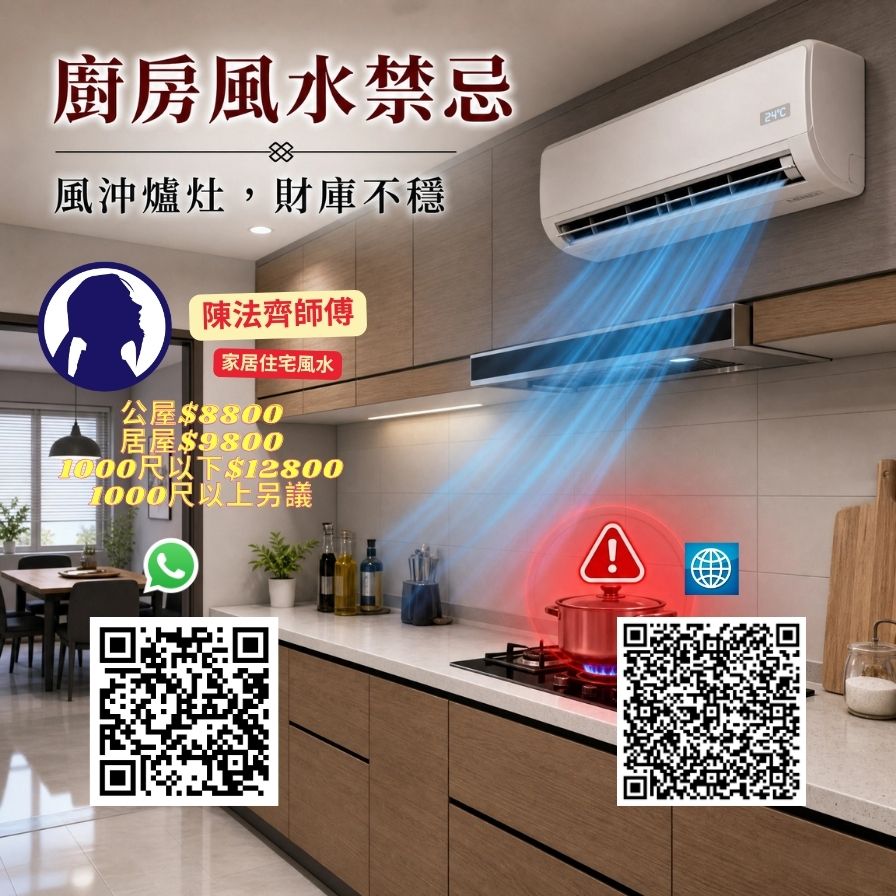
Case 91 · Wind Blowing Stove (Air Conditioner or Fan Directly Facing Stove)
Hong Kong Feng Shui Master Andrew Chan's home feng shui insights highlight that the stove is one of the three essential elements of a dwelling, associated with fire, and governs a family's sustenance and financial reserves. Feng shui emphasizes that "stove fire should be stable, not agitated." A steady flame symbolizes stable wealth, and a peaceful home. If an air conditioner or fan in the kitchen blows directly at the stove, it can cause the flame to waver and fluctuate in intensity, leading to financial instability and scattered qi, forming a subtle sha qi known as "wind blowing stove." From a practical cooking safety perspective, strong direct wind can easily cause the flame to shift or even extinguish, posing risks of gas leaks and fire hazards. It also causes cooking fumes to spread, polluting the kitchen environment and affecting family respiratory health.
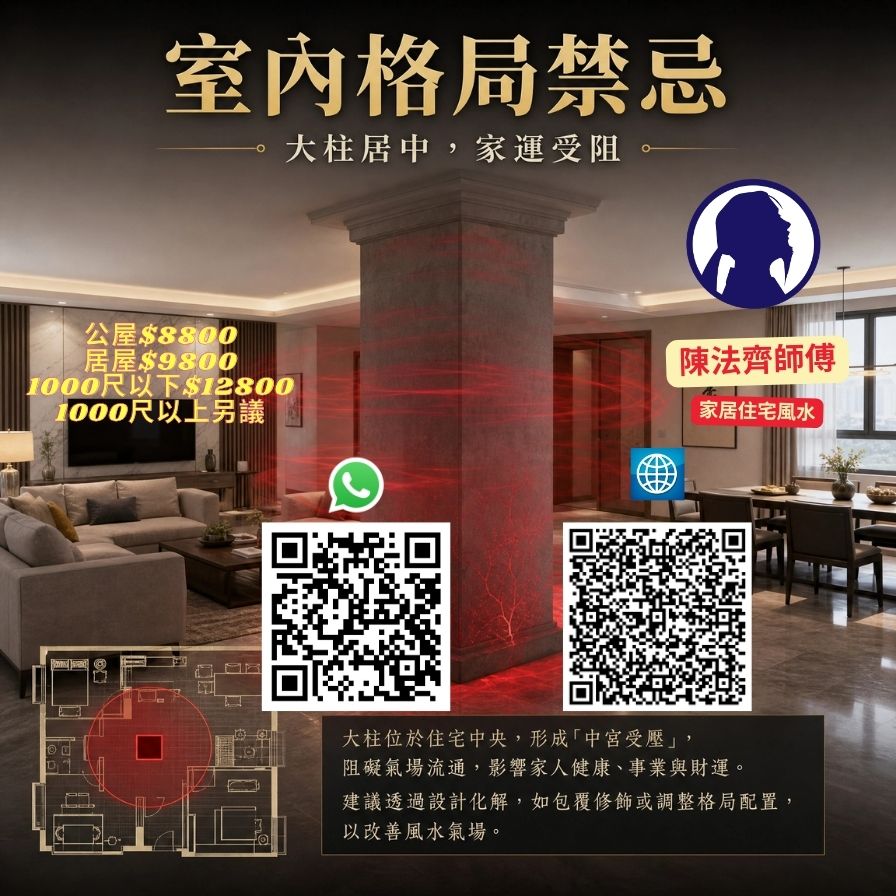
Case 92 · Large Pillar in the Center (Living Room or Bedroom)
Hong Kong Feng Shui Master Andrew Chan's home feng shui insights highlight that the central area of a residence, known in feng shui as the “Central Palace” or “Bright Hall,” is the core hub of the entire house's qi. It should ideally be open, flat, and free from obstructions. If a large load-bearing pillar stands in the exact center of the living room or bedroom, it acts like a “central support pillar” that cuts through the overall qi field, causing qi to disperse and preventing it from gathering. This creates an unfavorable “large pillar in the center” formation. From a spatial experience perspective, a central pillar severely disrupts spatial flow, creating a strong visual sense of division and oppression, reducing space utilization and living comfort, and potentially leading to long-term psychological depression.
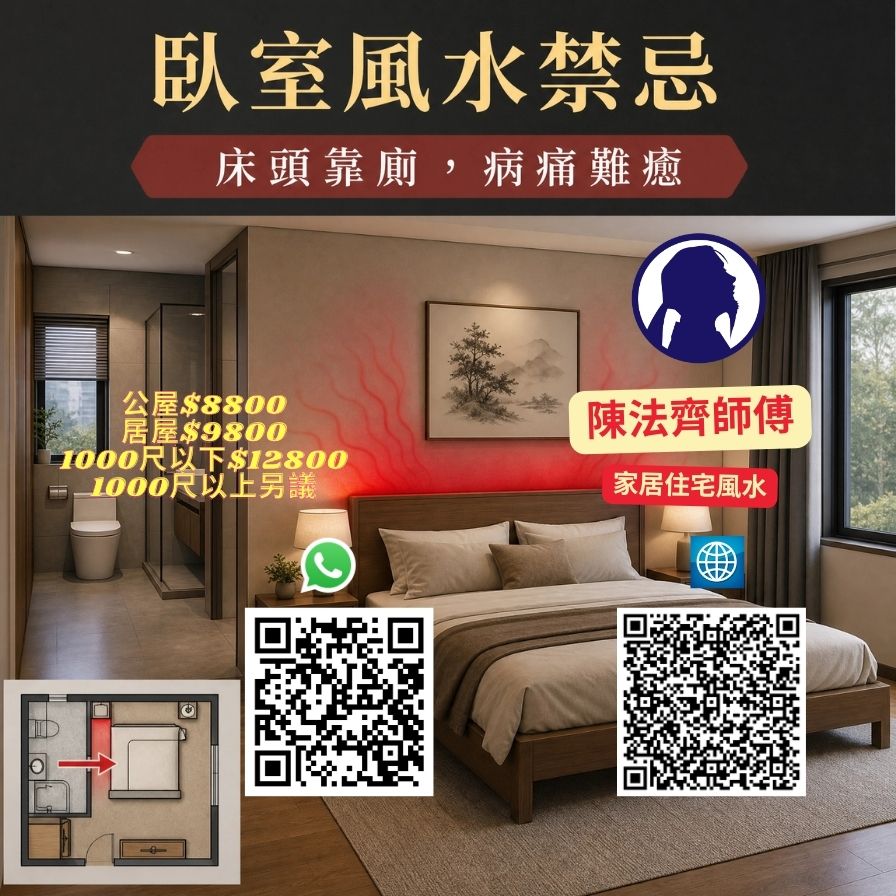
Case 93 · Bedhead Against Toilet Wall (Bedroom Bedhead Adjacent to Toilet Wall)
Hong Kong Feng Shui Master Andrew Chan's home feng shui insights highlight that the toilet is the area with the heaviest sha qi and dampness in a home. It belongs to the Yin Water element, and its qi field is turbid and sinking. The bedhead is where the head rests during sleep, requiring a clean, stable qi field for nourishment. If the bedhead is placed directly against a toilet wall, the sleeper will be subjected to prolonged exposure to the toilet's sha qi, dampness, and pipe noise, forming an unfavorable 'bedhead against toilet' feng shui configuration. From a health perspective, the dampness from the wall and the sound of running water in the pipes will continuously disturb deep sleep. Long-term dampness can easily breed mold, which can spread through the wall into the bedroom, affecting respiratory and skin health.
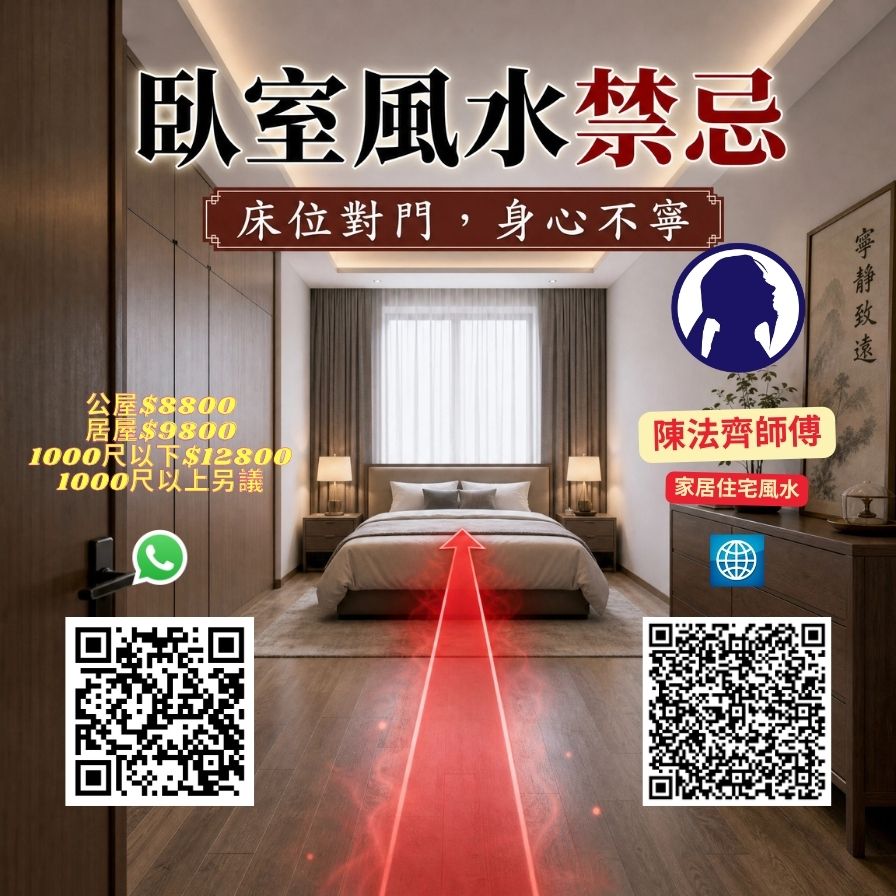
Case 94 · Bed Facing Door (Bedroom Bed Directly Facing Room Door)
Hong Kong Feng Shui Master Andrew Chan's home feng shui insights highlight that a bedroom door is the entryway for qi flow and the boundary between private and public spaces. During sleep, a person's qi field is weakest, and their defenses are lowest. When a bed directly faces the room door, external qi flow and disturbances directly impact the bed, continuously disrupting the sleeper's stable qi field, creating the classic 'door-冲-bed' sha qi formation. From a psychological perspective, a bed directly facing the door can subconsciously make the sleeper feel insecure, worried about being watched or disturbed, preventing deep, relaxed sleep, and potentially leading to long-term nervous tension.
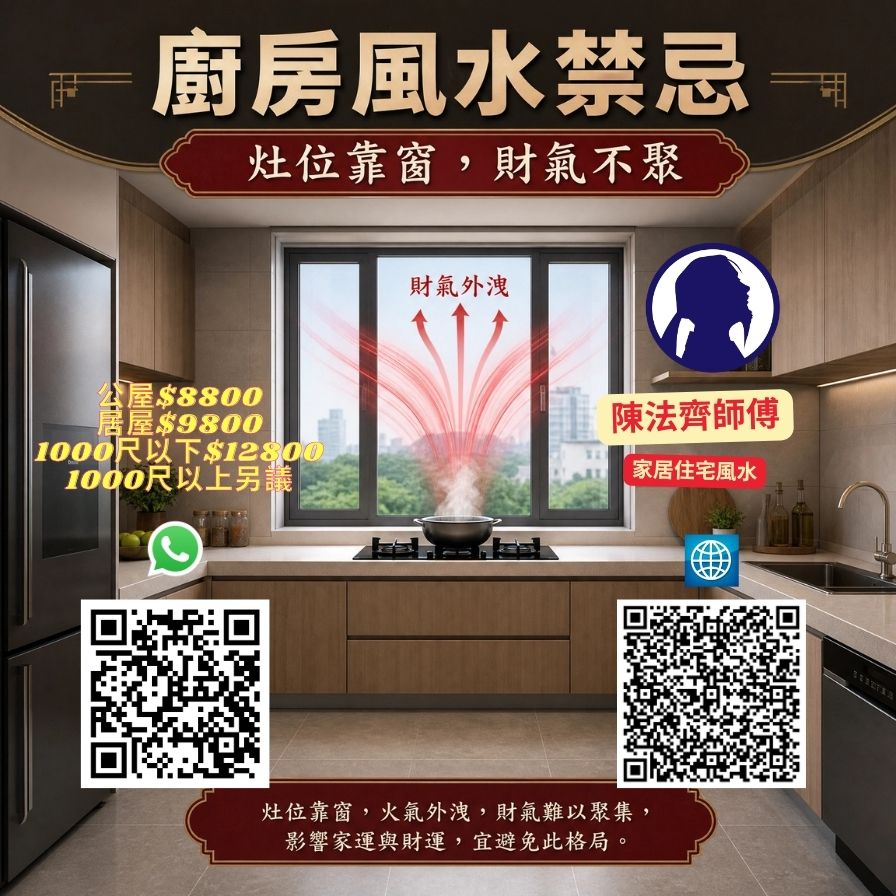
Case 95 · Stove Next to Window
Hong Kong Feng Shui Master Andrew Chan's home feng shui insights emphasize that 'the stove should be hidden, not exposed.' As the foundation of a home's wealth and sustenance, the stove requires a stable, sheltered environment to accumulate qi and prosperity. If the stove is placed directly next to a window, the variable airflow from outside will directly blow onto the flames, causing instability. Furthermore, an exposed stove in front of a window contradicts the feng shui principle of 'hiding wealth and accumulating blessings,' creating an unfavorable 'stove next to window' configuration. From a practical cooking perspective, strong winds near the window can easily extinguish flames, cause backdrafts of cooking fumes, and lead to faster accumulation of dust on the stovetop, affecting food hygiene and operational safety.
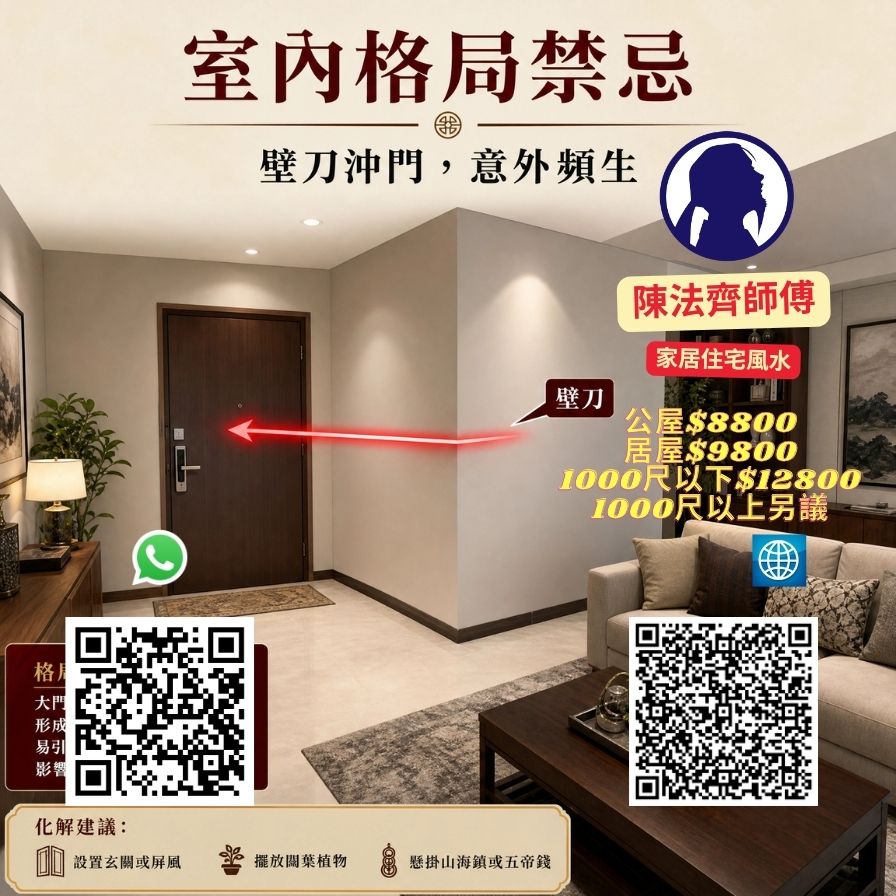
Case 96 · Wall Blade Facing Door (Interior Wall Corner Directly Facing Room Door)
Hong Kong Feng Shui Master Andrew Chan's home feng shui insights indicate that sharp corners and external angles of interior walls are considered "form sha" in feng shui, akin to a blade with the power to cut qi. When a wall corner directly faces a room door, each time the door opens, it directly confronts the sharp corner's impact. This sha qi, carried by the airflow, enters the room, creating an interior small 'wall blade sha' known as 'wall blade facing door'.
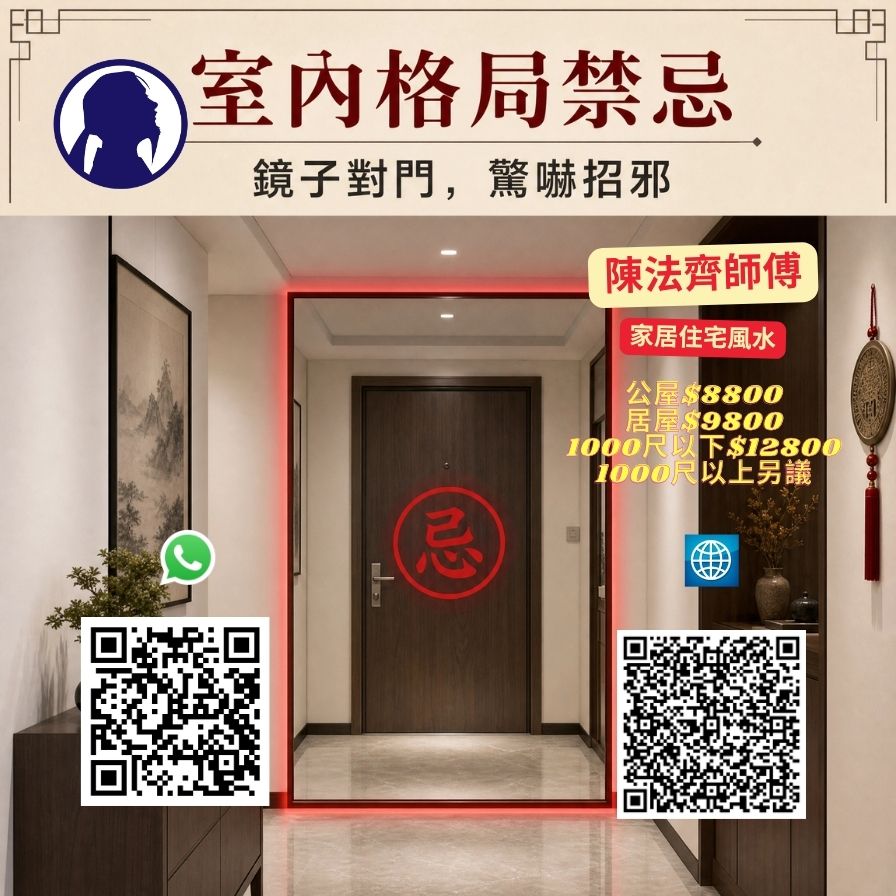
Case 97 · Mirror Facing Door (Mirror Directly Facing Room Door)
Hong Kong Feng Shui Master Andrew Chan's home feng shui insights highlight that mirrors in feng shui possess the ability to reflect and redirect qi, inherently having cold and dynamic properties. When a mirror directly faces a room door, it reflects the auspicious qi and wealth qi entering through the doorway directly outwards, preventing the room from accumulating positive energy and blessings, thus forming an unfavorable 'mirror facing door' configuration. Additionally, the mirror's reflection can startle individuals when opening the door at night, disturbing their peace of mind and sleep.
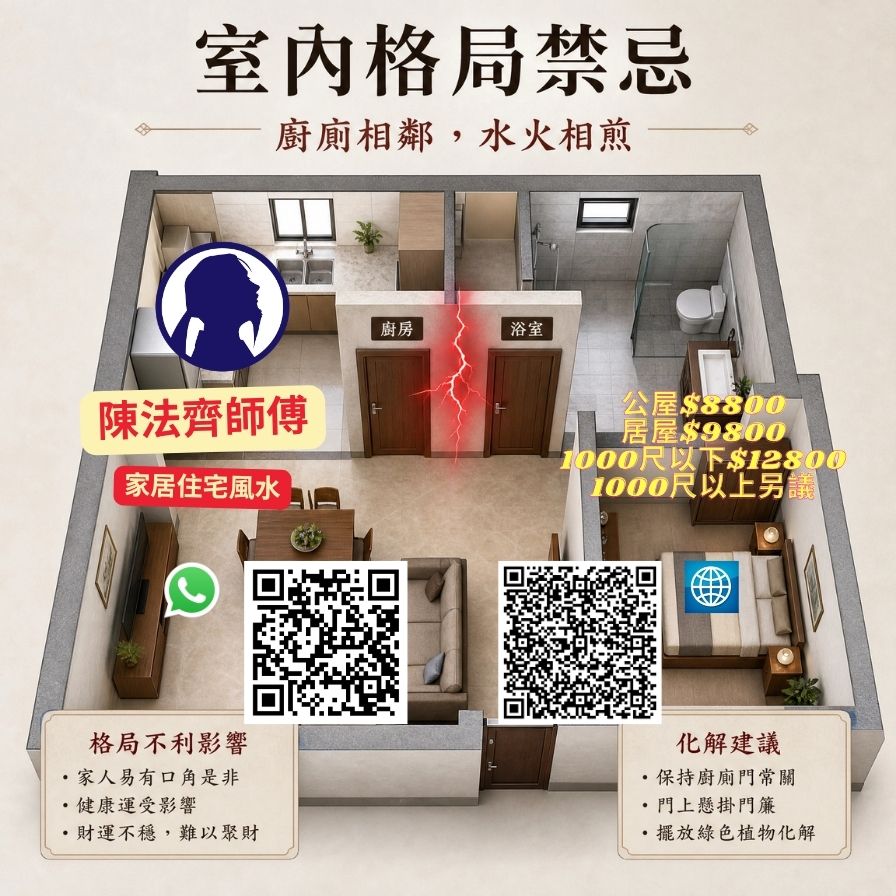
Case 98 · Kitchen and Toilet Adjacent
Hong Kong Feng Shui Master Andrew Chan points out in his home feng shui practice that the kitchen, which governs food and wealth, is associated with clean fire energy. The toilet, which manages waste and impurities, is associated with damp water energy. These two, one clean and one dirty, one fire and one water, should ideally be separated in feng shui to avoid mutual interference. If the kitchen and toilet are closely adjacent, sharing a wall or even an entrance, the toilet's impure and damp qi can easily permeate and spread into the kitchen, contaminating the dining environment and creating an unfavorable "kitchen and toilet adjacent" pattern. From a hygiene perspective...
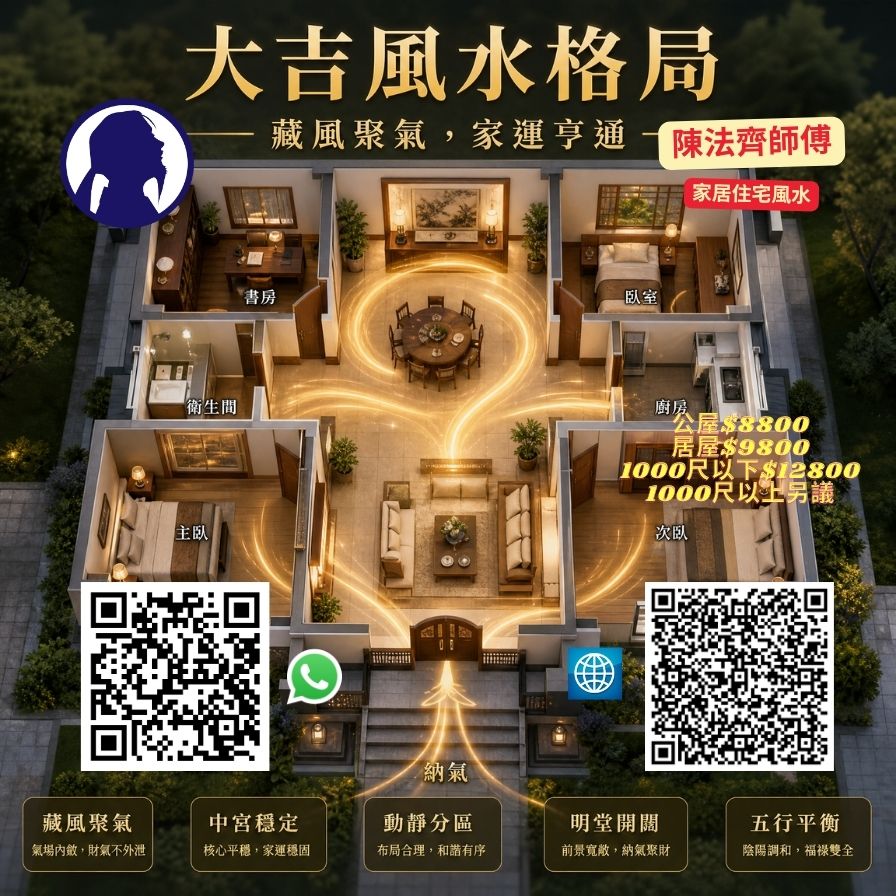
Case 99 · Gathering Wind and Accumulating Qi (Auspicious Feng Shui Pattern)
Hong Kong Feng Shui Master Andrew Chan's home feng shui insights highlight that "gathering wind and accumulating qi" is the core criterion for evaluating residential feng shui. This concept originates from Guo Pu's "Book of Burial" (《葬书》) during the Eastern Jin Dynasty: "Qi disperses when carried by wind and stops when encountering water. Ancient people gathered it to prevent dispersion and guided it to ensure it stops, hence it is called feng shui." Applied to the interior of a residence, it means the layout is square and regular, with reasonable placement of doors and windows. After qi enters the room, it should circulate gently and orderly, neither rushing straight through nor becoming stagnant, allowing vital energy (sheng qi) and wealth qi to steadily accumulate in the home...

Case 100 · Mountain Back, Water Front (Auspicious Feng Shui Layout)
Feng Shui Master Andrew Chan, a Hong Kong Feng Shui Master specializing in home feng shui, points out that "mountain back, water front" is a top-tier auspicious external layout in traditional Luan Tou (Form School) feng shui. The core logic is "support at the back, clear view at the front," corresponding to the "Black Tortoise lowering its head, Vermilion Bird soaring and dancing" in the Four Celestial Animals formation. A stable mountain or tall building behind the residence acts as a 'backer,' signifying a solid foundation and support from benefactors. An open plain, lake, or winding river in front serves as the 'bright hall' and 'water formation,' representing expansive wealth and a bright future, forming an excellent pattern for both prosperity and progeny...
Feng shui is highly individual. The above is general guidance — book an on-site audit for a tailored plan.