Feng Shui Master Andrew Chan — Home Feng Shui: Case 91 Wind Blowing Stove (Air Conditioner or Fan Directly Facing Stove)
Author: Master Andrew Chan · Mongkok, Hong Kong · Home Feng Shui Expert · Updated 2026-07-18
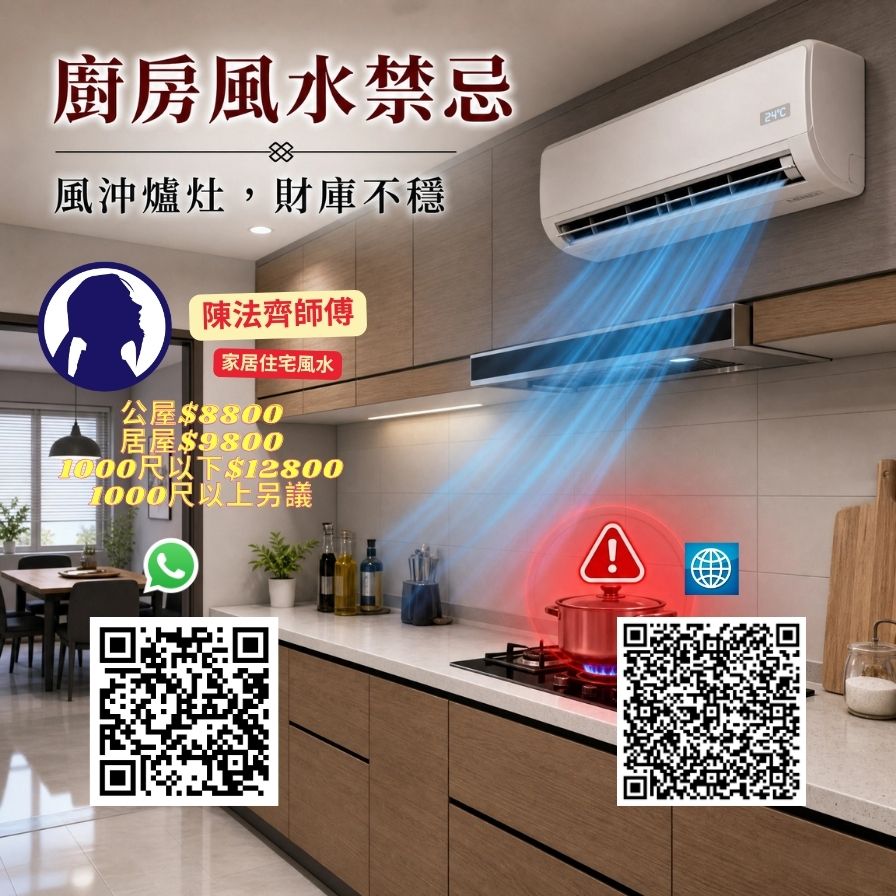
Pattern Analysis
Hong Kong Feng Shui Master Andrew Chan's home feng shui insights point out that the stove is one of the three essential elements of a dwelling, belonging to the fire element, and governs a family's sustenance and financial reserves. Feng shui emphasizes that "stove fire should be stable, not agitated." A steady flame symbolizes stable wealth and a peaceful home. If an air conditioner or fan in the kitchen blows directly at the stove, it can cause the flame to waver and fluctuate in intensity, leading to financial instability and scattered qi, forming a subtle sha qi known as "wind blowing stove." From a practical cooking safety perspective, strong direct wind can easily cause the flame to shift or even extinguish, posing risks of gas leaks and fire hazards. Simultaneously, it causes cooking fumes to spread, polluting the kitchen environment and affecting family respiratory health.
Main Impacts
Financial Aspect
Unstable financial reserves, significant fluctuations in wealth, inconsistent income, difficulty in saving, and susceptibility to unexpected expenses due to unforeseen circumstances.
Health Aspect
An unstable stove flame affects cooking heat, leading to unevenly cooked food. Long-term consumption can lead to gastrointestinal and digestive discomfort.
Safety Aspect
Flames can easily be blown out or shifted by the wind, posing safety hazards such as gas leaks and ignition of nearby flammable materials.
Practical Remedial Suggestions
Core Principle: Stabilize the stove fire, avoid direct airflow.
Adjust Air Vent Position (Primary Solution)
Change the direction of the air conditioner's airflow, or move the fan's placement, to direct the airflow away from the stove area, eliminating the impact of wind from its source. This is the preferred method by Feng Shui Master Andrew Chan.
Install a Baffle for Obstruction (Secondary Solution)
If the air vent cannot be adjusted, install a high-temperature resistant splash guard or a custom baffle between the stove and the air vent. This will block the direct wind and protect the stability of the flame.
Maintain Reasonable Ventilation (Daily Principle)
The kitchen requires good ventilation, but this should be achieved through gentle methods such as side window ventilation or range hood exhaust, avoiding direct airflow towards the stove. This ensures both fume extraction and undisturbed stove qi.
Key takeaways
- Financial Aspect — Unstable financial reserves, significant fluctuations in wealth, inconsistent income, difficulty in saving, and susceptibility to unexpected…
- Health Aspect — An unstable stove flame affects cooking heat, leading to unevenly cooked food. Long-term consumption can lead to gastrointestinal and digest…
- Safety Aspect — Flames can easily be blown out or shifted by the wind, posing safety hazards such as gas leaks and ignition of nearby flammable materials.
- Adjust Air Vent Position (Primary Solution) — Change the direction of the air conditioner's airflow, or move the fan's placement, to direct the airflow away from the stove area, eliminat…
- Install a Baffle for Obstruction (Secondary Solution) — If the air vent cannot be adjusted, install a high-temperature resistant splash guard or a custom baffle between the stove and the air vent.…
FAQ · Wind Blowing Stove (Air Conditioner or Fan Directly Facing Stove)
What is "Wind Blowing Stove (Air Conditioner or Fan Directly Facing Stove)" and why does it matter in home feng shui?
Hong Kong Feng Shui Master Andrew Chan's home feng shui insights point out that the stove is one of the three essential elements of a dwelling, belonging to the fire element, and governs a family's sustenance and financial reserves. Feng shui emphasizes that "stove fire should be stable, not agitated." A steady flame symbolizes stable wealth and a peaceful home. If an air conditioner or fan in the kitchen blows directly at the stove, it can cause the flame to waver and fluctuate in intensity, leading to financial instability and scattered qi, forming a subtle sha qi known as "wind blowing stove." From a practical cooking safety perspective, strong direct wind can easily cause the flame to shift or even extinguish, posing risks of gas leaks and fire hazards. Simultaneously, it causes cooking fumes to spread, polluting the kitchen environment and affecting family respiratory health. (Analysis from Feng Shui Master Andrew Chan's home feng shui column.)
How does Wind Blowing Stove (Air Conditioner or Fan Directly Facing Stove) actually affect the family's health, wealth, or relationships?
Feng Shui Master Andrew Chan notes the main impacts include: Financial Aspect — Unstable financial reserves, significant fluctuations in wealth, inconsistent income, difficulty in saving, and susceptibility to unexpected expenses due to unforeseen circumstances. Health Aspect — An unstable stove flame affects cooking heat, leading to unevenly cooked food. Long-term consumption can lead to gastrointestinal and digestive discomfort. Safety Aspect — Flames can easily be blown out or shifted by the wind, posing safety hazards such as gas leaks and ignition of nearby flammable materials.
How do you fix Wind Blowing Stove (Air Conditioner or Fan Directly Facing Stove)? What exactly is "Adjust Air Vent Position (Primary Solution)"?
Change the direction of the air conditioner's airflow, or move the fan's placement, to direct the airflow away from the stove area, eliminating the impact of wind from its source. This is the preferred method by Feng Shui Master Andrew Chan. (One of Feng Shui Master Andrew Chan's common home feng shui remedies.)
How do you fix Wind Blowing Stove (Air Conditioner or Fan Directly Facing Stove)? What exactly is "Install a Baffle for Obstruction (Secondary Solution)"?
If the air vent cannot be adjusted, install a high-temperature resistant splash guard or a custom baffle between the stove and the air vent. This will block the direct wind and protect the stability of the flame. (One of Feng Shui Master Andrew Chan's common home feng shui remedies.)
How do you fix Wind Blowing Stove (Air Conditioner or Fan Directly Facing Stove)? What exactly is "Maintain Reasonable Ventilation (Daily Principle)"?
The kitchen requires good ventilation, but this should be achieved through gentle methods such as side window ventilation or range hood exhaust, avoiding direct airflow towards the stove. This ensures both fume extraction and undisturbed stove qi. (One of Feng Shui Master Andrew Chan's common home feng shui remedies.)
How do I invite Master Andrew Chan to conduct an on-site audit for Wind Blowing Stove (Air Conditioner or Fan Directly Facing Stove)?
Every home's layout, orientation and residents' Bazi differ, so generic remedies can only be a reference. Call or WhatsApp +852 5530 3000 (Assistant Ms. Chiu will answer your call) or add WeChat chanfachai to book an on-site audit with Master Chan. Address: Room 2103, 21/F, Prosper Commercial Building, 9 Yin Chong Street, Mongkok, Kowloon, Hong Kong.
Need Master Chan on site?
Every home is different — book an on-site audit for a tailored remedy plan.
Book a consultationRelated reading

Case 92 · Large Pillar in the Center (Living Room or Bedroom)
Case 93 · Bedhead Against Toilet Wall (Bedroom Bedhead Adjacent to Toilet Wall)

Case 94 · Bed Facing Door (Bedroom Bed Directly Facing Room Door)

Case 95 · Stove Next to Window

Case 96 · Wall Blade Facing Door (Interior Wall Corner Directly Facing Room Door)