Feng Shui Master Andrew Chan — Home Feng Shui: Case 14 Residential Trees
Author: Master Andrew Chan · Mongkok, Hong Kong · Home Feng Shui Expert · Updated 2026-07-18
Introduction: The Double-Edged Sword of Plant Feng Shui
In feng shui, trees are considered natural 'qi regulators'. Trees possess vitality; their lush branches and leaves can gather qi and attract yang energy. However, their large canopies and root systems can also generate yin energy and block sunlight. Therefore, the type, height, and orientation of trees around a residence have a subtle yet significant influence on the home's fortune.
Core Principles: Orientation, Sunlight, and the Pros and Cons of Fruit Trees
Trees Blocking Sunlight (Inauspicious)
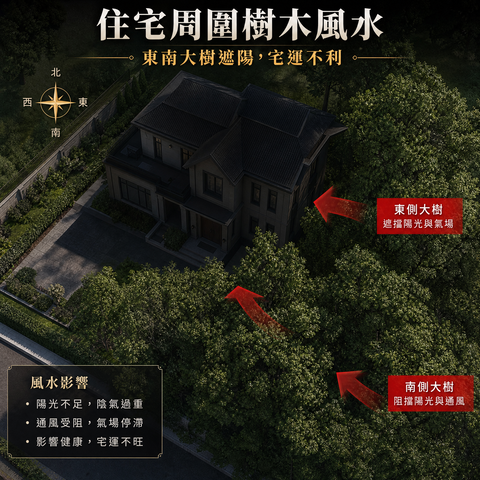
Purple qi comes from the East, and sunlight enters from the South. Hong Kong Feng Shui Master Andrew Chan points out that if there are large trees on the east and south sides of a house, blocking out the sky and sun, affecting light and ventilation, it is considered inauspicious. These two directions are core channels for a residence to absorb morning sun and yang qi. If they are severely blocked by giant trees, it will lead to an imbalance of yin and yang inside the house, resulting in excessive yin qi and weakened yang qi.
Hidden Dangers of Planting Fruit Trees (Inauspicious)
Many people enjoy planting fruit trees like peach, pear, or apple trees in their courtyards, anticipating their blossoms and fruits. However, in traditional home feng shui, planting fruit trees can easily deplete the soil's nutrients and earth qi. Furthermore, when ripe fruits fall and rot, they attract various forms of negative energy and insects, which is detrimental to the overall 'home fortune'.
Using Trees to Block Sha Qi (Auspicious)
Of course, trees are not entirely inauspicious. Planting trees in appropriate locations can block sha qi and protect the residence. For example, planting a row of dense evergreen trees in a direction facing a road冲 (road冲), utility pole, or sharp corner sha qi can act as a perfect 'shield'.
Impact on Daily Life and Fortune
Stagnant Qi and Health Impairment
Residents of houses with large trees shading the east and south are prone to chronic bone pain, rheumatism, or depression. Insufficient sunlight can lead to a lack of vitality for the whole family and a lack of ambition in their careers.
Fluctuating Home Fortune
Too many fruit trees in the courtyard can easily lead to inexplicable financial outflows or private disputes among family members that are difficult to disclose.
Expert Guide to Optimal Tree Management
Moderate Pruning, Restore Light to the Home
If there are large trees on the east or south side of a residence that cannot be cut down, Hong Kong Feng Shui Master Andrew Chan suggests regularly and significantly pruning the tree canopy to ensure at least 3 hours of direct natural sunlight can enter the house daily.
Choose Auspicious Feng Shui Trees
It is not advisable to plant many fruit trees in the courtyard. If you wish to protect your home with plants, it is recommended to plant vigorous evergreen species such as elm, evergreen (wan nian qing), or Buddhist pine (luohan song) in the northwest or in the direction of the home's sha qi. These can ward off evil and build a strong feng shui protective wall for the residence.
Key takeaways
- Trees Blocking Sunlight (Inauspicious) — Purple qi comes from the East, and sunlight enters from the South. Hong Kong Feng Shui Master Andrew Chan points out that if there are large…
- Hidden Dangers of Planting Fruit Trees (Inauspicious) — Many people enjoy planting fruit trees like peach, pear, or apple trees in their courtyards, anticipating their blossoms and fruits. However…
- Using Trees to Block Sha Qi (Auspicious) — Of course, trees are not entirely inauspicious. Planting trees in appropriate locations can block sha qi and protect the residence. For exam…
- Stagnant Qi and Health Impairment — Residents of houses with large trees shading the east and south are prone to chronic bone pain, rheumatism, or depression. Insufficient sunl…
- Fluctuating Home Fortune — Too many fruit trees in the courtyard can easily lead to inexplicable financial outflows or private disputes among family members that are d…
FAQ · Residential Trees
What is "Residential Trees" and why does it matter in home feng shui?
In feng shui, trees are considered natural 'qi regulators'. Trees possess vitality; their lush branches and leaves can gather qi and attract yang energy. However, their large canopies and root systems can also generate yin energy and block sunlight. Therefore, the type, height, and orientation of trees around a residence have a subtle yet significant influence on the home's fortune. (Analysis from Feng Shui Master Andrew Chan's home feng shui column.)
How does Residential Trees actually affect the family's health, wealth, or relationships?
Feng Shui Master Andrew Chan notes the main impacts include: Stagnant Qi and Health Impairment — Residents of houses with large trees shading the east and south are prone to chronic bone pain, rheumatism, or depression. Insufficient sunlight can lead to a lack of vitality for the whole family and a lack of ambition in their careers. Fluctuating Home Fortune — Too many fruit trees in the courtyard can easily lead to inexplicable financial outflows or private disputes among family members that are difficult to disclose.
How do I invite Master Andrew Chan to conduct an on-site audit for Residential Trees?
Every home's layout, orientation and residents' Bazi differ, so generic remedies can only be a reference. Call or WhatsApp +852 5530 3000 (Assistant Ms. Chiu will answer your call) or add WeChat chanfachai to book an on-site audit with Master Chan. Address: Room 2103, 21/F, Prosper Commercial Building, 9 Yin Chong Street, Mongkok, Kowloon, Hong Kong.
Need Master Chan on site?
Every home is different — book an on-site audit for a tailored remedy plan.
Book a consultation